

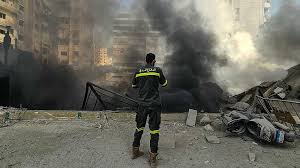
Beirut, 7 March: Israel has launched an intense wave of military strikes across Lebanon as it moves to curb the power of the Iran-backed militant group Hezbollah, dramatically widening the conflict that has already spread across the region.
Lebanese authorities say the Israeli bombardment has killed at least 217 people and wounded nearly 700 in the past week. The escalating attacks have also forced hundreds of thousands of civilians to flee their homes, raising fears of a new humanitarian crisis in the country.
The Israeli military says it has targeted Hezbollah facilities and infrastructure in hundreds of strikes stretching from the northern city of Tripoli to villages near the southern border. As the fighting intensifies, Israel has mobilized more than 100,000 reservists and expanded its presence along the border, increasing control over observation posts in southern Lebanon.
The latest escalation came after Hezbollah launched missiles and drones at a military base in northern Israel earlier this week. Israeli officials say the attack crossed a red line and triggered a broader campaign aimed at weakening the militant group and removing the threat it poses to Israel’s northern communities.
An Israeli military spokesman signaled that further escalation remains possible, saying, “All options remain on the table,” when asked about the prospect of a large-scale ground invasion.
The confrontation is unfolding amid a wider regional conflict following joint U.S.–Israeli strikes against Iran, raising concerns that fighting between Israel and Hezbollah could become another major front in the broader war.
Israeli leaders argue that Hezbollah has used previous ceasefires to rebuild its military capabilities. The two sides have remained locked in periodic clashes since the aftermath of the October 7 conflict, despite a ceasefire agreement that took effect in November 2024.
Military analysts say Israel’s objective may be to significantly degrade Hezbollah’s capabilities rather than completely eliminate the group. Yoav Limor, a military analyst with the Israeli newspaper Israel Hayom, said Israel “does not have the ability to completely dismantle Hezbollah” but is attempting to weaken it enough to remove the immediate threat along its northern border.
Hezbollah has rejected calls to disarm and signaled it will continue fighting. In a statement, the group declared, “We will not abandon the resistance. We will not abandon the weapon, and we will not vacate the field.”
Lebanon’s government has meanwhile warned against further escalation. Prime Minister Nawaf Salam said authorities would act to prevent the country from being dragged deeper into the conflict, adding that the government would take necessary steps to protect Lebanese citizens.
The situation has revived memories of the 2006 war between Israel and Hezbollah, which ended without a decisive outcome and allowed the militant group to rebuild a vast arsenal of rockets and drones in the years that followed.
With both sides showing little sign of backing down, analysts warn that the current fighting could expand further, deepening instability across Lebanon and increasing the risk of a prolonged regional
