

China, 19 Feb: China is accelerating its transformation into a global clean-energy leader, even as the United States signals a retreat from key climate commitments under the administration of Donald Trump.
From the deserts of northern China to vast western plains, Beijing’s renewable push is reshaping both landscapes and global energy politics.In the Kubuqi Desert of Inner Mongolia, what was once expanding sandscape now hosts sprawling solar installations. Aluminium-framed panels stretch across thousands of hectares, absorbing intense sunlight in one of China’s most arid regions.
Local residents say the transformation has brought cautious optimism. Researchers note that large solar arrays can function as partial windbreaks and provide shade, helping to stabilise topsoil and encourage vegetation growth. While experts caution that solar farms alone cannot halt desertification, the projects appear to have modest ecological benefits alongside their energy output.
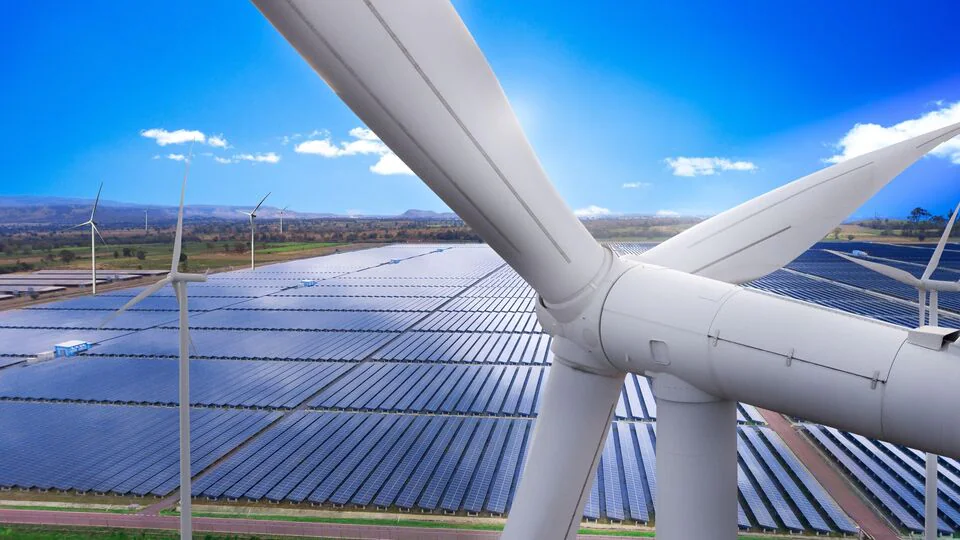
The region has become symbolic of China’s renewable ambitions — a place where environmental repair and industrial policy converge.Across the provinces of Gansu and Xinjiang, wide plains have been converted into hybrid wind-and-solar bases. Towering turbines rise above rows of photovoltaic panels, forming integrated renewable hubs capable of powering millions of homes.
Beijing’s expansion has been rapid. In 2010, China’s solar generation capacity stood at roughly 1 gigawatt. By 2018, it had surged past 100 gigawatts, and ultra-large projects exceeding 1GW each have since become common. Today, China leads the world in installed solar and wind capacity.Climate Targets and Policy Direction
In 2020, Chinese President Xi Jinping pledged at the United Nations that China would reach peak carbon emissions before 2030 and achieve carbon neutrality by 2060. Analysts have reported that China’s carbon dioxide emissions have stabilised or declined in recent months, raising the possibility that its emissions peak could arrive earlier than anticipated.
Despite remaining the world’s largest carbon emitter, China’s leadership argues that large-scale investment in renewables, grid upgrades and energy storage is accelerating structural change in its power sector.
Gobi Desert Solar Thermal Breakthrough
In the Gobi Desert, a newly commissioned solar thermal facility showcases China’s push into next-generation clean technology. The plant uses thousands of mirrors to concentrate sunlight onto two 200-metre towers, heating molten salt to high temperatures. Stored thermal energy allows electricity production even after sunset, addressing one of solar power’s long-standing intermittency challenges.
Developers describe the dual-tower system as a model that could improve efficiency and lower long-term costs.
Economic Pressures and Social Trade-offs
China’s aggressive build-out has not been without strain. Rapid production has led to oversupply in global solar markets, triggering price competition that has squeezed manufacturers’ margins. Domestically, questions have emerged about the pace of development, local consultation and the economic transition for coal-dependent communities.
The expansion highlights the dual nature of China’s green surge: environmental ambition paired with industrial rivalry and internal adjustment.
A Shift in Global Climate Leadership?
As Washington reassesses federal climate measures, Beijing’s continued investment in renewables has placed it at the forefront of the global clean-energy race. Analysts say the contrast underscores a broader geopolitical shift, with China seeking technological dominance in industries expected to define the 21st-century economy.
Whether this momentum translates into sustained emissions reductions — and whether it reshapes global climate diplomacy — remains to be seen. For now, China’s vast solar fields and wind corridors signal a decisive bet on a low-carbon future.
