

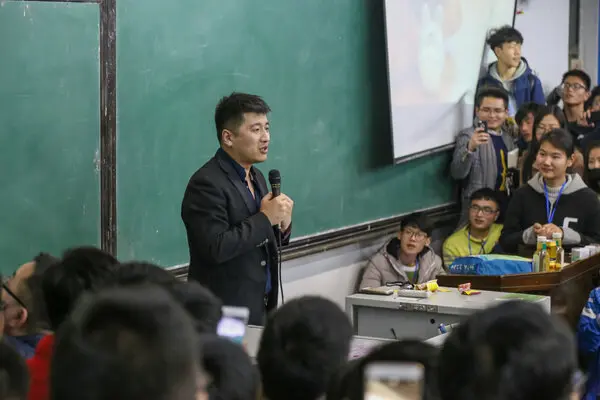
Beijing, Mar 28: The sudden death of Chinese education influencer Zhang Xuefeng has triggered a nationwide debate over ambition, inequality and the growing pressure on young people in China’s hypercompetitive education system.
Zhang, 41, died of cardiac arrest earlier this week, according to a statement released on his social media accounts. Within hours, tributes flooded Chinese platforms, where his name drew hundreds of millions of views, reflecting both his immense popularity and the controversy that defined his career.Education Anxiety in a Slowing Economy
Zhang’s rise was closely tied to a deeper structural shift in China’s economy and job market. As growth slows and youth unemployment remains a concern, the once-reliable promise of upward mobility through education has weakened.
“The days when a college degree guaranteed a good job are gone,” has become a widely shared sentiment, echoed in public discourse following his death. For many families, especially from less privileged backgrounds, education is still seen as the last viable path to social mobility — but one that is increasingly uncertain.
An expanding university system has also contributed to an oversupply of graduates, intensifying competition and placing “immense employment pressure” on young people entering the workforce.A Deeply Polarising Figure
Zhang’s influence stemmed not only from his reach but from his unapologetically blunt worldview. To supporters, he was a truth-teller who “changed the course of directionless families” by offering clarity in a confusing admissions system.
To critics, however, his advice reduced education to a narrow economic calculation. Some argued that he “ignored students’ academic ability and overall development,” questioning whether his guidance undermined broader societal values.
The debate surrounding his legacy continues: did he empower ordinary students with practical tools, or discourage them from pursuing passion and creativity?A Philosophy Rooted in Survival
At the core of Zhang’s message was a stark belief — that for most families, especially those without wealth or connections, mistakes in education choices carry lasting consequences.
“All I do is to save children from ordinary families,” he had said in one livestream, arguing that “the experimentation cost is too high.” His approach emphasized stability, employability, and strategic decision-making over personal interest.
For millions, this pragmatic framework offered something institutions often could not: a clear, if कठोर, roadmap to success.Controversy as a Signature
Zhang’s career was also marked by frequent controversy. His remarks — such as dismissing liberal arts as a “service industry” or claiming that “any major is better than journalism” — sparked repeated backlash.
He often argued that success depended less on academic performance and more on access to resources and networks, stating bluntly that “how good a job you’ll find has nothing to do with your grades.”
Such statements drew criticism from educators and intellectuals, but also strengthened his appeal among followers who felt he was exposing uncomfortable truths.Voices After His Death
In the wake of his passing, reactions have reflected the same divide that defined his life.
Supporters described him as someone who “placed reality plainly on the table” and gave hope to those without privilege. “The poor need Zhang Xuefeng,” read one widely shared comment.
Critics, meanwhile, reiterated concerns about his approach, calling it overly utilitarian and dismissive of individual potential.
At the same time, a broader introspection has emerged. Trending discussions questioned the cost of relentless ambition, with phrases like “excessive self-discipline” and calls to “enjoy your life” gaining traction.A Moment of Reflection
Zhang’s sudden death has also raised uncomfortable questions about work culture and burnout. Known for his intense schedule and frequent livestreams, he had reportedly expressed exhaustion in recent months.
His passing has led many to reconsider whether the relentless pursuit of success — carefully planned through exams, majors, and careers — is sustainable, or even meaningful, in an unpredictable world.The Legacy He Leaves Behind
Zhang once said he hoped to be remembered as “the memory of a generation of Chinese” — a generation striving for stability in uncertain times.
Judging by the scale of the response to his death, that ambition may already have been realized.
Yet his legacy remains complex: part guide, part provocateur, and ultimately a reflection of the anxieties shaping modern China.
