

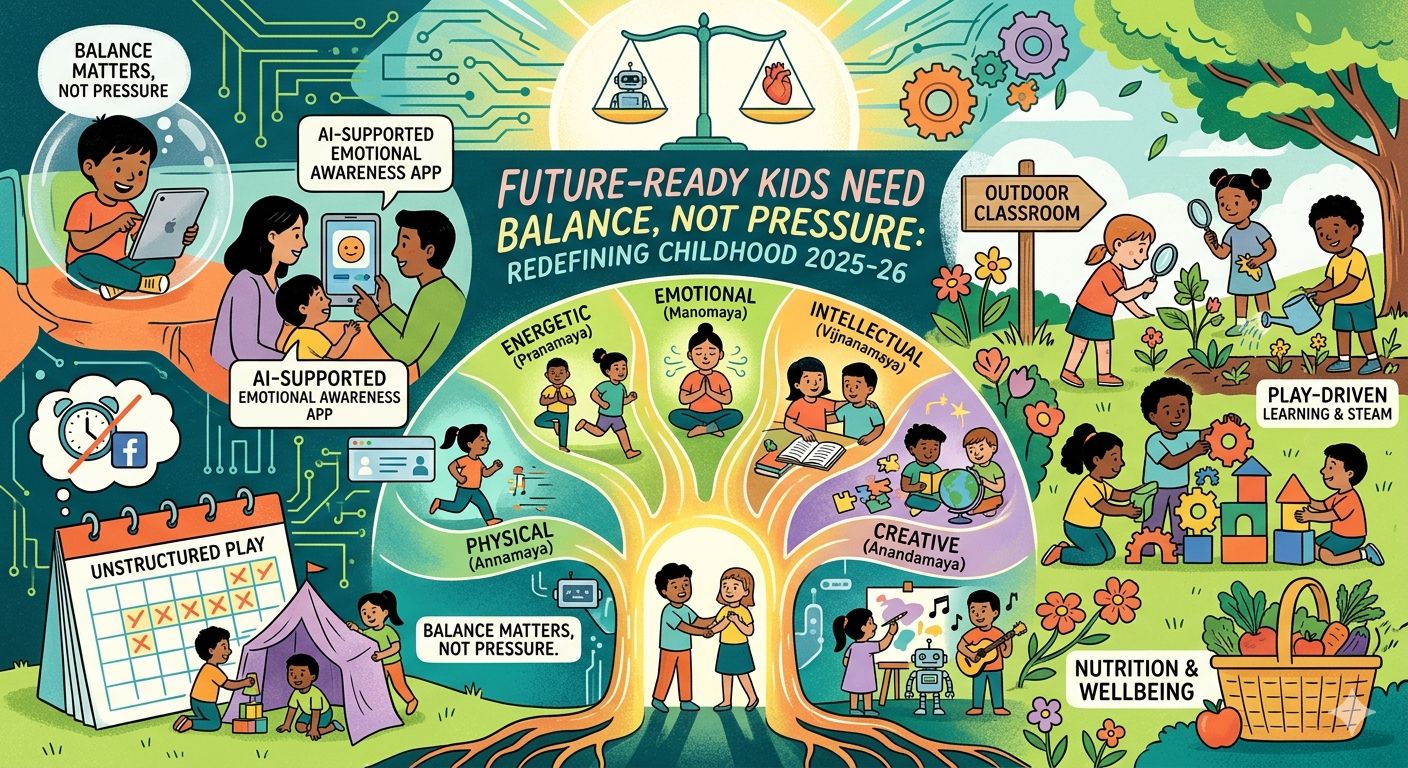
New Delhi, March 28: Childhood in 2025-26 is undergoing a significant transformation, shaped by rapid technological integration, evolving parenting philosophies, and a growing emphasis on holistic development, according to emerging research and educational insights.
Experts say children today are growing up in a deeply digital environment where technology is no longer a luxury but a necessity for learning, play, and social interaction. However, studies have raised concerns over excessive screen time, linking frequent social media use to attention challenges among children aged 10–14.
“Technology is now a necessity for play, learning, and social connection—not a luxury,” experts note, while cautioning that “balance matters… setting boundaries and emphasizing mindful tech use is crucial.”
Alongside digital exposure, there is a marked shift in educational priorities, with emotional and social intelligence gaining prominence over traditional academic benchmarks. Skills such as empathy, resilience, and emotional regulation are increasingly seen as essential.
“Emotional intelligence isn’t ‘extra’—it’s foundational,” experts emphasise, highlighting the growing use of AI-supported tools to assist parents in fostering meaningful emotional engagement at home.
The report also points to a decline in the “one-size-fits-all” model of education. Schools and caregivers are adopting personalized learning approaches and promoting inclusive environments that celebrate diversity in culture, language, and ability. This shift, educators say, helps children build confidence and grow at their own pace.
Equally significant is the renewed focus on nature-based and play-driven learning. Outdoor classrooms, sensory activities, and STEAM-based education are being encouraged to foster creativity and overall wellbeing.
Parenting trends are also evolving, with many families moving away from tightly packed schedules filled with extracurricular activities. Instead, there is a growing recognition of the value of unstructured play.
“Unstructured play isn’t just fun—it fuels imagination, problem-solving, and mental health,” experts say, adding, “Childhood is not a race.”
Health concerns remain central to the discourse, with childhood obesity emerging as a global issue. Specialists stress the need for balanced nutrition, physical activity, and attention to mental and emotional health.
A key framework gaining attention in understanding child development is the ancient Indian concept of Panchakosha, which views growth as a layered process encompassing physical, energetic, emotional, intellectual, and creative dimensions.
“What appears as erratic or defiant behaviour is… a deeply structured process of human development,” experts explain, adding that “these transitions are not random… they are signs of an inner intelligence unfolding.”
The framework underscores that each stage of childhood aligns with a specific developmental layer and warns against mismatched expectations.
“When expectations and development are out of sync, conflict becomes inevitable,” the report notes, advocating that “guidance replaces control.”
Experts further caution against modern parenting challenges such as overstimulation through screens, suppression of natural energy in children, and pushing creativity prematurely without a strong developmental foundation.
They stress that growth must be nurtured sequentially. “Growth cannot be rushed or skipped,” they say, adding that “true creativity is not a shortcut—it is the outcome of a well-lived process.”
In an age increasingly dominated by artificial intelligence, experts argue that holistic development—combining physical health, emotional strength, intellectual clarity, and creativity—is key to raising future-ready individuals.
“We are not just raising successful individuals—we are raising complete human beings,” they assert, noting that “machines can process information, but they cannot replicate the full spectrum of human potential.”
Summing up the evolving landscape of childhood, experts conclude: “The question is not whether children have the potential—the question is whether we understand how to nurture it.”
