

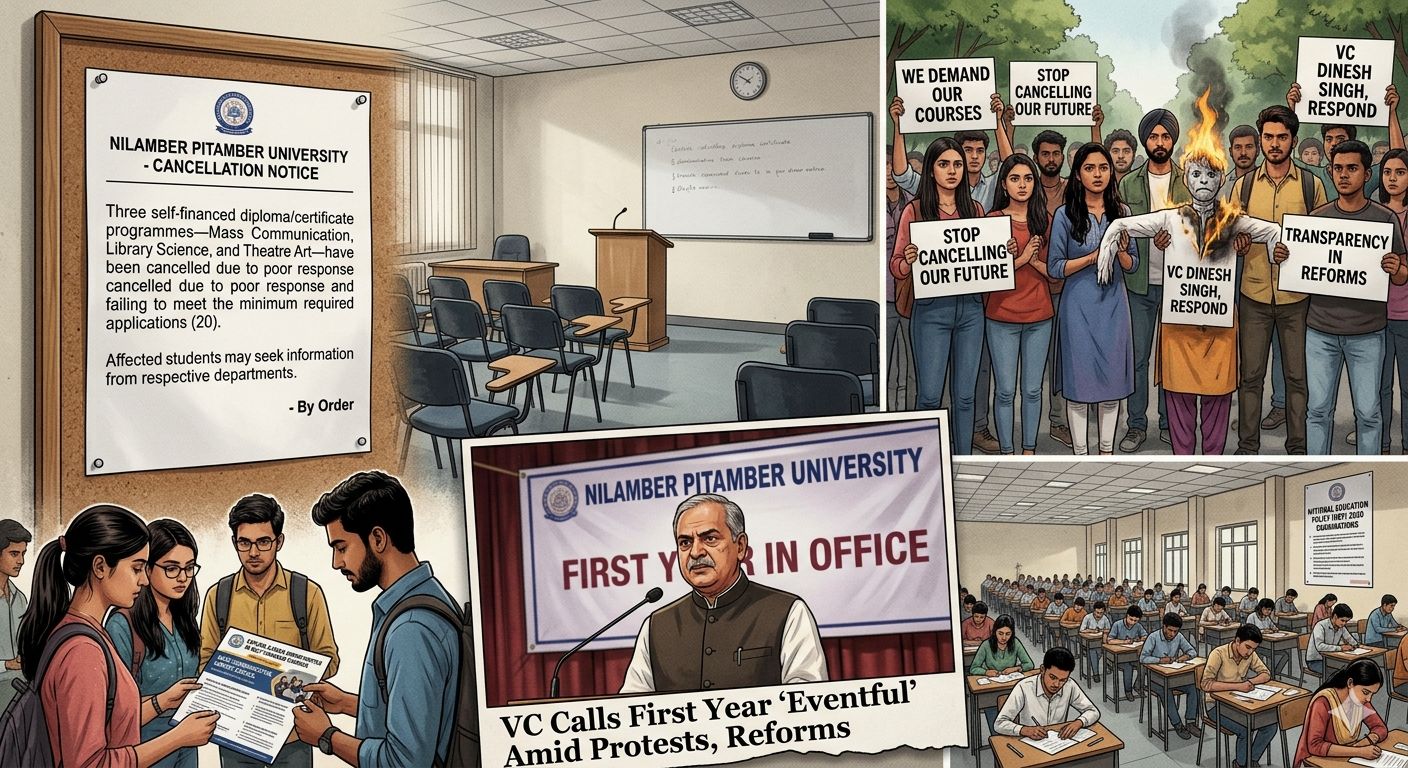
Daltonganj, Mar 27: Nilamber Pitamber University (NPU) has cancelled three self-financed diploma and certificate programmes — mass communication, library science and theatre art — due to poor response from students, officials said.
The decision was taken after none of the courses received the minimum required 20 applications, with only single-digit registrations recorded, prompting the university to scrap them before commencement.
“These courses did not receive even the minimum number of applications. We had no option but to ground them before take-off,” Vice-Chancellor Dinesh Kumar Singh said.
He clarified that as per the Academic Council’s mandate, self-financed courses must have at least 20 admissions, failing which they are rolled back. “An application for admission is just not a guaranteed admission,” Singh added.
The mass communication programme, which had earlier run for over a decade, was being revived after being discontinued due to low enrolment. However, it again failed to attract sufficient interest.
In response, the university is planning an awareness campaign across feeder colleges to promote such courses. “We will distribute leaflets detailing fee structure, course duration and career opportunities to encourage students to opt for these programmes after graduation,” the VC said, noting that many students tend to limit their choices to traditional BA and BSc degrees.
Reflecting on his first year in office, Singh described it as “eventful,” marked by protests, allegations and reform initiatives. “My first 100 days out of 365 were quite eventful. Protests were held, my effigy was burnt and a social media campaign was launched against me. I took it in my stride,” he said.
The tenure also saw allegations of corruption, which are currently under inquiry. “We welcome any probe. Audit teams are doing their job, and the university would also welcome a fresh audit from 2009,” he added.
Highlighting administrative progress, Singh said the university conducted over 100 examinations and published results for more than 70 within a year. The first semester examination under the National Education Policy (NEP) 2020 for the 2025–29 session has also been completed.
Addressing criticism over admissions, he said steps were taken to ensure a level playing field. “Some colleges had very low admissions, while others had very high numbers. The system has now improved overall intake,” he said.
The VC also pointed to improvements in basic infrastructure, including water and electricity, and claimed that degree preparation and distribution have reached record levels.
Looking ahead, Singh said the university would focus on student engagement, upgrading libraries and laboratories, and promoting research. New courses such as medical lab technology and nursing are also being planned, subject to government approval, while expansion of mass communication programmes has been delayed due to poor response.
On handling dissent, he maintained that while democratic expression is welcome, disorder will not be tolerated. “Dialogue is always open, but there is no place for chaos,” he said.
Summing up his first year, Singh remarked, “It is a year of hope emerging from despair, aimed at achieving success and excellence.”
