

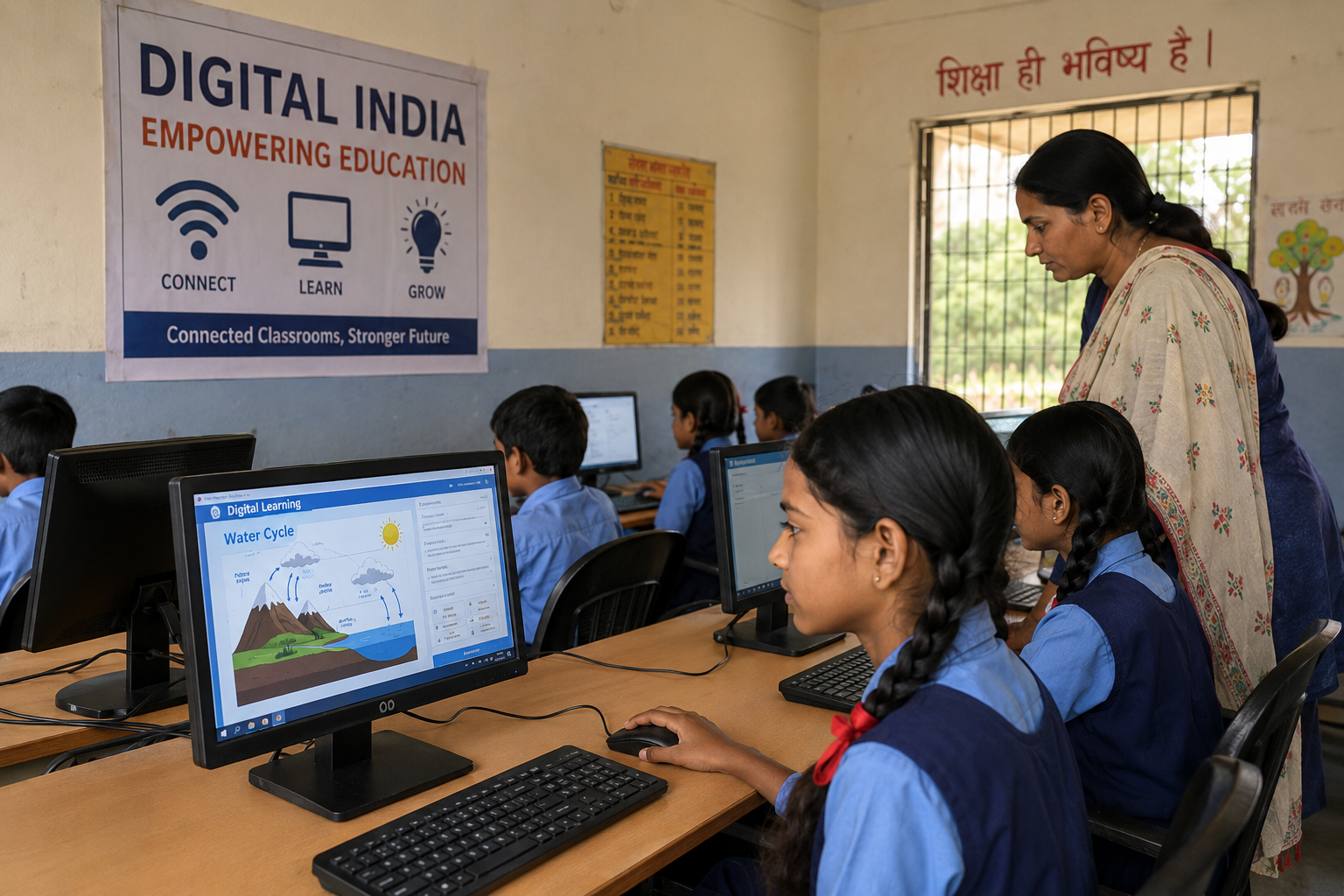
New Delhi, July 13 : Government schools have recorded the sharpest improvement in internet connectivity over the past three years, significantly narrowing the digital gap with aided and private institutions, according to the latest Unified District Information System for Education Plus (UDISE+) report.
Internet access in government schools increased from 46.2 per cent in 2023-24 to 63.1 per cent in 2025-26, reducing the connectivity gap with aided and private schools from nearly 28 percentage points to around 16 percentage points.
Overall, 67.4 per cent of schools across the country had internet facilities in 2025-26, up from 63.5 per cent in 2024-25 and 53.9 per cent in 2023-24, reflecting steady progress in digital infrastructure.
Government schools also posted notable gains in smart classroom availability, with coverage rising from 21.2 per cent in 2023-24 to 32.2 per cent in 2025-26. However, they continued to trail government-aided schools, where 41 per cent of institutions had smart classrooms, and private unaided schools at 39.9 per cent.
Among states, Goa achieved 100 per cent internet connectivity in schools, improving from 87.6 per cent in 2023-24. Excluding Union Territories, Andhra Pradesh ranked next with 99.2 per cent coverage, followed by Tamil Nadu (99 per cent), Gujarat (96.8 per cent) and Kerala (92.6 per cent).
At the other end of the spectrum, West Bengal recorded the lowest internet coverage at 19.7 per cent, followed by Arunachal Pradesh (36 per cent), Meghalaya (36.4 per cent), Manipur (38.8 per cent) and Tripura (42.5 per cent). While Meghalaya improved by nearly 12 percentage points and Tripura by over seven percentage points since 2023-24, West Bengal registered only a marginal increase from 17.5 per cent to 19.7 per cent during the period.
Internet connectivity in government-aided schools rose from 73.3 per cent to 79.7 per cent, while private unaided schools improved from 74.3 per cent to 79.2 per cent between 2023-24 and 2025-26.The report also highlighted continued disparities in computer availability. Overall, 69.9 per cent of schools had computers in 2025-26.
The share stood at 66.9 per cent in government schools, 76.6 per cent in aided schools and 80 per cent in private unaided institutions. For computers used specifically for teaching, the corresponding figures were 59.4 per cent, 73.7 per cent and 74 per cent, respectively.
National smart classroom coverage increased from 24.4 per cent in 2023-24 to 33.9 per cent in 2025-26, with government schools registering the largest improvement of about 11 percentage points over the period.
Despite improvements in digital infrastructure, digital libraries remained scarce, with only 7.1 per cent of schools reporting the facility. The availability was 5.7 per cent in government schools, 10.4 per cent in aided schools and 11.2 per cent in private unaided institutions.
The UDISE+ report noted that the National Education Policy envisions schools equipped with computing devices, internet connectivity, libraries and other essential infrastructure to create a safe, inclusive and effective learning environment.
The report also pointed to variations in school availability and enrolment across states. It observed that states such as Uttar Pradesh, Madhya Pradesh, Rajasthan, Karnataka, Odisha, Andhra Pradesh, Chhattisgarh, Assam, Jammu and Kashmir, Uttarakhand, Himachal Pradesh and Meghalaya have a higher share of schools relative to student enrolment, indicating underutilisation of infrastructure. In contrast, Maharashtra, Bihar, West Bengal, Tamil Nadu, Gujarat, Telangana, Punjab, Haryana, Delhi and Kerala have comparatively fewer schools relative to enrolment, suggesting a higher student load per school.
According to the report, 78.9 per cent of schools in West Bengal are primary schools, catering to 45.2 per cent of students, while only 3.4 per cent are secondary schools. In contrast, 50.5 per cent of schools in Chandigarh are higher secondary institutions, whereas only 5.3 per cent are primary schools, serving 42.7 per cent of students.
