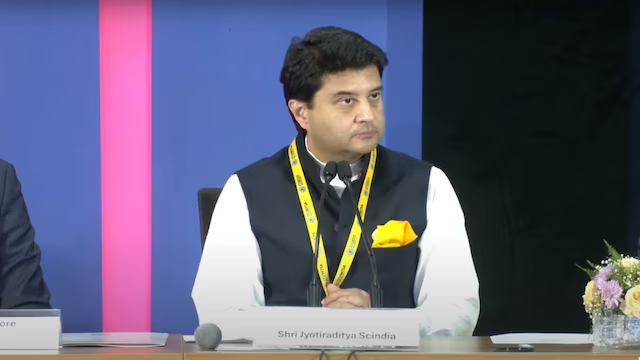
New Delhi, May 17 – India is set to expand the use of satellite communication technology to complement traditional terrestrial networks and improve connectivity in underserved areas, Telecom Minister Jyotiraditya Scindia said on Thursday.
Speaking on the growing role of satellite systems, Scindia highlighted their critical importance in regions where installing mobile towers and optical fiber is not feasible. “Satellite communication will serve as a complementary, not substitute, technology to terrestrial networks,” he said.
The Indian government has taken key steps to facilitate this expansion. Licenses have been granted to Eutelsat OneWeb and Jio Satellite Communications, while Starlink, operated by Elon Musk’s SpaceX, has received a Letter of Intent to operate in India.
In a major policy move, the Telecom Regulatory Authority of India (TRAI) last week recommended administrative allocation of satellite spectrum, rather than auctioning it, aiming for more efficient resource utilization. The regulator also proposed a spectrum usage charge of 4% of Adjusted Gross Revenue (AGR) for satellite service providers.
The initiatives are part of the government’s broader push to enhance digital inclusion and expand connectivity infrastructure, particularly in remote and rural regions where conventional solutions face logistical and economic hurdles.
“Satellite connectivity will open new avenues for digital advancement, bridging the urban-rural divide and enhancing national infrastructure,” Scindia said.
India’s push toward satellite-based communication aligns with global trends, as companies race to deploy low-Earth orbit (LEO) satellite networks capable of delivering high-speed internet to hard-to-reach areas.