

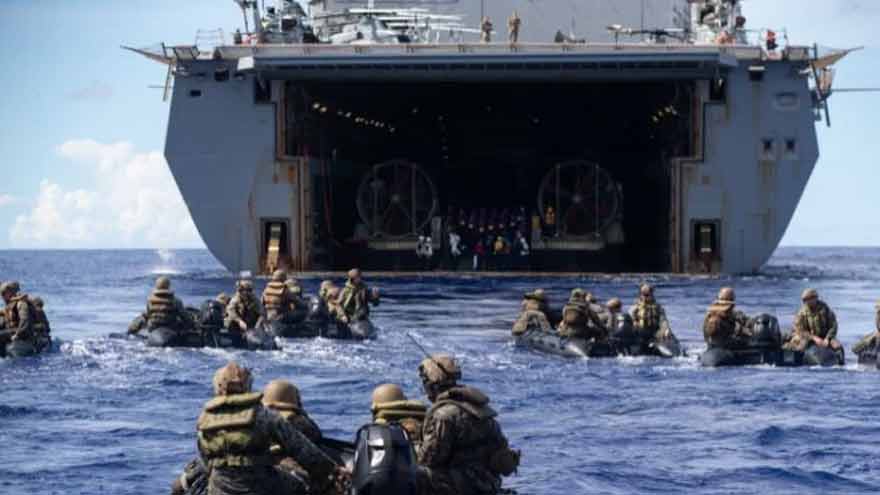
Washington, 14 March: The United States Marine Corps and the United States Navy are preparing to send additional forces to the Middle East as tensions with Iran intensify, according to US officials.
The reinforcement will come from an amphibious ready group and its Marine expeditionary unit, a formation that typically includes about 5,000 sailors and Marines operating across several warships. The group is expected to be led by the Japan-based amphibious assault ship USS Tripoli (LHA-7).
Officials said the deployment request was made by United States Central Command, which oversees US military operations in the region, and approved by US Defence Secretary Pete Hegseth.
The move comes amid a rapidly expanding conflict involving the United States, Israel and Iran. The fighting began after US and Israeli forces launched strikes on Iranian targets on 28 February, triggering a series of retaliatory attacks across the region.
The administration of Donald Trump said US forces had “totally obliterated” Iranian military infrastructure on Kharg Island, a strategic oil facility located near the Strait of Hormuz. The narrow waterway is one of the world’s most critical routes for global energy shipments.
Iran has since launched strikes against Israeli territory and US military installations in the Middle East. The confrontation has disrupted international aviation routes and pushed global oil prices sharply higher as security concerns grow around the Gulf.
US military planners are also considering measures to protect commercial shipping. President Trump told reporters that the US Navy could soon begin escorting oil tankers through the Strait of Hormuz, saying the operation would begin “soon.”
In addition, US officials said parts of a missile defence system currently stationed in South Korea are being relocated to the Middle East to strengthen regional protection against potential attacks.
The United States Department of Defense said American forces have already struck around 6,000 Iranian targets during the first two weeks of the conflict.
Meanwhile, Iran’s newly appointed supreme leader Mojtaba Khamenei signalled that Tehran would maintain pressure on the strategic waterway. In a televised statement, he vowed Iran would continue efforts to block the Strait of Hormuz and warned neighbouring states against hosting US military bases.
He also pledged to “avenge the blood” of Iranians killed in the conflict, underscoring the risk of further escalation across the Middle East.
