

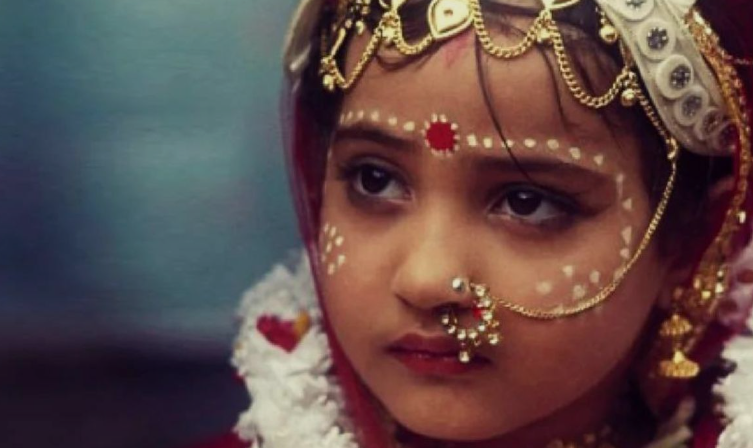
Balurghat, Dec 24: Despite the expansion of cash-transfer welfare schemes for girls and women, West Bengal continues to record high levels of child marriage, raising questions about the effectiveness of government interventions such as the Kanyashree and Rupashree schemes.
Recent data from the Sample Registration System (SRS), released in September 2025, shows that West Bengal now records the highest incidence of child marriage in the country.
According to the report, 6.3 per cent of all current marriages in the state involve girls below the age of 18, nearly three times the national average of 2.1 per cent.
Official figures from the National Family Health Survey (NFHS-5), conducted between 2019 and 2021, further underline the scale of the problem.
The survey indicates that 41.6 per cent of women aged 20–24 in West Bengal were married before attaining the legal age of 18.
Health workers say the social consequences are reflected in maternal and child health outcomes. Swapna Barman, an Accredited Social Health Activist (ASHA) from Buniadpur in Dakshin Dinajpur district, said she recently encountered a teenage mother suffering from anaemia and other ailments.
The woman, Barman said, was married at the age of 12 to a minor and came to medical attention during her pregnancy.
Repeated attempts to seek comment from the state Minister for Women and Child Development and Social Welfare, Shashi Panja, elicited no response.
The West Bengal government has long highlighted welfare schemes such as the Kanyashree Prakalpa and Rupashree Prakalpa as pillars of its women-centric development model.
Launched in 2013, Kanyashree provides annual assistance of Rs 1,000 to unmarried girls aged 13–18 from low-income families to encourage school attendance, along with a one-time grant of Rs 25,000 for those who continue education after 18.
The scheme currently covers around 8.9 million beneficiaries. Rupashree Prakalpa, introduced in 2018, offers a separate one-time grant of Rs 25,000 to support marriage expenses for brides from economically weaker sections, provided they are above 18 years of age.
However, economists and social workers argue that the schemes have not addressed the underlying drivers of early marriage. Economist Ishita Mukhopadhyay said that cash transfers often end up being diverted towards household expenses or dowry rather than education, reflecting deepening poverty and declining faith in education as a pathway to economic mobility.
District-level data points to sharp regional disparities. NFHS-5 figures show that in districts such as Murshidabad, Purba Medinipur, Birbhum, Malda and Purulia, more than half of women in their early twenties were married before the age of 18. In some areas, the rate exceeds 55 per cent.
Purba Medinipur presents a stark paradox, with female literacy levels above 88 per cent but persistently high levels of early marriage, suggesting that schooling is often viewed as a transitional phase rather than a route to higher education or employment.
Teachers report that the trend is visible within schools. Nandita Das, headmistress of Ayodhya Kalidasi Vidyaniketan in Balurghat, said many girls in Classes 9 and 10 fail to return after extended holidays because they are married off during that period.
Another teacher, Tuhin Mondal, said welfare incentives have not been sufficient to prevent early marriage or school dropouts.
Health department data further illustrates the scale of the issue. In Birbhum district, 3,443 minor girls were admitted to government health centres for childbirth between April and June 2025 alone. In South Dinajpur, official records indicate around 7,000 child marriages and more than 4,000 teenage mothers in a single year.
West Medinipur reported over 10,000 pregnancies among minors in one year. Non-governmental organisations working in the field say the problem is not confined to rural areas. Soma Bhowmik, associated with an NGO in Murshidabad, said early marriage is also prevalent in urban slums, often driven by financial distress and the absence of male guardians.
While authorities claim to be stepping up awareness campaigns and door-to-door counselling, legal enforcement remains limited.
On average, only about 100 cases are registered annually under the Prohibition of Child Marriage Act in the state. Social workers allege that police intervention is often avoided unless a formal complaint is lodged, with officials preferring written undertakings from families instead of prosecution.
SRS data also shows that marriage is heavily concentrated just after the legal age threshold, with West Bengal recording the highest proportion of marriages among women aged 18–20 at 44.9 per cent.
Analysts say this indicates that social norms have shifted from child marriage to the earliest possible legal marriage, leaving little scope for education or skill development.
As government spending on welfare schemes continues to rise, experts warn that without stronger enforcement, economic support alone may not be sufficient to alter long-standing social practices, leaving the life trajectory of many young women largely unchanged.
