

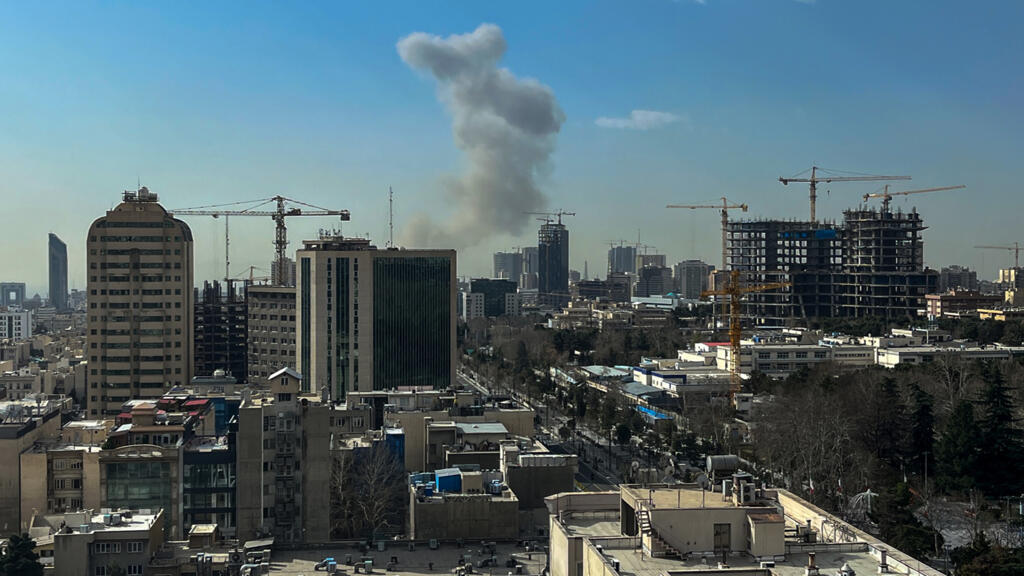
New Delhi. 28 Feb: A large-scale military confrontation erupted across the Middle East after the United States and Israel launched coordinated strikes on more than 30 locations inside Iran, triggering retaliatory missile attacks across Israel and several Gulf states hosting American forces.
Explosions were reported in multiple Iranian cities, including Tehran, Ilam province, Qom, Bushehr and near the military complex at Parchin. Iranian media said several government-linked and defense facilities were targeted. Communications disruptions were reported in parts of the capital as residents queued at fuel stations amid fears of further escalation.
The US administration confirmed the operation — described by officials as “Operation Epic Fury” — involved air and naval assets and focused on military and missile-related infrastructure.
US President Donald Trump said the strikes were intended to neutralize what he called “imminent threats” from Tehran.
“Short time ago, US military began major combat operation in Iran. Our objective is to defend the American people,” Trump said, adding that Iran’s missile capabilities would be dismantled and warning Tehran to “lay down your arms or face certain death.”
Trump also acknowledged the risks of escalation, stating that American lives could be endangered as operations continue.
Israeli Prime Minister Benjamin Netanyahu described the action as necessary to eliminate an “existential threat,” saying coordinated efforts with Washington were aimed at weakening Iran’s strategic military infrastructure.
Iranian Response
Iran swiftly launched retaliatory missile fire toward Israel and US military facilities across the Gulf. Air defense systems were activated in northern Israel as sirens sounded nationwide. Explosions were also reported near US-linked bases in Qatar, Kuwait, the United Arab Emirates and Bahrain.
Iranian state-affiliated media confirmed strikes targeting Al Udeid Air Base in Qatar and the headquarters of the US Fifth Fleet in Bahrain. Qatari authorities said several incoming projectiles were intercepted.
A senior Iranian official told media outlets that Tehran’s response would be “crushing,” while another warned that “all American and Israeli assets and interests in the Middle East” were now considered legitimate targets.
Iran’s Supreme Leader Ayatollah Ali Khamenei was moved to a secure location, according to officials, after reports that areas near key government sites were struck.
Civilian Impact and Regional Fallout
Iranian state media reported that an Israeli strike in Minab, in Hormozgan province, hit a girls’ school, killing at least 40 people. The claim could not be independently verified at the time of reporting.
Both Iran and Israel closed their airspace as the situation deteriorated. International airlines suspended flights over parts of the region, including Indian carriers Air India and IndiGo.
The UAE reported one fatality in Abu Dhabi after debris from intercepted missiles fell in a residential area.
India issued an advisory urging its citizens in the region to exercise “utmost caution,” as tensions spread beyond the immediate conflict zone.
Strategic Implications
Security analysts say the confrontation marks one of the most direct military exchanges between Washington and Tehran in recent years.
Muhanad Seloom of the Doha Institute said Iran appears intent on raising the strategic cost for US-aligned Gulf states. Meanwhile, Mehran Kamrava of Georgetown University in Qatar suggested the timing of the strikes could affect diplomatic efforts over Iran’s nuclear program.
Military officials indicated operations may continue for several days, raising concerns of a broader regional war involving allied non-state actors.
As missile exchanges continue and emergency measures remain in place across multiple countries, diplomatic channels appear stalled, leaving the region on edge amid fears of prolonged escalation.
