

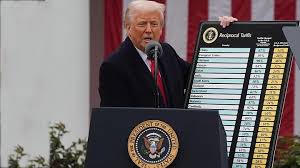
Washington, 21 Feb: In a ruling with sweeping implications for executive power and global trade, the Supreme Court of the United States on Friday struck down President Donald Trump’s worldwide tariffs imposed under a national emergency law, finding that the president overstepped constitutional limits.
By a 6–3 vote, the justices held that the 1977 International Emergency Economic Powers Act (IEEPA) does not authorize the unilateral imposition of tariffs. The decision affirms that the U.S. Constitution assigns taxing authority to Congress, not the White House.
Writing for the majority, Chief Justice John Roberts said Congress has delegated tariff powers only “in explicit terms and subject to strict limits,” adding that had lawmakers intended to grant such “extraordinary power,” they would have done so clearly.
Presidential Rebuke and Immediate Countermove
Within hours of the ruling, Trump denounced the judgment as “terrible,” accusing the justices who opposed him of being “fools and lap dogs” and “disloyal to our Constitution.” He signaled that refunds of previously collected duties would likely face prolonged litigation, saying the matter could be “tied up in court for years.”
The president simultaneously pivoted to a new legal pathway, signing a proclamation to impose a 10% global tariff under Section 122 of U.S. trade law, which permits temporary duties of up to 15% for 150 days pending congressional action. The measure is scheduled to take effect on February 24.
Administration officials said exemptions would apply to select categories, including certain minerals, fertilizers, pharmaceuticals, electronics and vehicles. Canada and Mexico will retain preferential treatment under the USMCA trade pact.
Billions at Stake
The ruling places a substantial financial question before lower courts. Between $130 billion and $175 billion in duties have been collected under the IEEPA-based tariffs, according to economic estimates, with total customs revenues reaching a record $195 billion in fiscal 2025.
Economists caution that businesses seeking reimbursement may face costly legal processes. Justice Brett Kavanaugh, dissenting, warned the aftermath could become “a mess,” reflecting uncertainty over how repayments might proceed.
Governors from several states swiftly demanded refunds. Gavin Newsom called for immediate repayment “with interest,” while JB Pritzker pressed for billions on behalf of Illinois families.
Business owners affected by the tariffs described the decision as a turning point. Some said the judgment lifted a heavy burden from supply chains strained by elevated import costs.
Separation of Powers at the Core
At the heart of the dispute was whether IEEPA — historically used to freeze assets and impose sanctions during national emergencies — extends to across-the-board tariffs. The statute does not explicitly reference tariffs, and Trump became the first president to invoke it for that purpose.
The majority concluded that stretching emergency powers to cover general trade taxes would disrupt the constitutional balance between the legislative and executive branches.
Global Response
International reaction was measured but watchful. Emmanuel Macron said the ruling underscored the value of democratic “checks and balances.” European officials indicated they were reviewing the implications of both the court’s decision and the newly announced 10% tariff.
Financial markets reacted positively to the court’s intervention, though analysts noted that the president’s alternative measures could prolong volatility in global trade flows.
What Comes Next
The White House has signaled it may explore additional authorities, including national security and unfair trade practice provisions, to sustain elements of its tariff strategy. Legal scholars expect further challenges if new duties mirror the breadth of those invalidated.
For now, the ruling represents a significant judicial check on executive trade powers — even as the administration moves quickly to test the boundaries of other statutes.
