

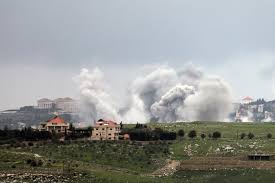
Beirut Mar 23: Israel has approved plans to expand its ground and air operations against Hezbollah in Lebanon, marking a significant escalation that is raising concerns of a broader regional conflict.
The Israeli military indicated that the campaign would be “prolonged,” with Chief of Staff Eyal Zamir stating that operations “have only begun,” signalling a sustained military push aimed at neutralising threats along Israel’s northern border.
Strategic Escalation and Military Objectives
Israeli officials say the objective is to prevent cross-border attacks after Hezbollah launched rockets earlier this month amid heightened tensions involving Iran, the United States, and Israel.
As part of the strategy, Israeli forces have targeted key infrastructure, including bridges over the Litani River. Military planners view these crossings as critical supply routes for Hezbollah fighters.
Recent airstrikes, including damage to the Qasmiyeh bridge, suggest a broader effort to isolate southern Lebanon, a region considered Hezbollah’s stronghold. Analysts note that the approach resembles tactics used in Gaza, where buffer zones were created through large-scale destruction and forced evacuations.
Lebanon Warns of ‘Prelude to Invasion’
Lebanese President Joseph Aoun condemned the strikes, describing them as a “prelude to a ground invasion” and warning that the attacks risk severing the country’s internal connectivity.
He accused Israel of pursuing “suspicious schemes” to establish a buffer zone along the border, potentially expanding its territorial footprint inside Lebanon. Aoun also cautioned that internal attempts to disarm Hezbollah by force could deepen sectarian tensions and destabilise the country.
Rising Humanitarian Concerns
The escalation has already had severe humanitarian consequences. Lebanese authorities report that more than 1,000 people have been killed, including children and healthcare workers, while over one million residents have been displaced within weeks.
Aid groups warn that continued strikes on infrastructure could cut off access to essential supplies, including food and medicine, particularly if southern regions become fully isolated.
Legal and International Concerns
Human rights organisations, including Human Rights Watch, have raised alarms over the scale of destruction. They warn that widespread demolition of homes and civilian infrastructure could constitute violations of international humanitarian law, particularly if attacks are deemed disproportionate.
Legal experts emphasise that even when targeting military objectives, parties to a conflict must minimise civilian harm and ensure that operations meet standards of necessity and proportionality.
Conflict in a Wider Regional Context
The current escalation is part of a broader geopolitical crisis linked to tensions between Israel, Iran, and their respective allies. The situation has been further shaped by the aftermath of the 7 October 2023 Hamas attack, which continues to influence Israel’s military doctrine across multiple fronts.
With both sides signalling readiness for further action, observers warn that what began as cross-border retaliation risks evolving into a wider regional confrontation, with significant humanitarian and political consequences.
