

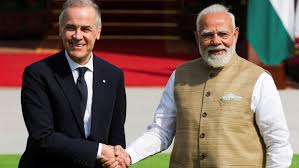
New Delhi, 2 March: In a significant diplomatic breakthrough, Narendra Modi and Mark Carney on Monday unveiled a sweeping roadmap to restore and expand bilateral ties, announcing a long-term uranium supply agreement and setting an ambitious target to raise two-way trade to $50 billion by 2030.
The agreements, finalised during high-level talks in New Delhi, signal a decisive reset after relations plunged in 2023 following allegations by former Canadian Prime Minister Justin Trudeau linking Indian agents to the killing of Khalistan separatist Hardeep Singh Nijjar. New Delhi had rejected the accusations as “absurd” and “politically motivated,” and the diplomatic fallout led to expulsions of envoys and suspension of visa services.
Nuclear Cooperation Anchors Reset
At the heart of the renewed engagement is what both leaders described as a “landmark” civil nuclear agreement guaranteeing long-term uranium supplies from Canada to fuel India’s expanding atomic energy programme. The two sides will also collaborate on Small Modular Reactors (SMRs) and advanced reactor technologies under a newly launched Strategic Energy Partnership.
Addressing reporters, Modi said the agreement reflects growing trust and shared priorities in energy security and climate responsibility. Carney, in turn, emphasised Canada’s role as a stable supplier capable of supporting India’s rapidly rising energy demand.
Trade Pact Back on Fast Track
Both governments committed to concluding a long-pending Comprehensive Economic Partnership Agreement (CEPA) by the end of 2026, aiming to double bilateral trade within the decade. Officials said the proposed deal would reduce trade barriers, improve regulatory certainty and boost investor confidence.
India and Canada also signed a critical minerals cooperation pact to strengthen resilient supply chains — a sector seen as strategically vital amid global competition over battery and clean energy resources.
Canadian pension funds, which have invested an estimated $100 billion in India, were cited by Modi as evidence of enduring investor confidence despite recent diplomatic tensions.
Defence Dialogue and Indo-Pacific Focus
In a notable expansion of security cooperation, the two countries agreed to establish an India–Canada Defence Dialogue. The framework will promote maritime collaboration in the Indo-Pacific, professional military exchanges and enhanced coordination on shared security concerns, including countering terrorism and radicalisation.
Officials described the move as reflective of “mature and deep mutual trust” between the two democracies.
Technology, Space and Innovation
The leaders underscored plans to deepen collaboration in artificial intelligence, supercomputing and semiconductor manufacturing. An innovation partnership will link startups and industries, including in the space sector, as both nations seek to position themselves in emerging technology value chains.
Canada also confirmed it will join the International Solar Alliance and the Global Biofuel Alliance, aligning climate goals with economic cooperation.
Agriculture, Education and People-to-People Links
Beyond strategic sectors, the reset extends to agriculture and education. An India–Canada Pulse Protein Centre of Excellence will be set up to advance agri-technology and food security initiatives. Cultural exchange programmes and educational partnerships were also strengthened, reflecting the strong people-to-people ties between the two nations.
Canada is home to one of the largest Indian diaspora communities globally — a factor both sides acknowledged as a foundation for rebuilding trust.
Diplomatic Context
Since taking office, Carney has sought to stabilise ties with New Delhi, stating that current Canadian assessments do not link India to ongoing violent threats on its soil. The Nijjar case, however, remains before Canadian courts.
Analysts view the rapprochement as pragmatic, shaped by shifting geopolitical realities and a shared desire to diversify trade partnerships amid global economic uncertainty and protectionist pressures.
With nuclear energy, defence cooperation and trade negotiations now back on track, New Delhi and Ottawa appear intent on transforming a strained relationship into what both leaders called a “next level partnership” for the decade ahead.
