

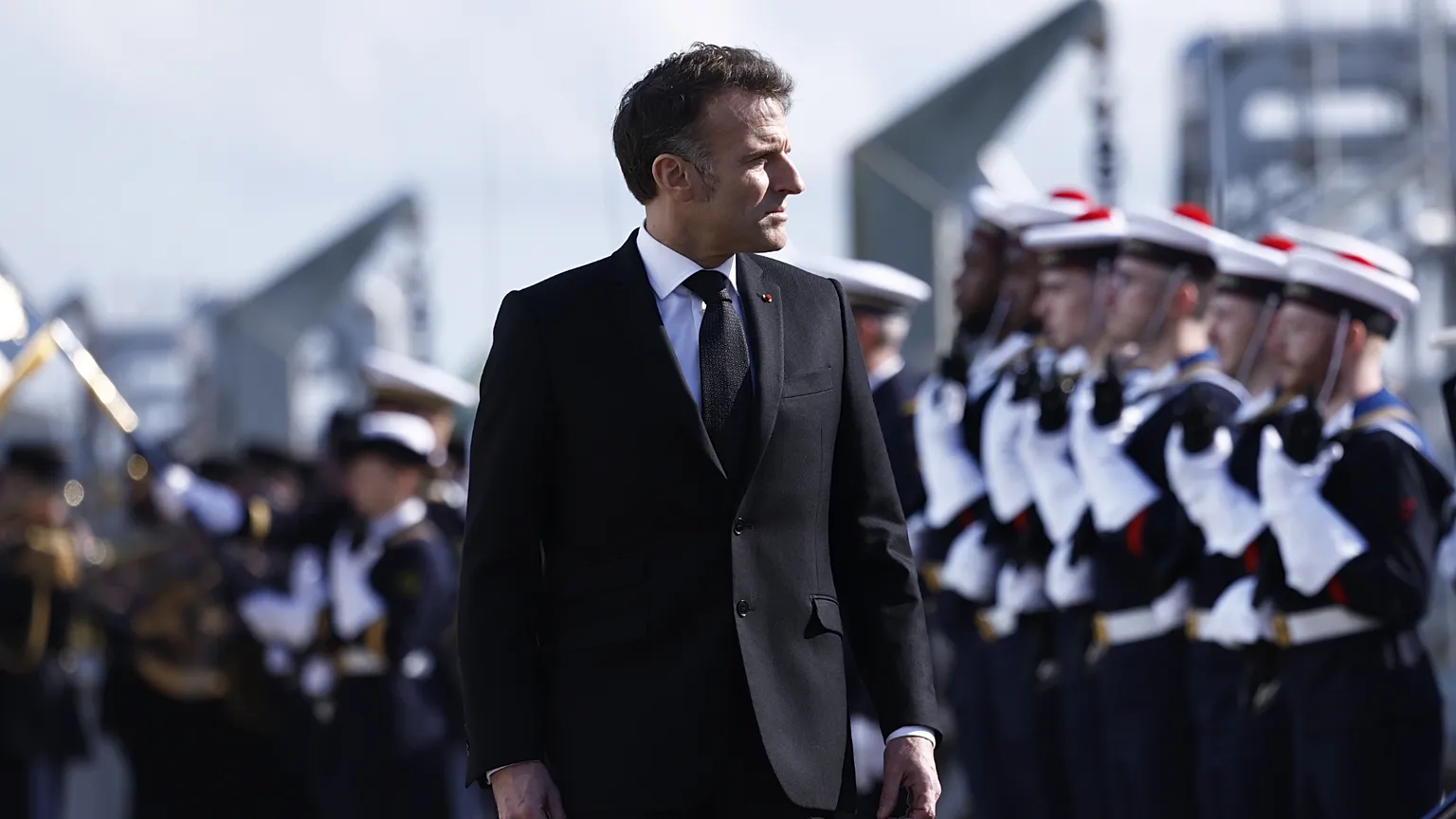
France, 3 March: President Emmanuel Macron has announced a sweeping overhaul of France’s nuclear strategy, pledging to increase the country’s warhead stockpile and extend elements of its deterrence posture deeper into Europe amid what he described as a “period of geopolitical upheaval, fraught with risk.”
Speaking from the Île Longue submarine base in Brittany, Macron declared that “the next 50 years will be an era of nuclear weapons,” signaling a decisive shift in French strategic thinking. France’s arsenal — estimated at roughly 290–300 warheads — will be expanded for the first time in decades. However, Paris will stop disclosing the size of its stockpile, reinforcing a doctrine of calculated ambiguity.
“This is not an arms race,” Macron said, framing the move as necessary to preserve France’s “assured destructive power.” He reiterated that the authority to launch nuclear weapons will remain solely with the French president, and that the definition of France’s “vital interests” — the threshold for nuclear use — will remain sovereign and intentionally undefined.
‘Advanced Deterrence’ and European Reach
Under a new strategy termed “advanced deterrence,” France will broaden cooperation with eight European partners: the United Kingdom, Germany, Poland, Netherlands, Belgium, Greece, Sweden, and Denmark.
The plan includes the potential deployment of nuclear-capable Dassault Rafale aircraft to allied territories and expanded joint exercises involving France’s Strategic Air Forces. Macron said dispersing strategic assets across the continent would “spread out across the depth of the European continent” and “complicate the calculations of our adversaries.”
A next-generation nuclear-powered ballistic missile submarine, to be launched in 2036 and named The Invincible, will anchor the maritime leg of the deterrent.
Partner nations may also contribute to auxiliary capabilities such as missile defence, space-based early warning systems and long-range conventional strike systems. However, Paris stressed there will be no shared control over nuclear launch decisions and no automatic security guarantee.
Franco-German Coordination
In a joint statement issued after the speech, France and Germany confirmed the creation of a high-level nuclear steering group. Berlin will participate in French nuclear exercises and strategic site visits. Both governments underlined that the arrangement will “complement, not replace” NATO’s nuclear deterrent framework.
Strategic Rationale
Macron cited Russia’s ongoing war in Ukraine, China’s growing military reach and uncertainty surrounding long-term U.S. defence commitments as drivers of the policy shift. He argued that Europe must assume greater responsibility for its own security architecture.
Polish Prime Minister Donald Tusk welcomed the initiative, stating: “We are arming up together with our friends so that our enemies will never dare to attack us.” Swedish Prime Minister Ulf Kristersson said strengthening European defence “has not been as important since the Second World War as it is right now.”
A Historic Shift
French officials describe the move as the most consequential update to national nuclear doctrine since the era of Charles de Gaulle, when the country established its independent force de frappe in 1960. While Paris insists the changes are defensive, the policy positions France more clearly as the European Union’s central nuclear power at a time of shifting transatlantic dynamics.
By reinforcing ambiguity while widening cooperation, France is seeking to project both independence and continental leadership — a balancing act that may redefine Europe’s strategic posture for decades to come.
