

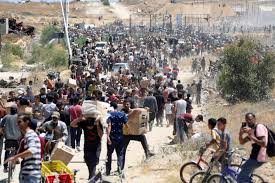
Gaza/Geneva, July 13: At least 798 people have been killed while seeking food at humanitarian distribution points in Gaza since late May, the UN human rights office said on Friday, as international criticism mounts over a controversial aid system backed by Israel and the United States.
The deaths include 615 people killed near food sites operated by the Gaza Humanitarian Foundation (GHF) and 183 along aid convoy routes, UN spokesperson Ravina Shamdasani told reporters in Geneva. “These incidents are deeply alarming and raise serious questions about the safety and impartiality of aid delivery in Gaza,” she said.
The GHF, a private entity backed by Israel as an alternative to the UN-led aid system, has drawn condemnation from rights groups for allegedly violating humanitarian neutrality and potentially enabling war crimes. The foundation operates four militarised food distribution zones overseen by American private contractors, replacing more than 400 non-militarised UN aid sites.
Israel has justified the new system by claiming that Hamas diverted UN aid—a claim the UN says remains unsubstantiated.
The GHF denied the UN figures, calling them “false and misleading,” and blamed the deaths on Israeli troops firing at civilians near distribution hubs. “The fact is the most deadly attacks on aid sites have been linked to UN convoys,” a GHF spokesperson said.
In Gaza, the GHF’s operations have been marred by near-daily reports of shootings near aid lines. Palestinians must follow strict routes and walk long distances for food, often without any assurance of safety.
On Friday, at least 10 people were killed and over 60 injured when Israeli forces opened fire on civilians waiting for food in Rafah, according to Ahmad al-Farra, head of paediatrics at Nasser hospital in Khan Younis.
Meanwhile, 15 more Palestinians were killed overnight in Israeli airstrikes in northern Gaza, including one on a school serving as a shelter for displaced families.
Médecins Sans Frontières reported a surge in acute malnutrition, saying cases at its Gaza City clinic had nearly quadrupled in two months. “The humanitarian situation is spiraling,” the group said in a statement.
Medical infrastructure remains severely strained. At Nasser hospital, doctors treated the wounded in hallways and outside under tents amid continued Israeli shelling and gunfire. The hospital, one of the few still operational in southern Gaza, has only 48 hours of fuel remaining. Air conditioning was shut off to conserve power during intense summer heat.
Witnesses reported tanks near displaced persons’ tents and Israeli soldiers operating in a nearby cemetery. Two residents claimed to have seen soldiers exhuming bodies before withdrawing early Friday morning. Displaced mother Nahla Abu Qursheen described spending the night on the street with her children after fleeing tank fire. “We slept under a single piece of cloth. They say there is a truce coming, but every day it’s more lies,” she said.
Despite a surge in Israeli military operations, ceasefire negotiations are ongoing. U.S. President Donald Trump said he was hopeful a deal could be reached during Israeli Prime Minister Benjamin Netanyahu’s visit to Washington.
Hamas has reportedly agreed to release 10 of the remaining 50 hostages under a proposed two-month truce. However, Qatari mediators say key disagreements remain, including Hamas’s demand for assurances that Israel won’t resume fighting, and Israel’s insistence on removing Hamas from Gaza entirely.
Meanwhile, Israeli Defence Minister Israel Katz has proposed relocating Palestinians to a “humanitarian city” in southern Gaza—a plan that the UN agency for Palestinian refugees (UNRWA) warned could constitute a crime against humanity.
The conflict began on October 7, 2023, when Hamas-led militants killed more than 1,200 people in Israel and took over 250 hostages. Since then, more than 57,000 people have been killed in Gaza during Israel’s 21-month military campaign.