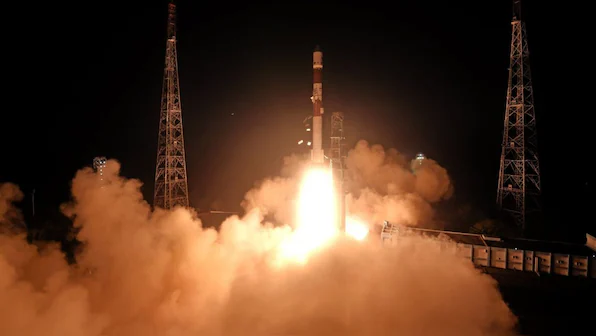
Bengaluru, Feb 7 : India is set to embark on groundbreaking scientific advancements with the launch of three major missions: Gaganyaan in 2026, Samudrayaan in 2026, and Chandrayaan-4 in 2027. These projects aim to expand the frontiers of human spaceflight, lunar research, and deep-sea exploration.
Union Minister Jitendra Singh, speaking to PTI, stated, “The objective of the Chandrayaan-4 mission is to gather samples from the Moon’s surface and return them to Earth.”
The Gaganyaan Mission marks India’s first human spaceflight program. It will send astronauts aboard an indigenous spacecraft into Low Earth Orbit (LEO) using ISRO’s GSLV Mk III (LVM-3) rocket. The mission will be preceded by an uncrewed flight in 2025 featuring ‘Vyommitra,’ a humanoid robot, to test systems.
The mission seeks to establish India’s independent human spaceflight capability and enhance collaborations with global space agencies. It also opens opportunities for commercial space tourism and private-sector participation.
Samudrayaan will explore marine biodiversity, seabed resources, and critical minerals. A three-member crew will descend to 6,000 meters below sea level in a submersible vehicle developed by the National Institute of Ocean Technology (NIOT), Chennai.
The mission supports India’s Blue Economy vision and aims to strengthen national security and undersea infrastructure while unlocking access to vital resources.
India’s first lunar sample return mission will focus on collecting and bringing back Moon soil and rock samples. Chandrayaan-4 will involve two launches with components assembled in lunar orbit. International collaborations, possibly with Russia or NASA, may be part of the mission.
The project will enhance India’s position in lunar exploration, laying the groundwork for future human Moon and Mars missions while enabling resource utilization like Helium-3 mining. ISRO is expanding its infrastructure with a third launch pad for heavier rockets at Sriharikota and a new small satellite launch site in Tamil Nadu’s Tuticorin district.
India’s space economy, currently valued at $8 billion, is projected to reach $44 billion by 2035. Private space companies are also set to play a significant role under new reforms, promoting start-ups and innovation.
These missions mark a transformational phase in India’s scientific journey. They are expected to bolster India’s global leadership in space technology, marine research, and planetary exploration, delivering technological, economic, and strategic benefits.