

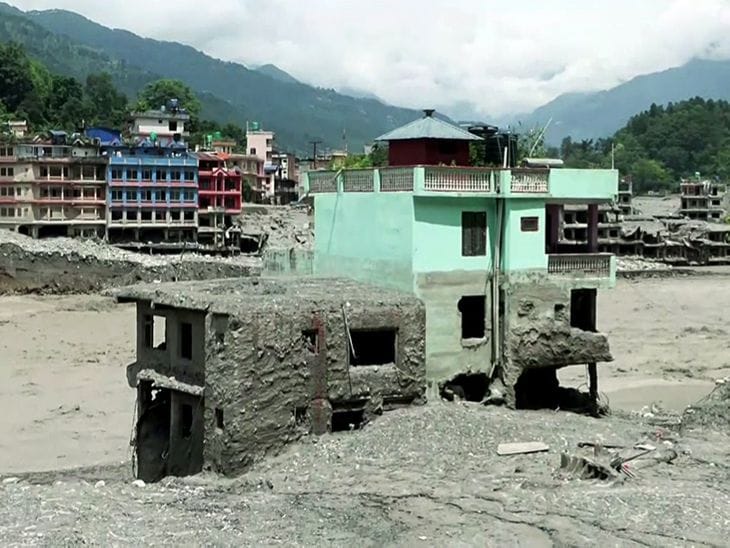
Nuwakot, Sep 1: A 40 year old green painted house in Nepal’s Nuwakot district has emerged as a striking symbol of survival after raging floodwaters of the Trishuli River swept away buildings, vehicles and belongings around it.
The house, owned by Prakash, remained largely intact even as the powerful current devastated the surrounding area. Six people, including Prakash and five family members, were inside when the flood struck.
Prakash was at his nearby shop when he received an alert about the rising water and rushed home to warn his family.
“I immediately ran towards the house. I went inside and called everyone, telling them to come quickly,” he recalled.
However, the situation deteriorated rapidly. After stepping outside, Prakash saw floodwaters overturning his vehicle and immediately ran back inside.
The family initially moved to the fourth floor, the highest regular floor of the building, but the water eventually reached that level too, forcing them to climb to the very top of the structure.
“The water came up to the fourth floor. After that, we went upstairs, to the very top floor,” Prakash said.
One of his sons was away at school when the flood hit, adding to his anxiety during the ordeal.
“Everyone was together, but one of my sons was not there. He had gone to school. I kept thinking about what would happen to him if something happened to us,” he said.
Prakash said the house’s survival was partly due to its strong construction and reinforced foundation. Built around four decades ago, the structure was specifically strengthened because of its proximity to the river.
“It is an old house, around 40 years old. At that time, the quality of cement and construction materials was better,” he said.
“We had also spent quite a lot on making the house strong because it was located close to the river,” he added, explaining that two or three layers of road material had been placed beneath the structure to reinforce its foundation.
While the main structure survived, the lower portion of the building, which housed a shop and warehouse, suffered extensive damage.
“A large amount of material was lost. Two vehicles were swept away, along with bikes and scooters. Everything was gone,” Prakash said.
The family remained trapped for around one to one-and-a-half hours before the water receded slightly. Residents from a nearby toll area then mounted a dramatic rescue operation, placing a pipe between buildings and using a rope to reach the family.
“Some people from the toll area came and placed a pipe between the buildings. They used the pipe and a rope to reach us from the other side. That is how we were rescued,” he said.
All six people inside the house survived the disaster. The family has since shifted temporarily to Kathmandu.
“Everyone is safe. We are currently staying in Kathmandu,” Prakash said.
Much of the family’s property, however, was destroyed or buried under mud, leaving them with the difficult task of rebuilding their lives.
“Whatever was here has either been destroyed or buried in the mud. We will now have to rebuild everything,” he said.
Asked whether he planned to rebuild and restart his life, Prakash responded with determination: “Yes, we will try to start again.”
The Nuwakot-Rasuwa road has also suffered severe damage, making access to the house difficult. People currently have to walk around 1.25 km from the nearest motorable point to reach the site.
Nepal Army personnel continue to assist with rescue and recovery operations in the affected area.
The green house, standing amid the devastation, has become a stark reminder of the extraordinary force of the floods — and the family’s desperate struggle to survive them.
