

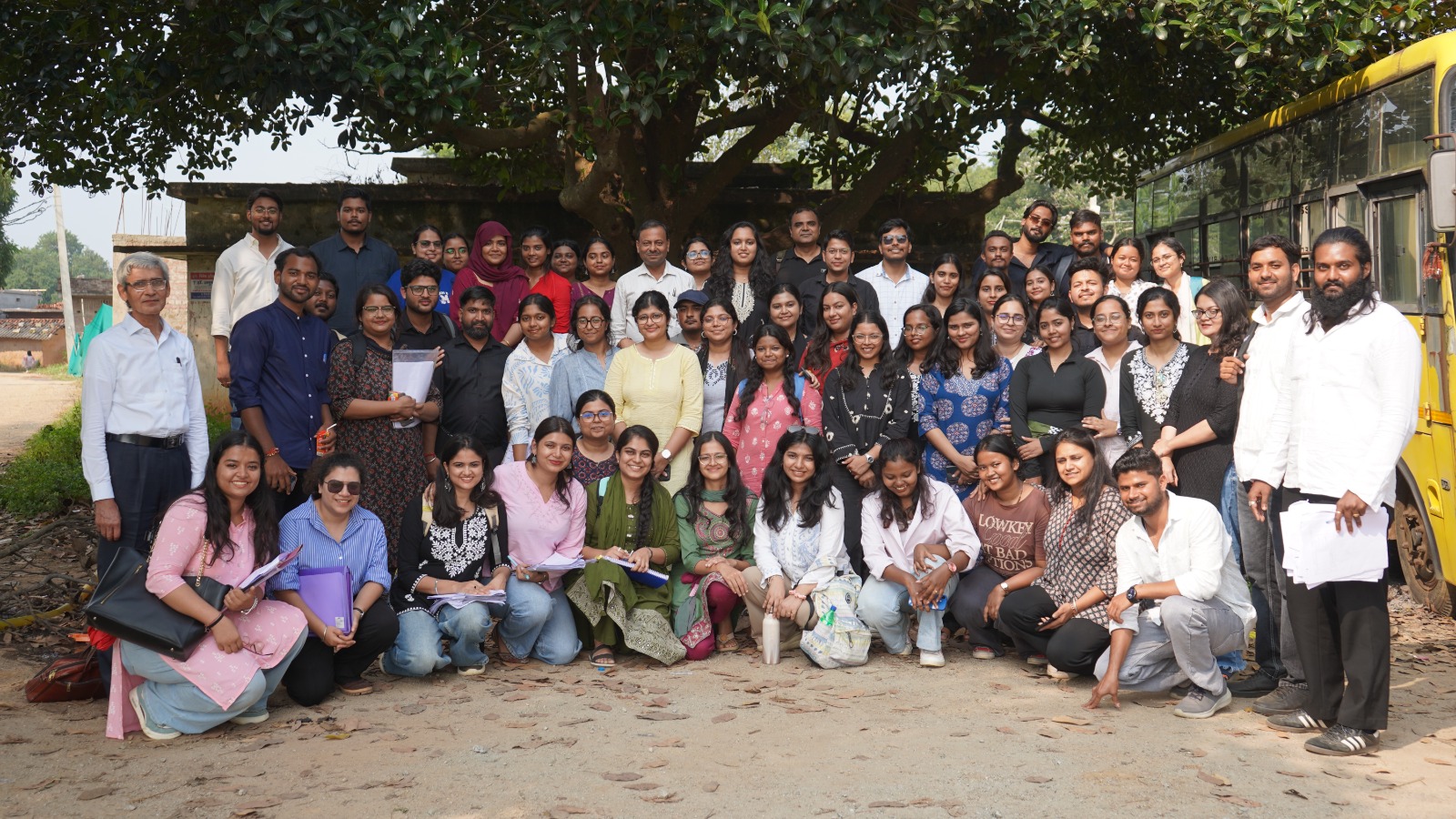
Ranchi, Oct 14: Around 64 students of the National University of Study and Research in Law (NUSRL), Ranchi, visited Chitarkota village in Ratu block of Ranchi district to study rural livelihoods, grassroots governance and the implementation of government welfare schemes as part of a research project.
The visit was conducted under the supervision of Dr. J. K. Pattnaik, Assistant Professor at NUSRL. Students were divided into groups and assigned topics covering Panchayati Raj institutions, education, healthcare, rural livelihoods and welfare schemes. They collected information through interviews, case studies and direct observation, interacting with villagers, families, the village Mukhiya, traditional village leaders, ASHA workers and ward members.
Chitarkota falls under Pali Gram Panchayat and is situated in a Scheduled Area, where the Panchayats (Extension to the Scheduled Areas) Act, 1996 (PESA), provides a framework for strengthening village-level self-governance.
Discussions with residents highlighted concerns over the availability of regular employment, with limited opportunities contributing to the migration of young people. Many families depend on agriculture and forest-based activities for their livelihoods. Access to quality education and healthcare also emerged as areas requiring attention.
At the Anganwadi centre, students observed its functioning and learned about nutrition-related services and the mid-day meal scheme. Interactions with ASHA workers and ward members provided information about local healthcare services and administrative mechanisms.
Discussions with the Mukhiya and traditional village leaders helped students understand how elected Panchayati Raj institutions and traditional leadership structures operate alongside each other. The interactions also highlighted varying experiences in accessing government welfare schemes. While some benefits had reached residents, limited awareness and procedural delays were identified as barriers to accessing entitlements.
The field visit gave students an opportunity to examine the functioning of the Gram Panchayat, Gram Sabha and welfare delivery mechanisms beyond the classroom. It also helped them develop research skills through interviews, documentation and case studies.
Dr. Pattnaik highlighted the importance of field-based engagement in legal education, noting that such exercises help students better understand the relationship between law, governance and society. The information gathered during the visit will be compiled into field reports and research work, with the potential to bring local concerns to the attention of the appropriate authorities.
During a concluding discussion, students suggested raising awareness of government welfare schemes, improving last-mile delivery of services, encouraging greater participation in Gram Sabha meetings and expanding educational opportunities for rural youth.
They also stressed the effective utilisation of existing government schemes, including the Mahatma Gandhi National Rural Employment Guarantee Act (MGNREGA), Ayushman Bharat and the Pradhan Mantri Awas Yojana (PMAY).
