

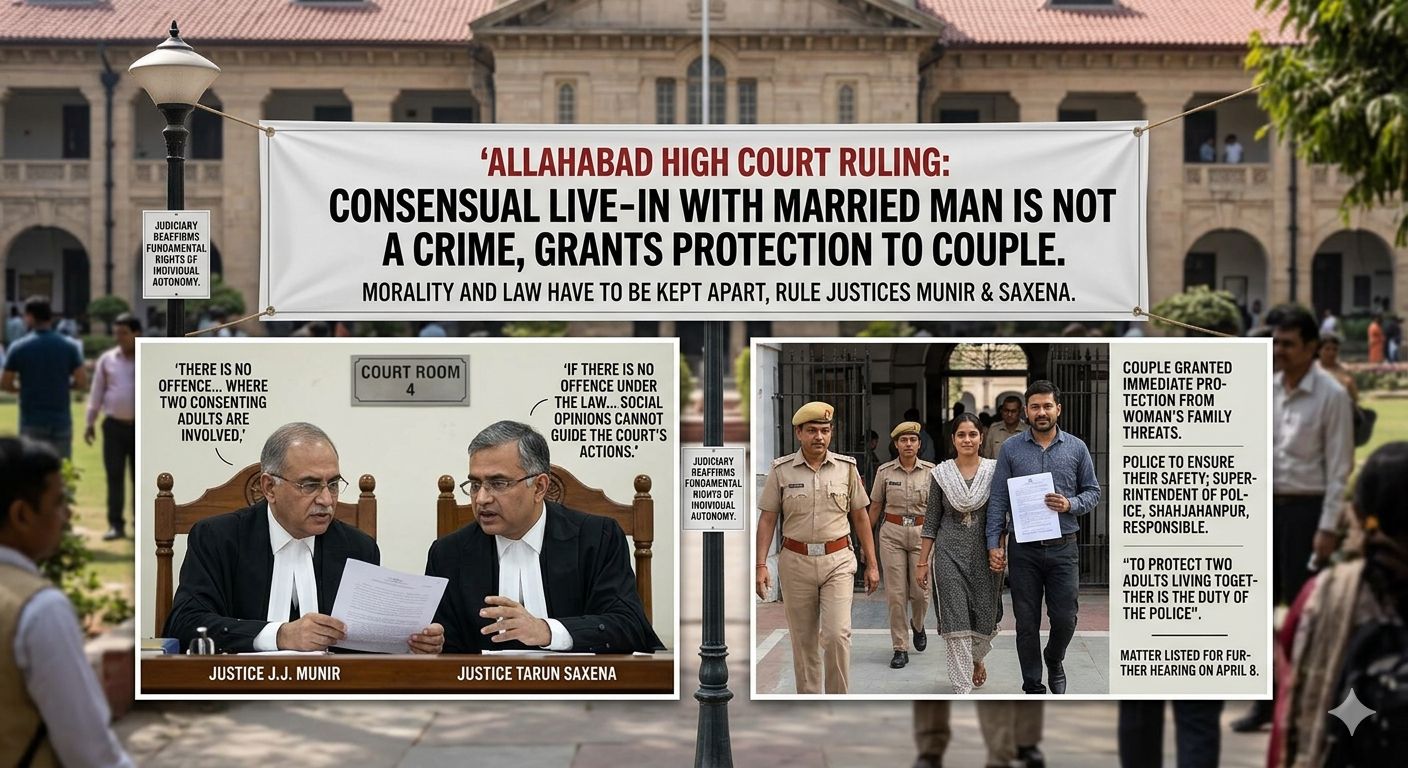
Prayagraj, Mar 27: The Allahabad High Court has ruled that a married man living in a consensual live-in relationship with an adult woman does not constitute a criminal offence, emphasising that courts cannot be guided by social morality in the absence of any violation of law.
A division bench comprising Justice J.J. Munir and Justice Tarun Saxena made the observation while granting protection to a couple facing threats from the woman’s family.
“There is no offence… where a married man, staying with an adult in a live-in relationship, by consent… can be prosecuted,” the bench said, underlining that the relationship between two consenting adults is not punishable under existing law.
Stressing the distinction between legal principles and societal perceptions, the court observed, “Morality and law have to be kept apart,” adding that “if there is no offence under the law… social opinions cannot guide the court’s actions.”
The case came before the court after the woman approached authorities stating she was living with her partner of her own free will but faced threats from her family, including apprehensions of “honour killing.” The court also took note of alleged inaction by the police despite prior complaints.
Directing immediate protection, the bench ordered that the couple should neither be harmed nor harassed and should not be arrested in connection with any related case, including a kidnapping complaint registered against them.
The court further restrained the woman’s family from contacting the couple, entering their residence, or causing any form of interference in their lives.
Holding law enforcement accountable, the bench said, “To protect two adults living together is the duty of the Police,” and made the Superintendent of Police, Shahjahanpur, personally responsible for ensuring their safety.
A notice has been issued to the Uttar Pradesh government, and the matter has been listed for further hearing on April 8.
The ruling reinforces the principle that individual autonomy and consent between adults take precedence over societal pressures, reaffirming the judiciary’s role in safeguarding fundamental rights.
