

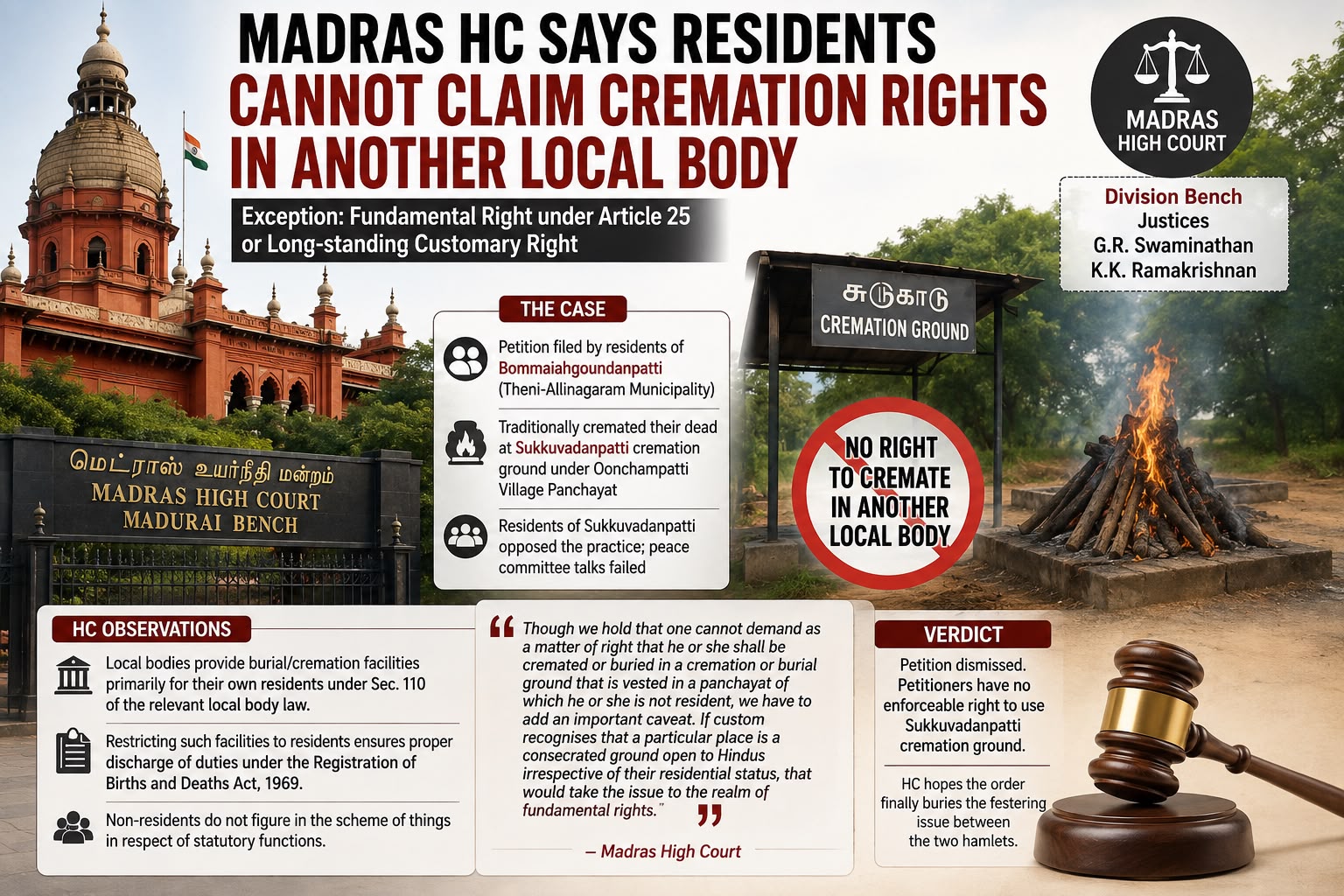
Madurai, July 18: The Madurai Bench of the Madras High Court has held that residents of one local body cannot claim a legal right to bury or cremate their dead in a burial or cremation ground vested with another local body, while clarifying that such a claim may be enforceable if it is protected as a fundamental right under Article 25 of the Constitution or is backed by a long-standing customary practice.
A Division Bench comprising Justices G.R. Swaminathan and K.K. Ramakrishnan delivered the ruling while dismissing a petition filed by residents of Bommaiahgoundanpatti in Theni-Allinagaram Municipality.
The petitioners contended that they had traditionally cremated their dead at the cremation ground in Sukkuvadanpatti, a hamlet under Oonchampatti Village Panchayat. They approached the court after residents of Sukkuvadanpatti objected to the practice and efforts to resolve the dispute through a peace committee failed.
The Bench observed that local bodies establish and maintain burial and cremation grounds primarily to meet the needs of their own residents as part of their statutory obligations under Section 110 of the relevant local body law. It further noted that restricting such facilities to residents also facilitates the proper discharge of statutory duties under the Registration of Births and Deaths Act, 1969.
At the same time, the court carved out an exception, stating that a claim could be sustained where a burial or cremation ground is recognised by custom as a consecrated place open to all Hindus irrespective of their place of residence, thereby bringing the issue within the ambit of fundamental rights under Article 25.
Holding that the petitioners had no enforceable right to use the Sukkuvadanpatti cremation ground, the Bench dismissed the petition and expressed hope that its decision would bring an end to the long-standing dispute between the two villages.
