

Roopak Goswami
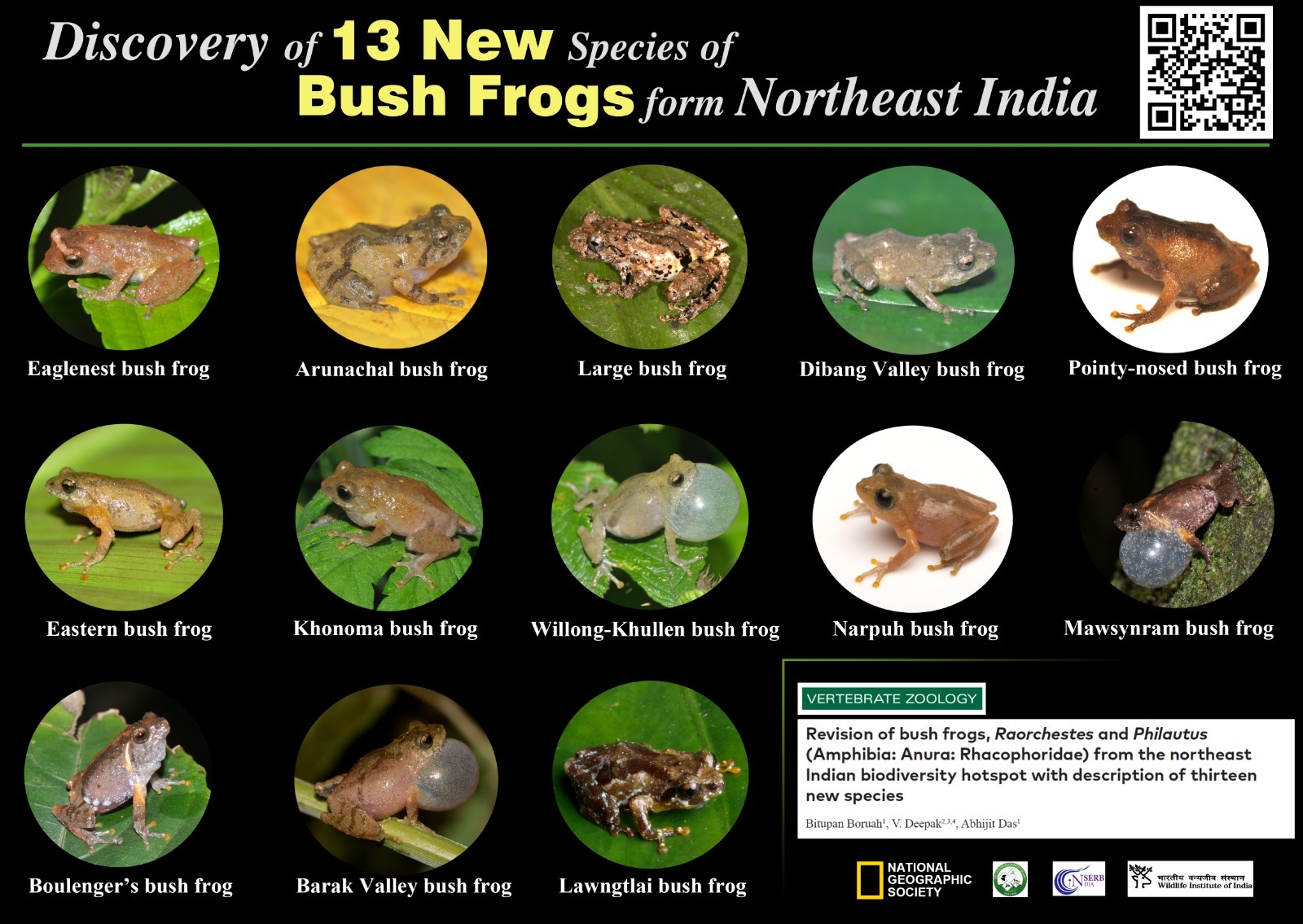
Guwahati, Nov 20: In a landmark discovery that reshapes India’s amphibian map, scientists have identified 13 new species of bush frogs across Northeast India. This is one of the most significant biodiversity findings in the region in recent years.
Published in Vertebrate Zoology, the discovery is the outcome of eight years of exhaustive fieldwork across the Northeast’s rugged mountains, deep valleys and cloud-drenched forests. The multi-year taxonomic investigation was led by Bitupan Boruah, PhD researcher at the Wildlife Institute of India (WII), along with herpetologist Dr. Abhijit Das (WII) and Dr. Deepak Veerappan of the Natural History Museum, London, and Newcastle University, UK.
Straddling the Himalaya and Indo-Burma biodiversity hotspots, Northeast India has long been suspected to harbour rich but largely undocumented amphibian diversity. Bush frogs, in particular, are notoriously cryptic: many species look nearly identical, making them extremely difficult to distinguish through appearance alone.
Of the 13 species described, six are from Arunachal Pradesh, three from Meghalaya, and one each from Assam, Mizoram, Nagaland and Manipur. Each species carries the signature of its home landscape:
• Raorchestes lawngtalaiensis — Ngengpui WLS, Mizoram
• Raorchestes barakensis — Barail WLS, Assam
• Raorchestes eaglenestensis — Eaglenest WLS, Arunachal Pradesh
• Raorchestes magnus — Dibang Valley, Arunachal Pradesh
• Raorchestes dibangensis — Mehao WLS, Arunachal Pradesh
• Raorchestes nasuta — Namdapha Tiger Reserve, Arunachal Pradesh
• Raorchestes orientalis — Namdapha Tiger Reserve, Arunachal Pradesh
• Raorchestes arunachalensis — Adi Hills, Arunachal Pradesh
• Raorchestes narpuhensis — Narpuh WLS, Meghalaya
• Raorchestes monolithus — Senapati District, Manipur
• Raorchestes khonoma — Khonoma, Nagaland
• Raorchestes boulengeri — Cherrapunji, Meghalaya
• Raorchestes mawsynramensis — Mawsynram, Meghalaya
The study stands out not only for the number of species discovered but for its rigorous, integrative methodology – combining DNA sequencing, acoustic analysis and detailed morphology to resolve long-standing taxonomic puzzles surrounding the tiny “tik…tik…” bush frogs that characterise the region’s nocturnal soundscape. The team also re-examined century-old specimens in international museums, correcting several historical misidentifications.
Field surveys spanned 81 localities across eight northeastern states, including 25 Protected Areas. Along with identifying new species, the researchers also revised the distribution of several known frogs, synonymised four previously described species, and pushed India’s bush frog tally from 82 to 95 species.
The findings carry major implications for conservation, as many newly described species are likely to be highly range-restricted and potentially vulnerable to habitat loss.
“This work underscores how much of Northeast India’s biodiversity still remains undocumented,” the authors write. “Integrative taxonomy is essential to reveal and protect the region’s hidden natural heritage.”
The study, conducted between 2019 and 2024, was supported by the National Geographic Society and the Meghalaya Biodiversity Board.