

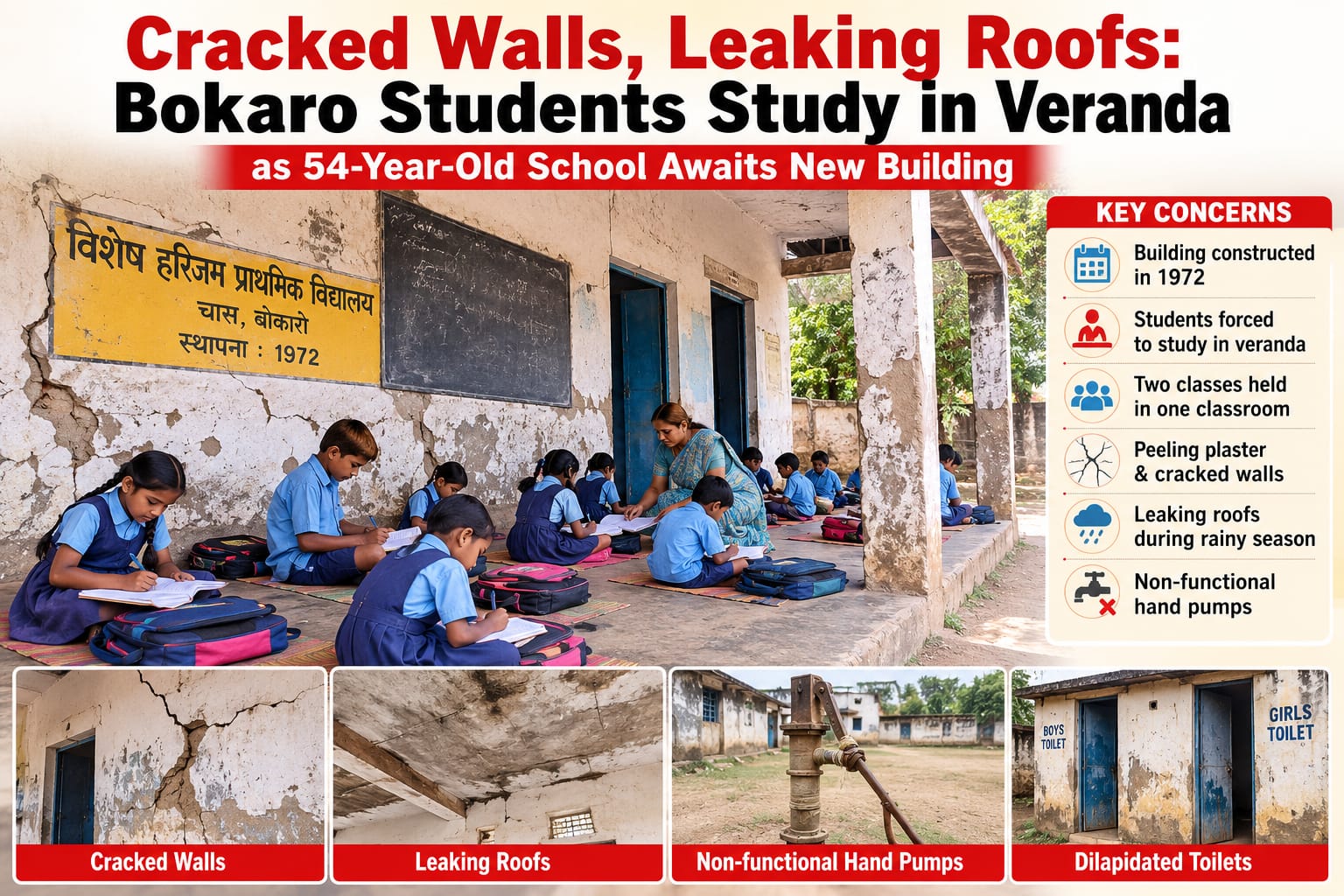
Bokaro, July 11: Children at the Special Harijan Primary School in Chas, Bokaro, are continuing their education in unsafe and inadequate conditions as the 54-year-old school building remains in a dilapidated state, forcing students to attend classes in a veranda and overcrowded classrooms while repeated requests for a new building remain pending.
Built in 1972, the government primary school has only two classrooms and a veranda for students from Classes I to V. Owing to the shortage of classrooms, two classes are conducted in a single room, while several students are made to study in the veranda, posing challenges for both teaching and learning.
The deteriorating infrastructure has further aggravated the situation. The school building has peeling plaster, cracked walls and leaking roofs, with rainwater seeping into classrooms during the monsoon, disrupting academic activities and raising safety concerns.
The school has 72 students, including nine in Class I, ten in Class II, 14 in Class III, 21 in Class IV and 18 in Class V. They are taught by two government teachers and one assistant teacher, who have to manage multiple classes simultaneously due to the lack of adequate infrastructure.
Basic civic amenities at the school are also inadequate. Both hand pumps installed on the campus are non-functional, forcing the school to rely on piped drinking water supplied from a deep borewell located near a temple. Although separate toilets for boys and girls are available, the toilet structures are also in a dilapidated condition. The school’s kitchen is too small, with limited land restricting its expansion.
Acting Principal Manjula Kumari said the condition of the school building has been a long-standing concern. “The school building is old. Water leaks from the roof during the rainy season. The walls are cracked,” she said.
She added that the school management has repeatedly approached the authorities for a new building. “Three letters have been sent to the department requesting a new building. Due to a lack of space, students have been accommodated in the veranda,” she said, adding that drinking water is currently supplied through pipelines from a nearby deep borewell.
Apart from infrastructure issues, the school management has also sought a change in the institution’s name. Despite representations to the Education Department and requests from various social and political organisations, no decision has been taken so far.
With repeated appeals for improved infrastructure and a new school building yet to yield results, students and teachers continue to carry out academic activities under the shadow of unsafe classrooms, leaking roofs and inadequate facilities.
