

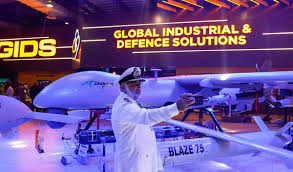
NEW DELHI/ISLAMABAD, May 28 – A deadly cross-border escalation earlier this month has thrust India and Pakistan into a new arms race centred on drones, as both nuclear-armed neighbours ramp up investment in unmanned aerial vehicles (UAVs) following their first large-scale drone conflict, officials and analysts say.
The fighting erupted after a militant attack in Indian-administered Kashmir on April 22 killed 26 people, most of them Indian tourists. India blamed the assault on Pakistan-based militants and launched retaliatory air strikes on May 7. In response, Pakistan deployed swarms of drones the following night to probe Indian air defences across 36 locations along the 1,700-kilometre border.
Between 300 and 400 drones were involved in the offensive, Indian officials said. The drone clashes marked a historic first in the countries’ decades-long conflict, which has traditionally involved artillery shelling, fighter jets and missile deployments.
Though a ceasefire was brokered by the United States days later, military and industry sources in both countries say the skirmishes have triggered an acceleration in drone development and procurement.
India plans to triple its UAV spending to approximately $470 million over the next 12 to 24 months, according to the Drone Federation of India, an industry body representing over 550 firms. The increase follows the government’s recent approval of $4.6 billion in emergency defence procurement funding.
“Drone manufacturers are now being called in at an unprecedented pace for trials and demonstrations,” said Vishal Saxena, vice president at Indian drone company ideaForge Technology (IDEF.NS), which has supplied over 2,000 UAVs to Indian forces.
The Indian military reportedly used Israeli-made HAROPs, Polish WARMATE drones and domestic loitering munitions in precision strikes during the conflict. Many incoming Pakistani drones were intercepted by Cold War-era anti-aircraft guns retrofitted with modern radar systems from state-run Bharat Electronics (BAJE.NS), Indian officials said.
“Ten times better than what I’d expected,” said retired Indian Brigadier Anshuman Narang, now a UAV analyst at the Centre for Joint Warfare Studies in New Delhi.
Pakistan, facing financial constraints and limited numbers of high-end fighter jets, is leaning heavily on UAVs as a low-risk, cost-effective alternative. It deployed Turkish-origin YIHA-III and Asisguard Songar drones and domestically produced Shahpar-II UAVs during the fighting, according to Pakistani sources.
Islamabad is expanding cooperation with China and Turkey to boost its drone capabilities. The National Aerospace Science and Technology Park, in collaboration with Turkish defence contractor Baykar, can now assemble drones locally in just two to three days, a Pakistani official said.
India’s reliance on UAV components from China — including lithium batteries and magnets — remains a strategic vulnerability. Four Indian drone makers acknowledged the risk of potential supply chain disruption, particularly in times of geopolitical tension.
“The weaponisation of the supply chain is a concern,” said Saxena. “Diversification is essential, but not something that can be achieved overnight.” Analysts warn that while drone warfare reduces the risk of immediate large-scale escalation, it is not without danger.
“UAVs allow leaders to demonstrate resolve without risking pilots, but their use in contested or populated areas could still provoke serious consequences,” said Walter Ladwig III, a political scientist at King’s College London.
Despite significant losses on both sides, officials say the advantages of drones — including precision, scalability and reduced cost — make them a growing fixture in South Asia’s military strategies.
“This is the beginning of a new chapter in regional warfare,” said Michael Kugelman, a South Asia expert based in Washington. “Drones may not have the shock value of fighter jets, but they offer power and deniability — a potent combination for both New Delhi and Islamabad.”