

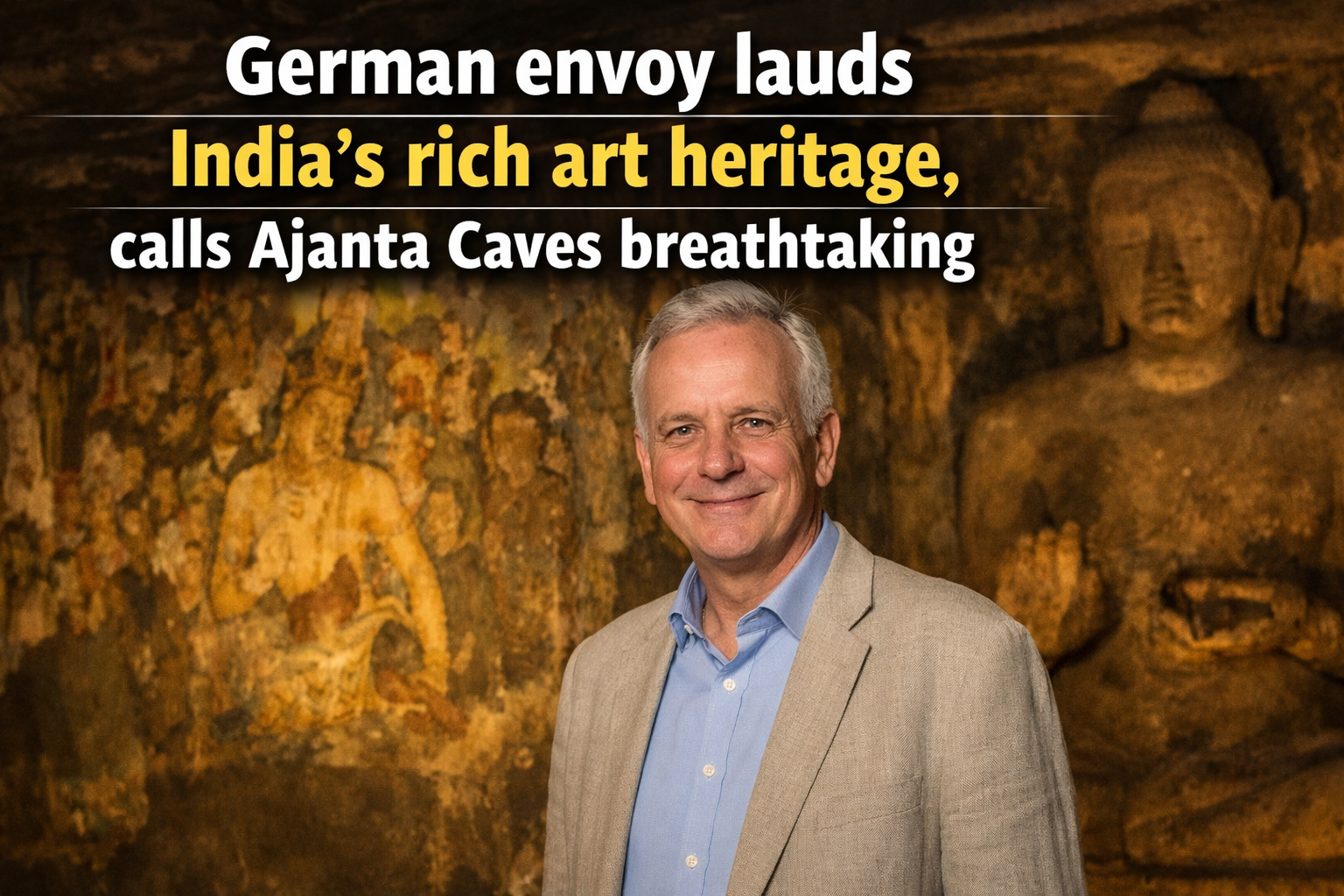
New Delhi, Jan 5: German Ambassador to India Dr Philipp Ackermann, an art historian by training, has expressed deep admiration for India’s rich artistic and cultural heritage, describing art as a powerful medium that can also strengthen diplomacy between nations.
Ackermann, who studied Art History and Economics in Europe and earned his doctorate in art history in 1993, said his personal engagement with Indian art extends beyond professional interest. His official residence in Delhi reflects this passion, featuring Makrana marble flooring — the same marble used in the Taj Mahal — and a Chola bronze Nataraja sculpture gifted to the German ambassador in 1955.
The envoy also actively promotes contemporary Indian art, hosting curated works by young Indian artists at his residence, with exhibitions changing every six months.
Among India’s artistic treasures, Ackermann said the Ajanta Caves left the strongest impression on him, describing the early Buddhist frescoes as vibrant, sensual and rich in narrative. He also termed Humayun’s Tomb the most perfect example of Indian architecture, citing its clarity of form and striking contrast between marble and red sandstone.
A strong admirer of South Indian sculpture, Ackermann praised Chola bronzes for their advanced metalwork, refinement and aesthetic excellence. He also expressed appreciation for India’s living craft traditions, frequently visiting Dastkar and Nature Bazaar, and singled out Warli tribal art from Maharashtra for its strong bond with nature and everyday life.
Emphasising that civilisations and art forms are deeply interconnected, the ambassador pointed to historical cultural exchanges between India, Southeast Asia and Europe. He highlighted European influence on Indian art through examples such as Srinath Pichwai paintings, which he said draw inspiration from 17th-century Dutch landscape prints.
For art enthusiasts, Ackermann recommended the MAP Museum in Bengaluru for its focus on modern and popular Indian art, and the Bihar Museum in Patna as a world-class institution offering insights into the evolution of Hindu, Buddhist and Jain art traditions.
He also underscored the role of art in diplomacy, noting that artistic empathy can help diplomats better understand and engage with their counterparts.
Ackermann said he is currently reading Anirudh Kanisetti’s History of the Chola Empire and Arundhati Roy’s Mother Mary Comes to Me, both of which, he said, offer valuable perspectives on Indian history and society.
