

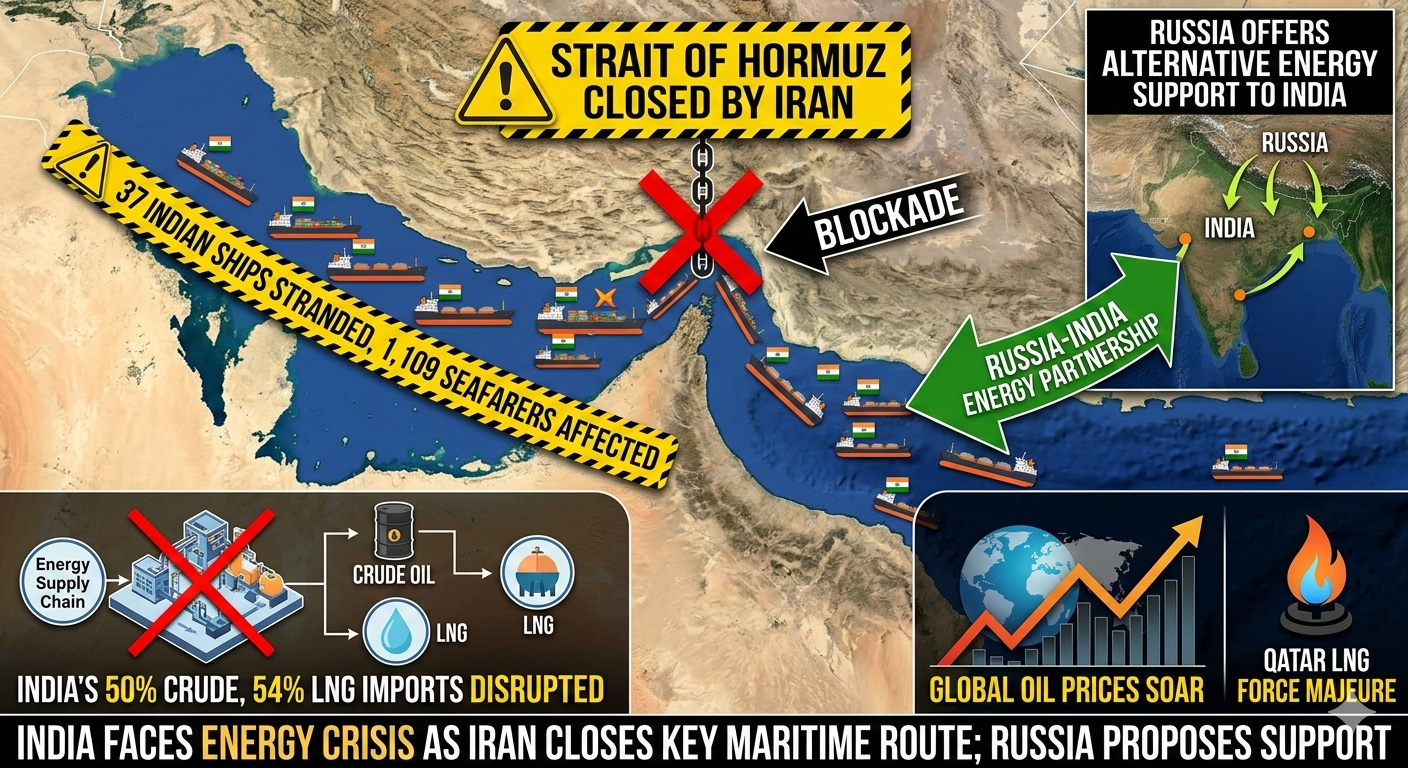
New Delhi March 3: As many as 37 Indian-flagged ships carrying 1,109 seafarers are stranded in the Persian Gulf, the Gulf of Oman and adjoining sea areas after Iran blocked the Strait of Hormuz amid escalating military tensions involving the United States and Israel.
The closure of the strategic maritime route — one of the world’s most critical energy corridors — has triggered a sharp rise in global oil prices and raised concerns over energy security, particularly for countries like India that depend heavily on the route for energy imports.
According to officials, some of the stranded vessels are carrying crude oil and liquefied natural gas (LNG) to Indian ports, while others are en route to Gulf nations to load petroleum products.
“A total of 37 Indian-flagged ships with 1,109 sailors are stuck in the Persian Gulf, the Gulf of Oman and adjoining sea areas due to the closure of the key shipping route through the Strait of Hormuz,” an official aware of the development told PTI.
The Strait of Hormuz, which connects the Persian Gulf and the Gulf of Oman, handles nearly one-fifth of the world’s traded oil. India imports around 50 per cent of its crude oil and about 54 per cent of its LNG through this route, making the disruption a serious concern for the country’s energy security.
Amid the crisis, Russia has offered to assist India with energy supplies if disruptions occur due to the ongoing conflict in West Asia.
The Ministry of External Affairs warned of the broader economic impact of the situation, saying India’s trade and energy supply chains pass through the region.
“Our trade and energy supply chains also traverse this geography. Any major disruption has serious consequences for the Indian economy,” the ministry said.
The Shipping Ministry has set up a dedicated quick response team to coordinate with authorities and provide assistance to Indian seafarers and their families. The Directorate General of Shipping is also closely monitoring the situation and maintaining contact with shipping companies.
Shipping firms and recruitment agencies have been advised to exercise caution in crew deployment and maintain regular communication with seafarers and their families, while helpline numbers have been activated for support.
Meanwhile, the conflict has also resulted in casualties, with at least three Indian seafarers on foreign-flagged vessels reported killed and one injured.
In a related development, LNG supplies from Qatar have been affected after the country halted production and declared force majeure following an Iranian drone strike. Qatar accounts for nearly 40 per cent of India’s annual LNG imports of around 27 million tonnes.
Officials said the disruption has already led to supply cuts of up to 40 per cent for some Indian industries.
Shipping Minister Sarbananda Sonowal chaired a high-level review meeting to assess the evolving security situation in the Persian Gulf region. Authorities are coordinating closely with the Indian Navy, the Ministry of External Affairs, the Information Fusion Centre–Indian Ocean Region, the Maritime Rescue Coordination Centre and Indian missions abroad to safeguard Indian maritime assets and personnel.
