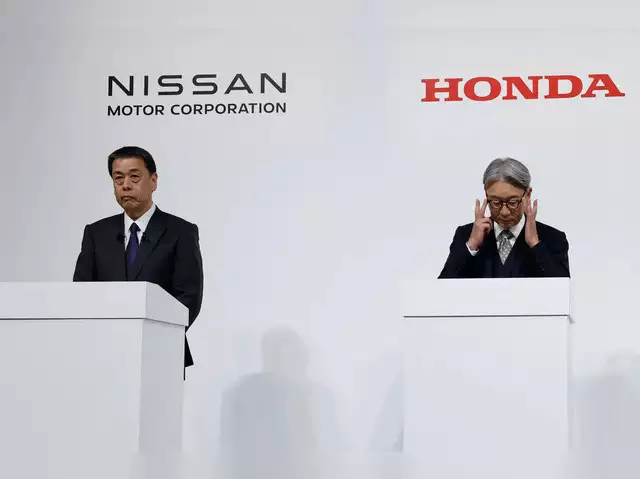
Tokyo, Dec 25: Honda Motor Co.’s plan to absorb Nissan Motor Co. could create the scale needed to take on China’s BYD Co., according to sales data released on Wednesday. However, both Japanese automakers are struggling individually, underscoring the urgency of their potential merger.
In the first 11 months of 2024, Honda sold 3.43 million cars globally, while Nissan sold just over 3 million. In comparison, China’s largest automaker, BYD, sold 3.76 million vehicles in the same period. The figures highlight the challenges Honda and Nissan face separately, yet combined, they could pose a stronger challenge to the Chinese giant, as The Economics Times.
Both automakers have been grappling with stiff competition in China, the world’s largest car market, which surpassed Japan as the leading car exporter last year. The market is expected to further widen the gap in 2025.
Honda, which has faced a significant drop in Chinese sales, reported a 28% year-on-year decline in November and a 38% reduction in output. Similarly, Nissan’s sales in China fell 15.1% last month, while production dropped by 26%. In a broader global context, Honda’s sales in November slipped 6.7%, while production tumbled 20.4%. Nissan’s sales dropped 1.3%, and production fell 14.3%.
The merger is seen as essential to strengthen Honda and Nissan’s position in a rapidly evolving market, where both brands have been scaling back production and staff. Mitsubishi Motors Corp., another Japanese automaker, has essentially pulled out of China.
However, any efforts to catch up in the market could be hampered by Honda’s significant ¥1.1 trillion ($7 billion) stock buyback announced earlier this week. S&P Global warned that such large-scale repurchases could limit Honda’s ability to reinvest in its business. Honda has set the upper limit of the buyback at 24% of issued shares, though its stock rose 0.8% on Wednesday.
While Honda and Nissan struggle in China, Toyota Motor Corp., the world’s largest automaker, also faces pressures. Toyota reported a slight 0.2% drop in global sales in November, totaling 984,348 units, while production fell 9.4%. The company’s production in China, however, only declined by 1.6%. The global slowdown, coupled with regulatory challenges and recall-related output cuts, have compounded Toyota’s struggles.
Toyota, like Honda and Nissan, is contending with increasing competition from Chinese automakers, especially in the electric vehicle segment. As Chinese-made EVs flood markets, Toyota’s dominance in Southeast Asia is under threat. Despite these challenges, Toyota’s shares gained 4.4% after a Nikkei report revealed the company’s plans to double its return-on-equity target to 20%, a move that has reassured investors.
Should Honda and Nissan successfully merge, the combined force could intensify the competitive pressure on Toyota, while also helping to curb the growing influence of China’s BYD on the global automotive stage. However, the road ahead remains uncertain as both brands work to recover from a year marked by declining sales and production cuts.