

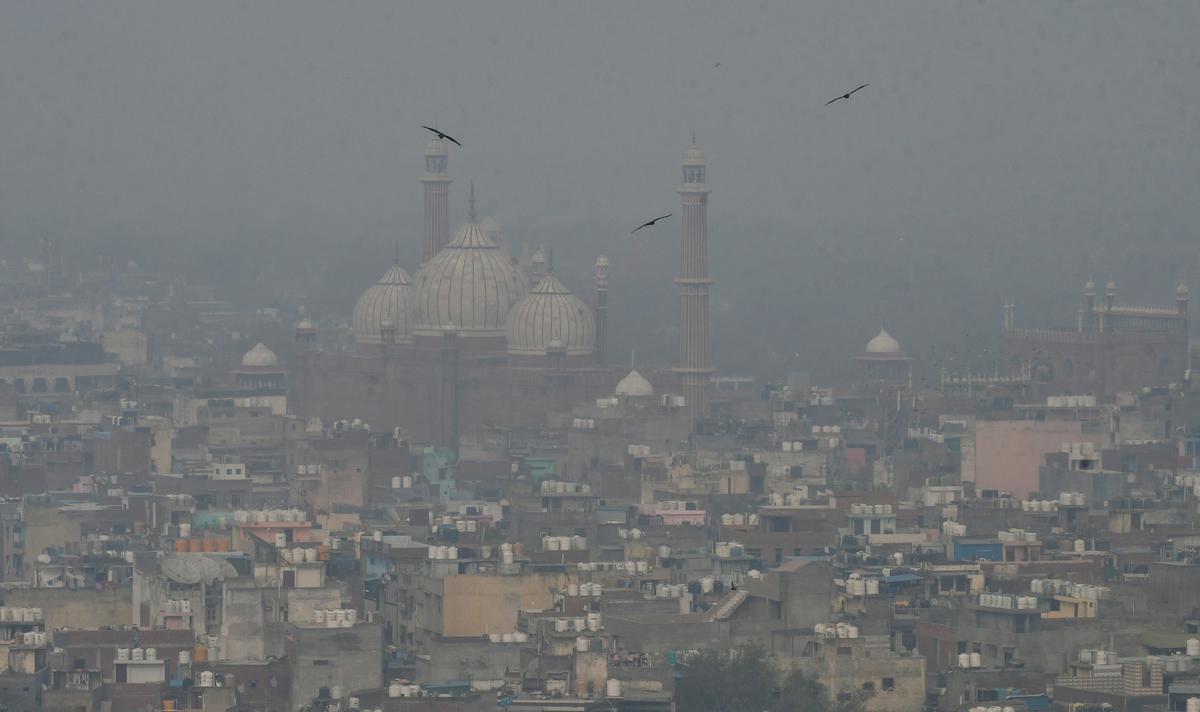
New Delhi, Dec 12: Delhi woke up to a thick layer of toxic smog on Friday as the city’s average Air Quality Index (AQI) touched 329 at 7 am, placing it firmly in the “Very Poor” category, according to data from the Air Quality Early Warning System (EWS) of the Indian Institute of Tropical Meteorology and the Central Pollution Control Board (CPCB).
A heavy build-up of dense smog, PM2.5 and PM10 particles and stagnant atmospheric conditions led to severely reduced visibility across several parts of the national capital. Officials said low wind speeds and calm atmospheric mixing prevented pollutants from dispersing, allowing them to accumulate close to the surface. Dense fog is expected to persist through the day, further complicating commuting conditions and contributing to continued pollution build-up.
Several parts of Delhi recorded AQI levels much higher than the city’s average. Anand Vihar and Ghazipur reported AQI readings of 386, while Wazirpur logged 382, Sonia Vihar 338, and Dhaula Kuan 337. Bawana, one of the worst-hit localities, recorded 365, keeping it deep in the “very poor” zone. In contrast, NSIT Dwarka reported an AQI of 269, falling under the “poor” category. Similar weather and pollution conditions were observed in neighbouring Haryana, where Karnal recorded a minimum temperature of 7°C amid dense fog.
Health experts cautioned that prolonged exposure to toxic air could worsen respiratory and cardiovascular ailments. Vulnerable groups, including children, the elderly and those with pre-existing health conditions, face heightened risks. They advised residents to limit outdoor activity, wear protective masks when stepping outside and use air purifiers indoors. Schools and eldercare centres have also been urged to take additional precautions, especially during early mornings and late evenings when pollution levels peak.
The AQI scale ranges from 0 to 500 and is divided into six categories — “good,” “satisfactory,” “moderate,” “poor,” “very poor” and “severe.” Even air in the “satisfactory” range can affect sensitive groups, while “moderate” pollution levels may trigger breathing difficulties in people with asthma, lung disease or heart issues.
