

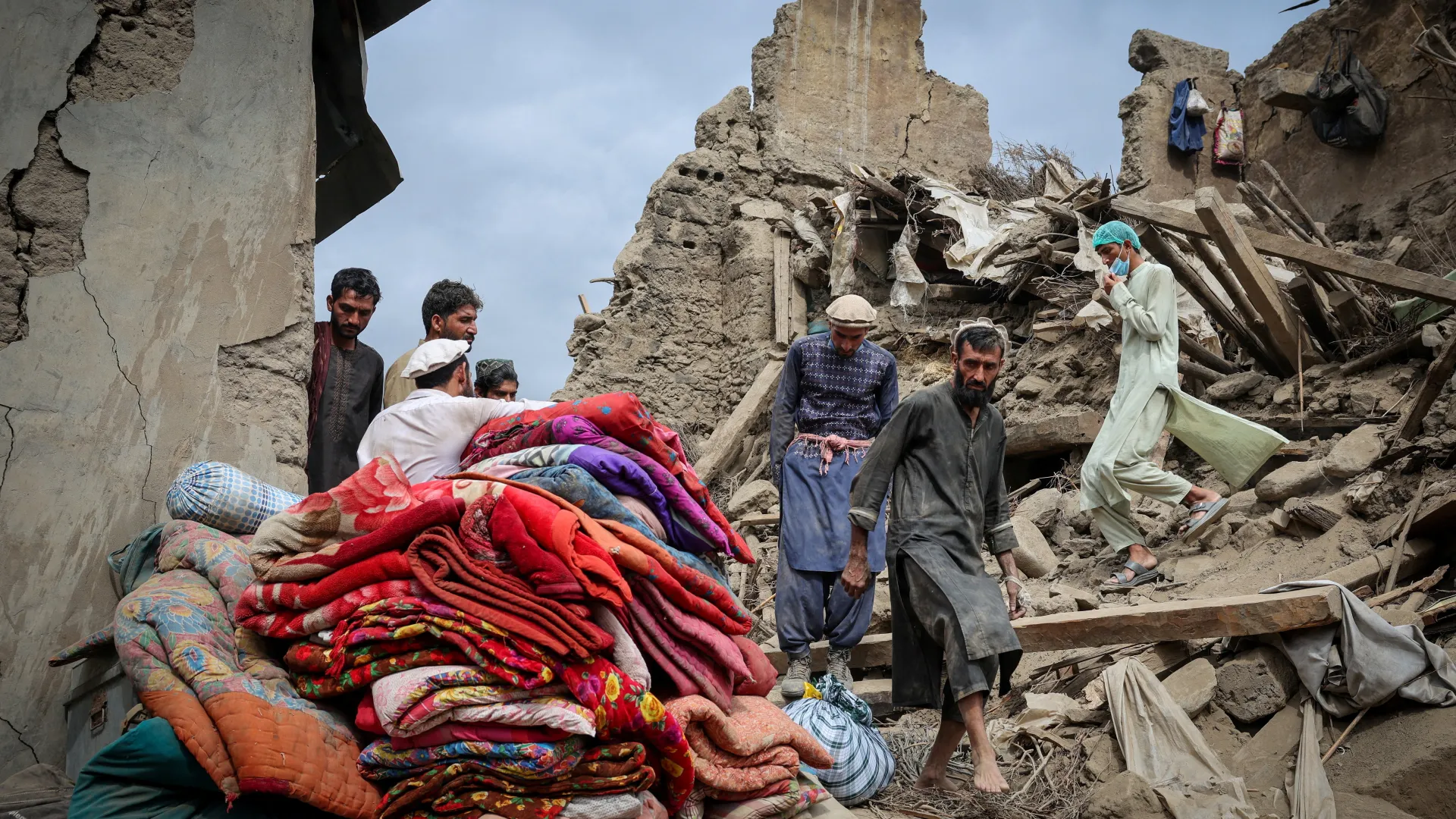
Kabul, November 4: A powerful 6.3 magnitude earthquake struck near the northern Afghan city of Mazar-e-Sharif early on Monday, killing at least 20 people, injuring hundreds and damaging the city’s historic Blue Mosque, officials said, warning that the death toll could rise as rescue efforts continue.
The U.S. Geological Survey (USGS) said the quake occurred at a depth of 28 km (17.4 miles) near Mazar-e-Sharif, a city of more than half a million residents known for its shrines and centuries-old Islamic architecture.
According to the Afghanistan National Disaster Management Authority, at least 20 people were killed and 643 injured, including 25 in critical condition. Local authorities said the quake caused severe damage in Tashqurghan district, close to the epicentre, and left several buildings in ruins.
“Rescue and health teams have reached the affected areas, and hospitals have been placed on emergency alert,” Health Ministry spokesperson Sharfat Zaman said.
Footage released by the Afghan Ministry of Defence showed military rescue teams pulling victims from the rubble. Reuters could not independently verify the location or date of the videos.
The United Nations mission in Afghanistan (UNAMA) said it was assisting with rescue efforts. “We stand with the affected communities and will provide necessary support,” the mission said in a post on social media platform X.
India, which has recently sought to re-engage diplomatically with the Taliban government, also announced humanitarian assistance. “Indian relief material for the earthquake-impacted communities is being handed over today. Further supplies of medicines to reach soon,” Foreign Minister Subrahmanyam Jaishankar said on X.
Officials said part of the Blue Mosque, one of Afghanistan’s holiest and most iconic landmarks, was damaged. The mosque, built in the 15th century, is believed to house the tomb of Ali ibn Abi Talib, the cousin and son-in-law of the Prophet Mohammad. Footage shared online showed broken masonry and tiles scattered across its courtyard, though the main structure remained intact.
The quake disrupted power supplies across several provinces, including the capital Kabul, according to the Da Afghanistan Breshna Company, the national power utility.
Aid group Save the Children said the earthquake adds to Afghanistan’s worsening humanitarian crisis, with winter approaching and many families still displaced by earlier disasters. “As temperatures fall, thousands of children in the earthquake-devastated east are already facing the winter with only tents for protection. Now, families in the north are also experiencing fear and uncertainty,” said Samira Sayed Rahman, a programme director with the group.
Afghanistan, which sits on two active fault lines, is highly vulnerable to seismic activity. More than 2,200 people were killed in an earthquake and strong aftershocks that struck the east of the country in August 2025.
The latest disaster compounds the challenges facing the Taliban administration, already struggling with economic isolation, declining foreign aid, and mass deportations of Afghan refugees from neighbouring countries.
