

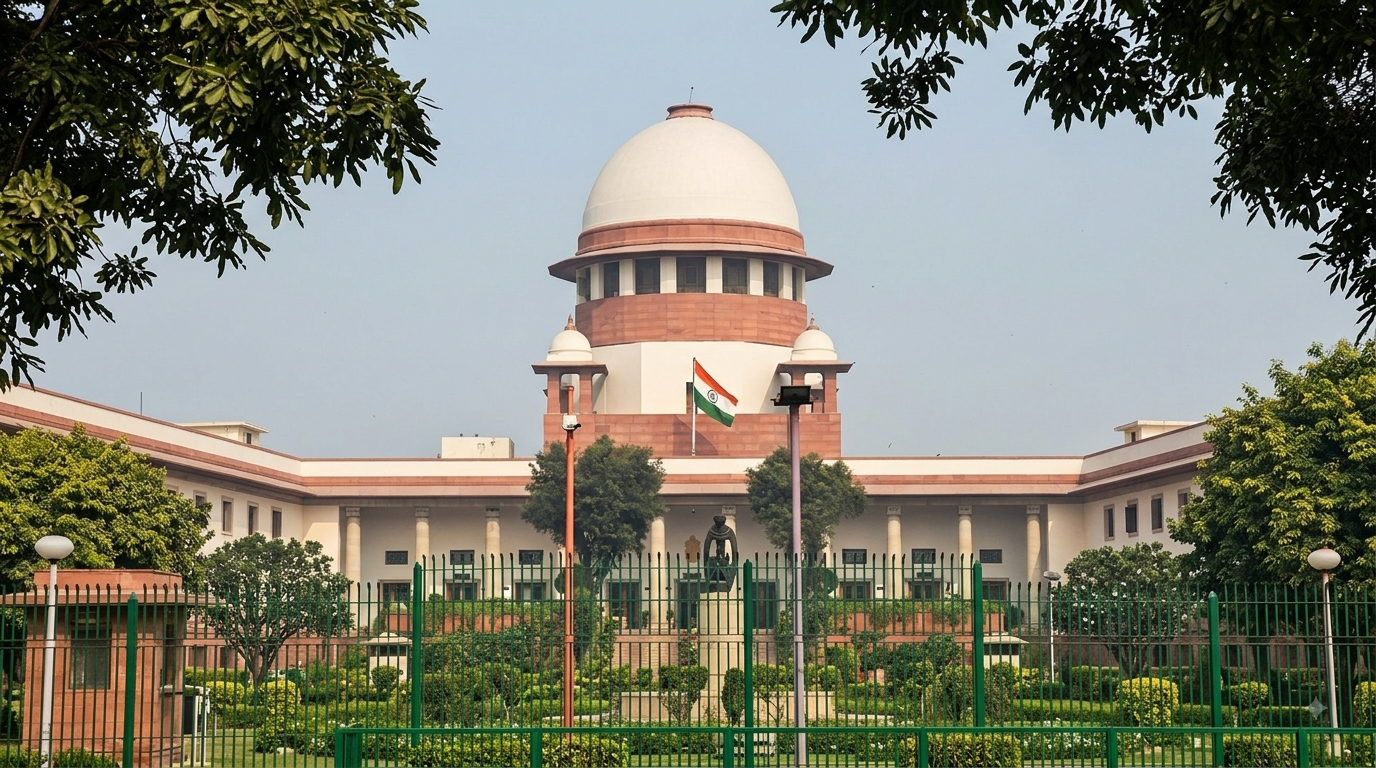
New Delhi, Aug 12: The Supreme Court on Wednesday criticised the repeated extension of a temporary law protecting unauthorised colonies, slums and constructions in Delhi, observing that it has contributed to “ad-hocism” in the governance of the national capital and could hinder efforts to restore the Yamuna.
A bench of Justices Manoj Misra and Manmohan raised concerns over the continued operation of the National Capital Territory of Delhi Laws (Special Provisions) Act, 2006, while hearing proceedings related to the preparation of a comprehensive Yamuna Action Plan (YAP).
“See how ad-hoc this city is being governed. You have a Master Plan for Delhi and it has not been allowed to be implemented for 20 years,” the bench observed.
The 2006 legislation was originally introduced as a temporary measure to provide protection from sealing and demolition to certain unauthorised colonies, slums and constructions. It has since been extended several times, with the latest extension continuing the protection until December 31, 2026.
The bench warned that such statutory protection could make implementation of the proposed Yamuna Action Plan difficult.
“If you bring the Yamuna Action Plan, the entire exercise will be futile if you are not able to implement it,” the court remarked.
Additional Solicitor General Aishwarya Bhati informed the court that the Master Plan for Delhi 2047 had been tabled and finalised. The bench, however, questioned the manner in which the capital had been governed over the past two decades.
“You cannot govern a city like this. For 20 years, Delhi is not allowed to have a Master Plan,” it said.
Senior advocate K Parmeshwar, assisting the court as amicus curiae, said the committee headed by the Union Home Secretary had prepared a draft Yamuna Action Plan pursuant to the court’s May 21 order, but more time was required to finalise it.
He also agreed to examine concerns regarding the implementation of the plan in view of the protections under the 2006 Act and submit suggestions.
Justice Manmohan, recalling his experience as acting Chief Justice of the Delhi High Court, referred to a case involving a slum in Nizamuddin West that allegedly obstructed the natural flow of water into the Yamuna.
According to the judge, the obstruction contributed to backflow during the monsoon and flooding in areas such as Maharani Bagh. Attempts to remove the settlement, he said, were opposed by the political administration by citing the 2006 Act.
“There is a statutory prohibition prescribed by the Act. Unless it is interfered with, no action plan can be implemented,” the bench said.
The court also observed that the normal life of a Master Plan is around 20 years and expressed concern that Delhi’s planning process had effectively remained frozen during the period.
In its May 21 order, the court had highlighted the deteriorating condition of the Yamuna, observing that encroachments on the riverbed, particularly in the fragile Zone ‘O’ of Delhi, along with toxic industrial effluents, untreated sewage and the mixing of sewage with rainwater drains had reduced the river to “little more than a sewage channel”.
The court had called for an integrated approach to the river’s conservation, noting that several government agencies were working in silos or sometimes at cross purposes.
It had directed the YAP committee to include the chief secretaries of all states and Union territories through which the Yamuna flows, the heads of their respective State Pollution Control Boards and the amicus curiae.
The court had also stressed that difficult measures, including removal of encroachments, closure of illegal industries and relocation of unauthorised colonies, may be unavoidable for meaningful restoration of the river.
Such measures, it said, would require the Union government, states and Union territories to act together.
The proposed Yamuna Action Plan is to be framed as a long-term, integrated strategy along the lines of the Namami Gange Programme, with clearly defined objectives, implementation mechanisms, responsibilities of various agencies, budgetary allocations and timelines.
The Supreme Court granted the committee additional time to finalise the plan and posted the matter for further hearing on September 22.
