

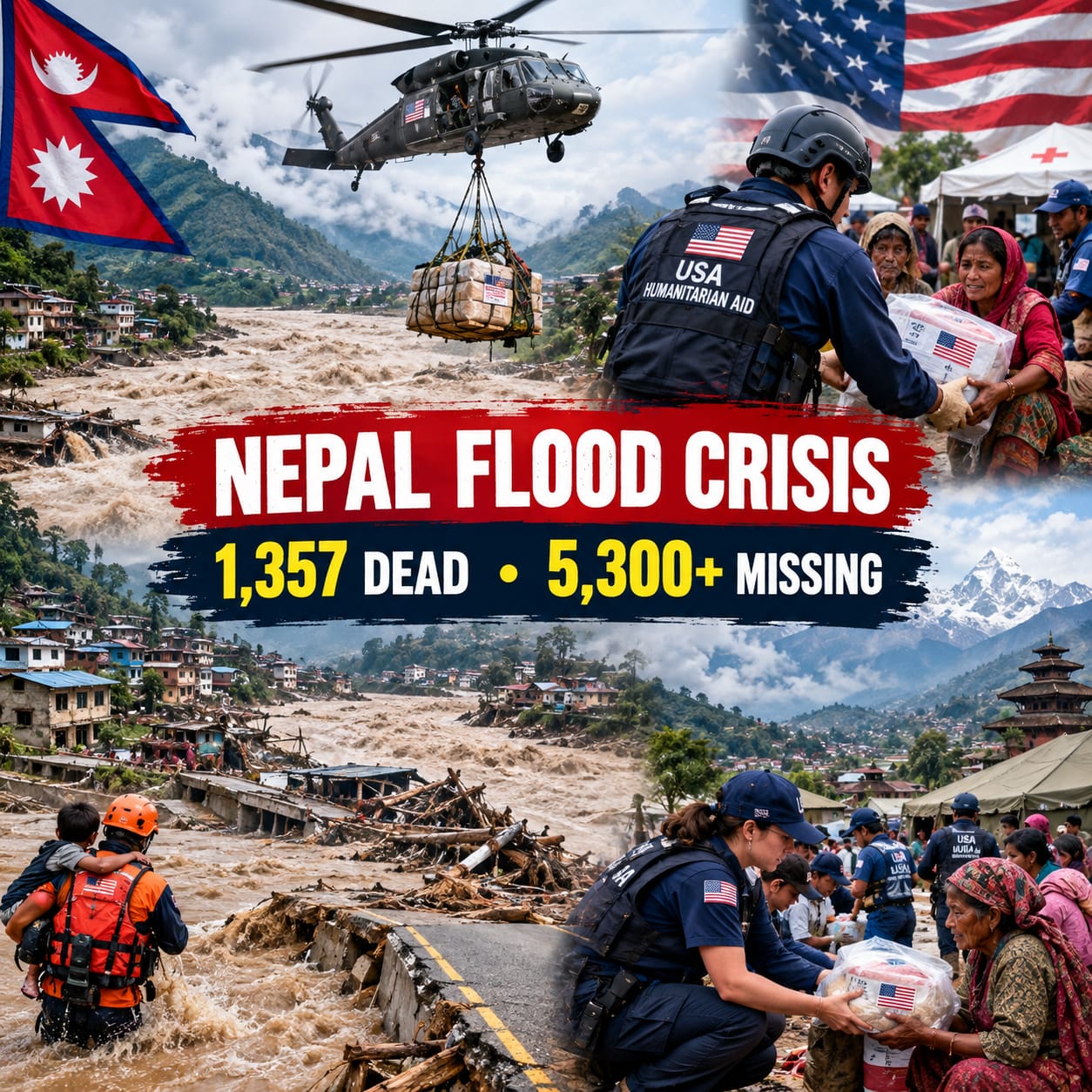
Kathmandu, Sep 8: The United States has stepped up support for Nepal’s flood rescue and recovery operations, sending senior diplomat Megan Bouldin to Kathmandu as the death toll from the devastating August 26 disaster climbed to 1,357, with more than 5,300 people still missing.
Bouldin has been appointed Charge d’Affaires at the US Embassy in Kathmandu for the next few months and will work with Deputy Chief of Mission Scott Urbom to coordinate the embassy’s efforts in response to the disaster, particularly assistance to US citizens affected by the floods.
“She will work with DCM Urbom to lead the US Embassy efforts in response of Nepal’s flood response and recovery, with a focus on assisting US citizens affected by the flood,” the embassy said in a statement.
Nearly 64 US nationals are among those reported missing, as rescue teams continue operations across areas devastated by the flash floods and landslides.
The United States has also pledged USD 500,000 in emergency grant assistance for flood victims in Rasuwa, one of the areas badly affected by the disaster.
The US Embassy said Bouldin’s deployment reflected Washington’s “sustained commitment to working closely with the government of Nepal and partners as relief and recovery efforts continue”.
Bouldin, a career member of the senior foreign service, arrives in Nepal from the US Embassy in Dhaka, where she had served as Deputy Chief of Mission since August 2024. She has previously handled diplomatic and crisis-management assignments in Ukraine, Iraq, Bangladesh and Washington.
According to Nepal’s disaster authority, 5,326 people remain missing nearly two weeks after the disaster. Authorities are continuing to verify reports from different parts of the country to establish a more accurate figure.
“We have been compiling reports and verifying them. That is what has caused the increase in the number,” disaster authority assistant spokesman Prakash Pokhrel said.
“We are trying to get to a number that is close to reality,” he added.
The disaster was triggered by an ice-rock or glacial avalanche near the China-Nepal border, causing the Bhotekoshi River to surge downstream. The resulting devastation swept away homes, vehicles, roads and bridges and caused extensive damage to hydropower projects.
Rescue teams are now concentrating on at least three hydropower projects where workers are believed to remain trapped inside tunnels.
The rescue of three workers from tunnels in recent days has offered a glimmer of hope. Two Nepali workers were rescued on Friday and a Chinese national was pulled out on Saturday, raising hopes that more people could still be alive.
“Our search and rescue operation is ongoing,” disaster authority chief Dharam Raj Uprety said.
“We are hoping that there might still be survivors in at least three projects, and we are pushing our operations there,” he said.
Nepal has received assistance from foreign experts, including teams from China, India and South Korea, as rescue and recovery efforts continue in difficult terrain.
The country’s Foreign Ministry has also said it has not abandoned hopes of finding survivors.
“Hopes of finding survivors remain, and the reported number of people missing inside the tunnels remains unverified,” it said.
The scale of the disaster has overwhelmed local facilities, with mortuaries reportedly overflowing. Authorities have buried hundreds of bodies in mass graves after collecting DNA samples to facilitate identification at a later stage.
In neighbouring China, 43 people have been confirmed dead and 519 remain missing, according to state media. The combined toll from the disaster in Nepal and China has therefore reached 1,400 dead and 5,845 missing.
The disaster has also renewed concerns over the impact of climate change on mountain communities. Scientists have warned that accelerating glacial melt could increase the risk of glacial and mountain-related disasters, although the exact cause of the collapse remains unclear.
Nepal, a predominantly rural country of around 30 million people that contributes relatively little to global greenhouse gas emissions, is facing a massive reconstruction challenge that could cost billions of dollars.
Relief teams are also struggling to reach isolated communities because of damaged infrastructure and hazardous terrain.
David Fisher of the International Federation of Red Cross and Red Crescent Societies described access routes as “narrow and dangerous”.
“Every delay means families wait longer for the support they urgently need,” Fisher said.
With rescue teams continuing to search for survivors and authorities still working to verify the missing-persons figures, Nepal’s immediate priority remains locating those trapped or unaccounted for while delivering urgent assistance to communities cut off by the disaster.
