

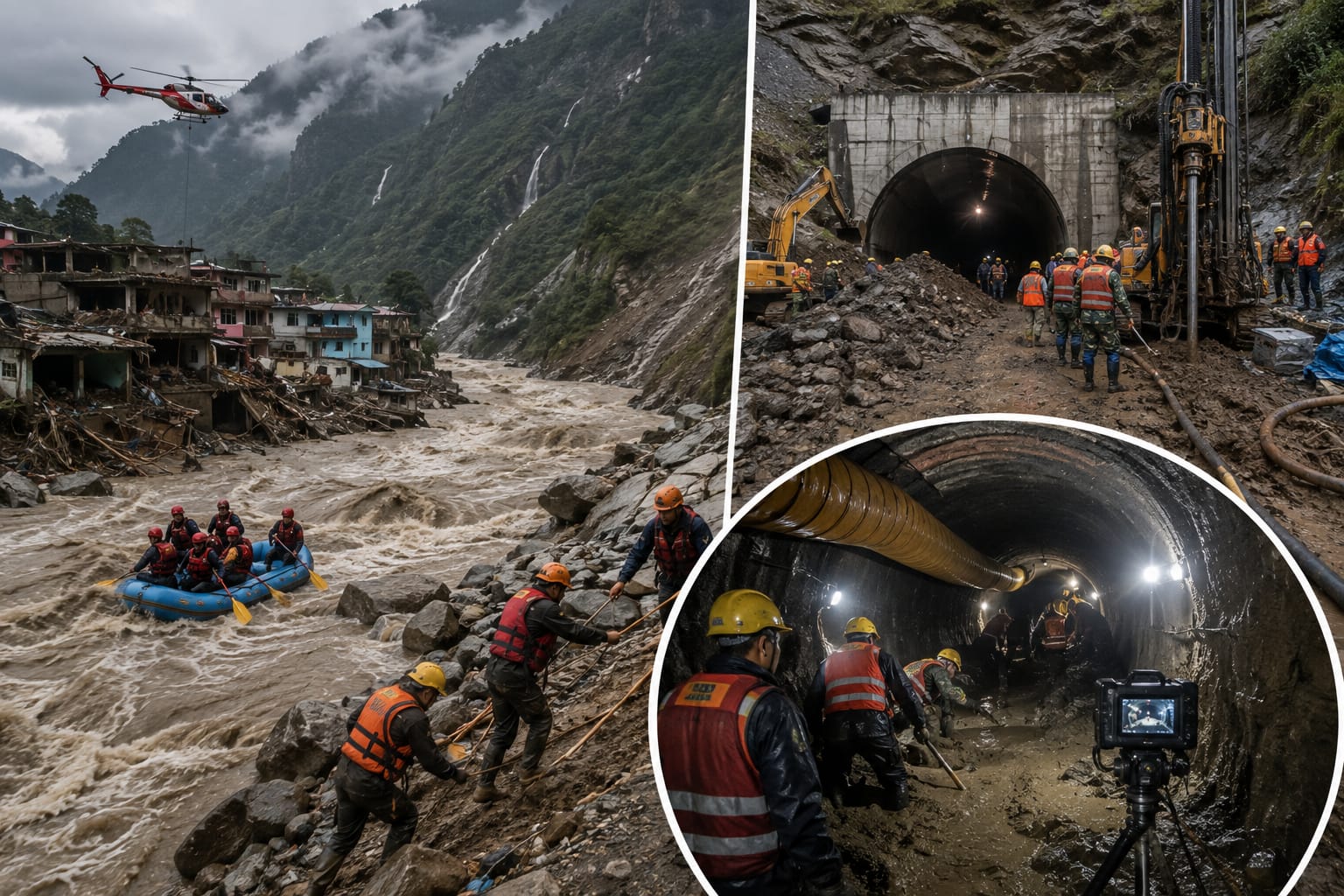
Kathmandu, Aug 31: Rescue operations in Nepal intensified on Monday as the death toll from the devastating August 26 flash floods rose to 903, with more than 4,200 people still missing and hundreds feared trapped inside debris-filled hydropower tunnels.
Nepalese authorities said 4,247 people remain missing, while Chinese authorities reported 16 deaths and 546 missing persons in Tibet. The combined number of missing people across Nepal and Tibet is now nearly 4,800.
Rescue teams have turned their focus to around half a dozen hydropower project tunnels where workers are believed to be trapped beneath massive quantities of mud, rocks and other debris.
According to Nepal’s National Disaster Risk Reduction and Management Authority, 933 hydropower workers were among those reported missing. Nearly 300 workers, including several Indian nationals, have so far been rescued.
The Trishuli 3A and 3B hydropower projects have emerged as key rescue sites. At Trishuli 3A, teams drilled through the upper portion of a mud-filled tunnel, pumped air inside and sent a camera into the structure to search for survivors.
“A large amount of debris has been deposited and that is posing us a big challenge to open the tunnels,” Nepal Army spokesperson Raja Ram Basnet said.
“Our main focus is on opening the tunnels,” he added.
The floods were triggered by what scientists believe was the collapse of part of a glacier near the Langtang Lirung peak. The massive surge of ice, rock, water and debris entered the Lende River before sweeping through several districts of Nepal.
Rescue efforts have been repeatedly hampered by difficult terrain, rain and rising river levels. Two large barrier lakes also formed during the floods, with one overflowing and temporarily forcing rescue operations to halt.
“As the floodwaters have receded, the team has resumed efforts to locate the tunnel entrance using drilling machines, excavators, hydraulic cutters and other equipment,” the Nepal Army said.
Researchers have warned that the barrier lakes could pose a fresh threat to people working in downstream hydropower tunnels and power stations. A sudden surge of water could potentially trap or injure workers and flood survivors in the area.
“If a sudden flood rushes down, it could slam into these tunnels and power stations, trapping or injuring anyone who is still there,” said Nitesh Khadka, a Nepali researcher and physical geographer specialising in glacial floods.
International assistance has also expanded, with Nepal accepting help from India and China after initially rejecting foreign assistance.
China has mobilised more than 2,100 rescue workers and provided at least 220 million yuan (around USD 33 million) in relief support, besides air-dropping equipment and supplies to rescue teams.
India has deployed 18 Army officers trained in tunnel rescue operations and six teams of forensic experts to assist with DNA-based identification of victims. It has also sent humanitarian supplies, including portable generators, food, medicines, tents, blankets, water pumps and water purification tablets.
The Indian Army is additionally supplying Bailey bridges to help rescue teams reach areas cut off after highways and bridges were washed away.
International relief assistance has also come from the United Nations, the Red Cross Federation, Australia, South Korea and the United States.
Nepal Prime Minister Balendra Shah described the floods as an “unprecedented and devastating natural disaster”.
“Despite the adverse weather, difficult terrain and continuing risks, we are moving forward with determination to save the lives of our citizens,” Shah said.
With thousands still unaccounted for and rescue teams facing unstable terrain, blocked tunnels and the threat of further flooding, authorities are racing against time to locate survivors and identify victims.
