

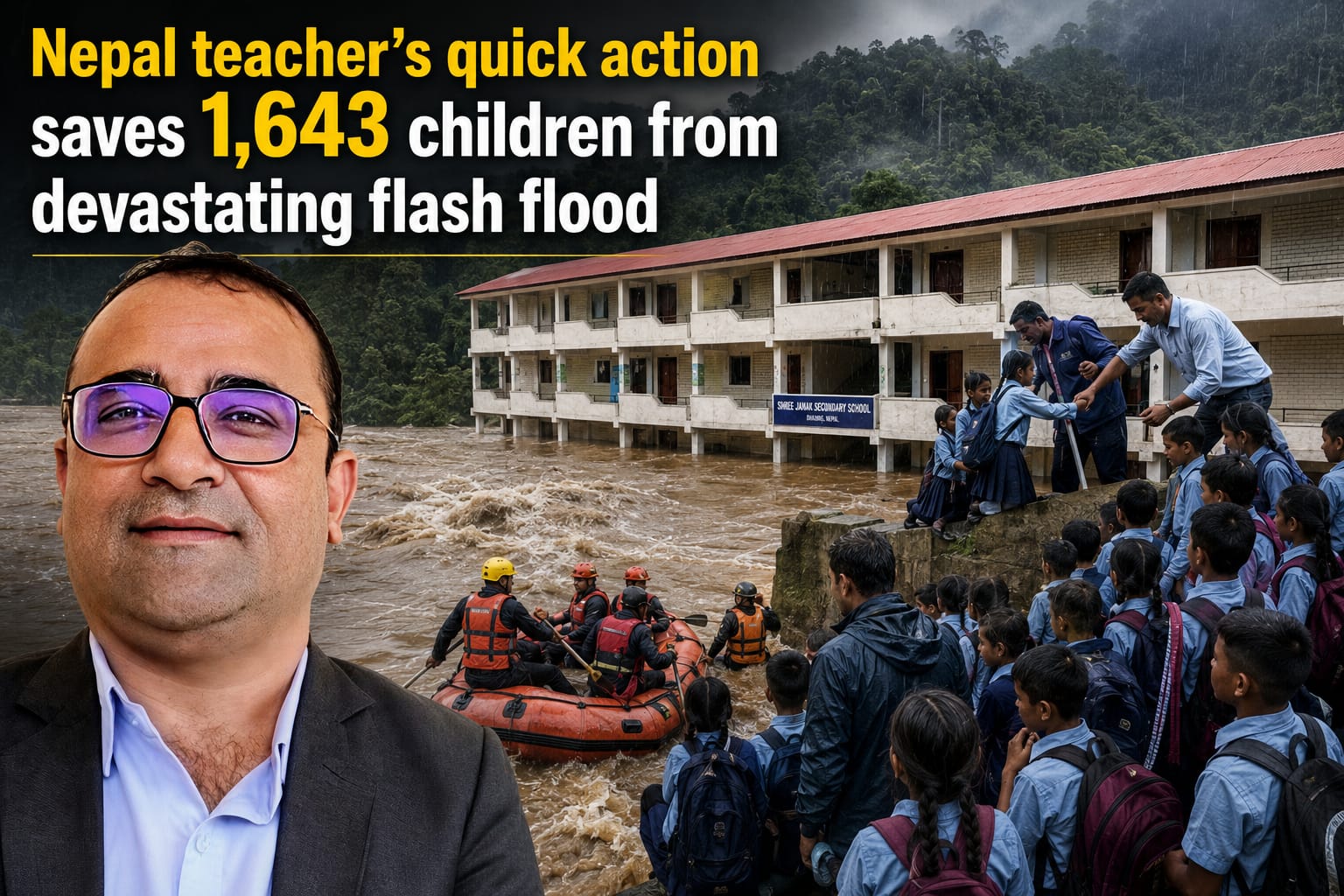
Kathmandu, Aug 30: A Nepali school principal’s quick thinking and decisive action saved the lives of 1,643 children when a devastating flash flood tore through the Trishuli Valley, sweeping away their school and leaving a trail of destruction.
Rajendra Dawadi, 47, principal of Tribhuvan Trishuli Secondary School and an English teacher, received an urgent warning from a friend at around 9:20 am that the village had been swept away by the river and floodwaters were heading towards the school.
“He said the village was gone: taken by the river. He told me to run,” the warning conveyed to Dawadi said.
With only minutes to act, Dawadi rang the school bell and ordered teachers to evacuate classrooms. He also contacted school bus drivers and instructed all but one to turn back as the danger became increasingly apparent.
The students began fleeing the school on foot, with Dawadi following them. One girl suffered a panic attack and was taken uphill on a motorbike, while the remaining children moved towards safer ground.
The children eventually took shelter beneath a bodhi tree, even as powerful floodwaters surged through the area and swept away the school buildings.
Dawadi’s intervention ensured that all 1,643 students and all but one member of the teaching staff survived the disaster.
Two school staff members, however, were killed. Social history teacher Santos Pariyar, 32, was washed away after returning to his rented room near the river to cook breakfast. School janitor Sultan Lama also died after returning to the premises to close the doors.
The three-storey concrete school, located around 60 metres above the river, was eventually destroyed by the force of the floodwaters.
The flash flood was triggered when a massive chunk of ice and rock broke away from Langtang Lirung peak and plunged around 1,200 metres into the steep upper gorge of the Lhende Khola river near the Tibet border.
Daniel Shugar, a geomorphologist at the University of Calgary, estimated that the ice-and-rock mass covered nearly 50 acres, an area roughly comparable to London’s Green Park.
Although locals have hailed Dawadi as a hero, he has played down his role.
“What else could I do?” Dawadi said while surveying the muddy ruins of the school.
The wider disaster has killed more than 750 people in Nepal, with around 2,498 people still missing. Another 546 people are reported missing in Tibet’s Gyirong County.
The tragedy has also brought back memories of the region’s devastating past. In 2015, a magnitude 7.8 earthquake killed 8,962 people across South Asia and triggered an avalanche that buried all 300 residents of Langtang in the flood-hit Rasuwa district.
As rescue and relief operations continue, Dawadi’s actions have emerged as a remarkable story of courage and quick decision-making amid one of Nepal’s worst recent natural disasters.
