

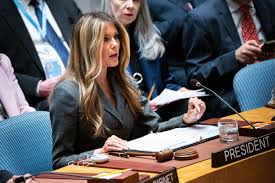
Washington, 3 March: In a first for the United Nations, US First Lady Melania Trump formally presided over a United Nations Security Council session on children and education in conflict, as the United States held the Council’s rotating presidency for March.
The high-level meeting, titled “Children, Technology, and Education in Conflict,” unfolded against the backdrop of ongoing US military operations in Iran — a development that prompted sharp criticism from Tehran.
Opening the session, the First Lady underscored the role of education in conflict-affected societies, calling it essential to “advancing tolerance and world peace.” She stressed that the United States “stands with all of the children throughout the world” and voiced hope that peace would soon prevail for those caught in war zones.
Trump also offered condolences to American service members killed in recent operations, stating, “Their bravery and dedication will always be remembered,” while wishing a “swift and smooth recovery” to those injured.
The session marked the first time a First Lady has formally chaired a Security Council meeting, underscoring the symbolic weight Washington sought to attach to the issue of children’s protection during armed conflict.
Stark Warnings from the UN
Briefing the Council, Rosemary DiCarlo, Under-Secretary-General for Political and Peacebuilding Affairs, warned that children remain among the most vulnerable when violence escalates.
“When conflicts erupt, children are among those most severely affected,” she said, describing the debate as occurring at “a moment of exceptional relevance.”
DiCarlo highlighted alarming figures: 234 million children living in conflict-affected areas require educational support, and 85 million are entirely out of school. She noted that schools across Israel, the United Arab Emirates, Qatar, Bahrain and Oman have recently shifted to remote learning due to regional hostilities.
She also referenced reports from Iran alleging that an elementary school in the town of Minab was struck over the weekend, resulting in heavy casualties.
Tehran Pushes Back
Iran’s envoy to the UN, Amir Saeid Iravani, sharply criticized Washington’s leadership of the session.
“It is deeply shameful and hypocritical that on the very first day of its presidency of the Security Council, the United States convened a high-level meeting on protecting children,” he said.
Iranian officials have blamed the United States and Israel for the reported strike in Minab. US Central Command said it was reviewing the claims, while Israel’s military stated it was not aware of any operations in the area.
US Secretary of State Marco Rubio rejected allegations of intentional targeting of civilian infrastructure, stating, “The United States will not deliberately target a school.”
Technology as Lifeline — and Risk
Beyond the geopolitical tensions, the debate centered on the dual role of technology in conflict zones. UN officials described digital learning tools as a vital bridge for children cut off from classrooms. However, they cautioned that without safeguards, online platforms can expose children to recruitment by armed groups, exploitation, and widening inequality.
Diplomats broadly agreed that while remote learning offers temporary relief, durable solutions depend on strengthened child protection systems, sustained international investment in education, and ultimately, the restoration of peace.
As the Council session concluded, the political divisions were evident. Yet the central theme — the protection of children’s right to learn amid war — remained a rare point of universal acknowledgment in an otherwise polarized chamber.
