

Kyiv/Washington, May 3 – Ukrainian President Volodymyr Zelenskyy has described a newly finalized minerals agreement with the United States as “historic,” emphasizing that the deal now represents an equal partnership and opens the door to significant investment and modernization in Ukraine’s economy.
In his nightly address, Zelenskyy said the agreement had been substantially revised during negotiations and was shaped in part by a meeting with U.S. President Donald Trump at the Vatican, held on the sidelines of Pope Francis’s funeral.
“The agreement has changed significantly during the preparation process. It is now truly an equal partnership – one that creates opportunities for substantial investment in Ukraine, as well as significant modernisation of Ukraine’s industries and, equally importantly, its legal practices,” Zelenskyy said.
Ukrainian economists and officials hailed the outcome as a rare negotiating victory. Tymofiy Mylovanov, president of the Kyiv School of Economics, said Ukraine had resisted “overreaching demands” and managed to remove provisions that would have required repayment of previous U.S. military aid — a clause Trump had repeatedly pushed for.
The Kremlin did not officially respond to the agreement, but former Russian President Dmitry Medvedev claimed it demonstrated Ukraine’s weakness, saying Trump had “broken the Kyiv regime” by forcing it to exchange mineral resources for military support.
In Washington, U.S. Treasury Secretary Scott Bessent said the deal showed there was “no daylight” between the American and Ukrainian people, sending a message of unity to Moscow. “It gives President Trump the ability to now negotiate with Russia on even a stronger basis,” Bessent said in an interview with Fox Business Network.
The Trump administration, which had suspended all military aid to Ukraine after taking office, approved its first arms sale to Kyiv this week. A State Department notification to the U.S. Senate confirmed a proposed license to export $50 million or more in defense equipment and services.
In a related move, the State Department announced that Julie Davis, currently ambassador to Cyprus, will lead the U.S. embassy in Kyiv during what it called a “critical moment” for peace efforts. Davis previously served as ambassador to Belarus and as deputy to NATO.
Meanwhile, European Union foreign policy efforts continue alongside U.S. moves. French Foreign Minister Jean-Noel Barrot said on Thursday the EU was preparing a 17th round of sanctions against Russia, which would be coordinated in timing and substance with Washington. “Putin remains the sole obstacle to peace,” Barrot said.
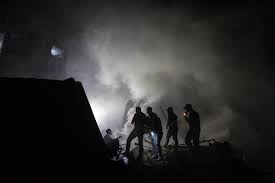
On the battlefield, a Russian drone strike hit the southeastern Ukrainian city of Zaporizhzhia late Thursday, injuring 14 people and setting buildings ablaze, local governor Ivan Fedorov said. Initial reports of a fatality were later corrected. The attack targeted homes, high-rise buildings, schools, and infrastructure.