WASHINGTON, April 17 – Scientists have detected what may be the strongest evidence yet of life beyond Earth, after identifying two gases in the atmosphere of a distant planet that, on Earth, are produced only by biological processes, according to a study published this week.
The James Webb Space Telescope detected dimethyl sulfide (DMS) and dimethyl disulfide (DMDS) in the atmosphere of exoplanet K2-18 b, located 124 light-years away in the constellation Leo. Both gases are produced on Earth by marine microorganisms, such as phytoplankton, and their presence on K2-18 b is seen as a possible biosignature — a chemical indicator of life.
“This is a transformational moment in the search for life beyond the solar system,” said astrophysicist Nikku Madhusudhan of the University of Cambridge’s Institute of Astronomy, the lead author of the study published in Astrophysical Journal Letters. “We have entered the era of observational astrobiology.”
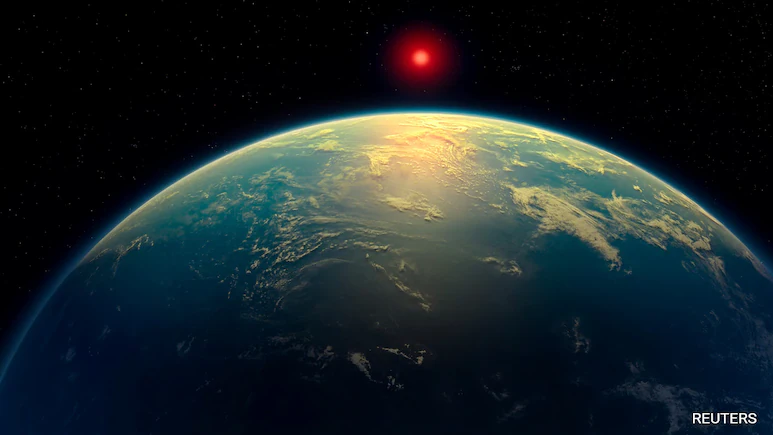
K2-18 b is a “hycean world,” a type of planet hypothesized to be covered by a water-rich ocean beneath a hydrogen-dominated atmosphere. It is roughly 8.6 times the mass of Earth and 2.6 times its diameter. The planet orbits a red dwarf star within the habitable zone, where conditions may allow for liquid water.
Webb’s observations suggest the gases are present in concentrations exceeding 10 parts per million — far greater than found on Earth — and not easily explained by abiotic, or non-living, processes, according to the study.
While the findings are compelling, scientists caution against jumping to conclusions. “These are tantalizing results,” said Christopher Glein, principal scientist at the Southwest Research Institute in Texas. “But we must test and validate the data rigorously. Independent verification is essential before we can assess the possibility of life.”
The presence of DMS and DMDS was detected using the telescope’s transit spectroscopy method, in which light from a star passes through a planet’s atmosphere as it transits. Webb’s instruments captured spectral signatures of gases in a different wavelength range from previous observations, bolstering confidence in the detection.
K2-18 b belongs to the “sub-Neptune” class of planets — larger than Earth but smaller than Neptune — and has emerged as one of the most promising candidates for studying potentially habitable alien worlds. Previous Webb observations had already detected carbon-based molecules such as methane and carbon dioxide in the planet’s atmosphere, further raising hopes of habitability.
Madhusudhan emphasized the need for caution and further research. “We need to repeat the observations two to three times to confirm the robustness of the signal,” he said. “And we need more theoretical and laboratory work to rule out alternative, non-biological sources for these gases.”
No nation or space agency has yet announced the formal discovery of extraterrestrial life. Scientists say such claims must meet a very high burden of proof to rule out false positives. “The findings represent a big ‘if’ on the question of life,” Madhusudhan said. “It is in no one’s interest to claim prematurely that we have detected life. But this may be the closest we’ve ever come.”