

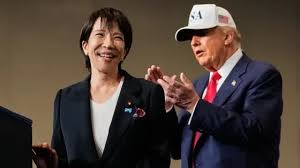
Washington, March 19 — Donald Trump is expected to urge Sanae Takaichi to expand Japan’s role in the ongoing Iran conflict during high-level talks at the White House, placing Tokyo in a delicate strategic position as the war reshapes global security dynamics.
What was initially planned as a reaffirmation of the long-standing U.S.–Japan partnership has evolved into a critical moment for alliance politics, with Washington seeking tangible support from its allies beyond traditional regional boundaries.
At the center of the discussions is the disruption in the Strait of Hormuz, a key artery for global energy supplies. The United States is pushing for allied naval participation to secure shipping lanes, including mine-clearing operations and tanker escorts, as tensions in the region continue to threaten oil flows and global markets.
However, Japan faces significant constraints. Its postwar constitutional framework limits the scope of overseas military engagement, and public opinion remains cautious about involvement in conflicts outside its immediate region. Takaichi has indicated that Tokyo has not received a formal request from Washington but is reviewing what actions may be possible within legal boundaries.
The situation underscores a broader challenge for Japan: balancing its security alliance with the United States against domestic political realities and longstanding defense principles.
Washington’s push comes amid visible frustration with other allies. Several European countries have declined to participate in Gulf operations, highlighting growing divisions over the extent to which partners should be involved in a conflict widely seen as tied more to global energy security than direct territorial defense.
For Japan, the stakes are particularly high. A refusal to support U.S. efforts could strain relations with its key security partner, while any military contribution risks political backlash at home and potential regional repercussions.
Beyond naval support, the United States is also expected to explore expanded defense industrial cooperation with Japan, including the possible co-development or production of missiles to replenish depleted stockpiles. Such proposals align with Washington’s broader strategy of integrating allied capabilities into its defense framework.
Despite these pressures, Japan may seek alternative ways to contribute. With diplomatic ties to Tehran, Tokyo could position itself as a potential intermediary, while also emphasizing economic investment and technological cooperation as part of its overall support.
The meeting comes at a time when Japan’s primary strategic focus remains the Indo-Pacific, particularly concerns over China’s growing assertiveness and the security of Taiwan. The Iran conflict, though geographically distant, has introduced new economic and security pressures that are increasingly difficult to ignore.
Analysts say the outcome of the talks will be less about immediate commitments and more about setting expectations for how alliances function in a rapidly changing global environment.
As the conflict continues to ripple across regions, the U.S.–Japan dialogue reflects a larger shift: alliances are no longer defined solely by shared principles, but by the willingness—and ability—of partners to act when crises emerge beyond their traditional spheres.
