

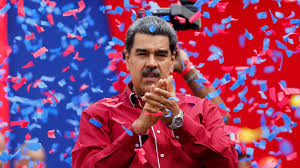
Washington, December 13: The United States on Thursday imposed fresh sanctions targeting Venezuela, including three nephews of President Nicolas Maduro’s wife and a network of crude oil tankers and shipping companies, as Washington ramps up pressure on Caracas amid a military buildup in the Caribbean.
The U.S. Treasury Department said it sanctioned six shipping companies and six crude oil tankers that it accused of engaging in “deceptive and unsafe shipping practices” while providing financial resources to what it described as Maduro’s “corrupt narco-terrorist regime.”
Four of the sanctioned tankers, including the Panama-flagged H. Constance and Lattafa, are registered in Panama, while the remaining two are flagged by the Cook Islands and Hong Kong, Treasury said. The vessels are large crude carriers that recently loaded oil in Venezuela, according to internal shipping documents from state oil company PDVSA.
The sanctions also target Franqui Flores and Efrain Antonio Campo Flores, nephews of Venezuelan first lady Cilia Flores, who were convicted in the United States in 2016 of attempting to carry out a multimillion-dollar cocaine deal after being arrested in a DEA sting in Haiti. The pair, dubbed the “narco nephews,” were sentenced to 18 years in prison but were released in a 2022 prisoner swap with Venezuela.
A third nephew, Carlos Erik Malpica Flores, was also sanctioned for what U.S. officials say was his involvement in a corruption scheme at PDVSA.
The measures follow comments by U.S. President Donald Trump on Wednesday that the United States had seized a sanctioned oil tanker off Venezuela’s coast. The seizure — the first of a Venezuelan oil cargo since U.S. sanctions were imposed in 2019 — has sharply escalated tensions between Washington and Caracas. Sources told Reuters the Trump administration is planning additional tanker seizures.
U.S. Attorney General Pam Bondi said on X that the FBI, Homeland Security and the Coast Guard, with support from the U.S. military, carried out the seizure warrant against a tanker transporting sanctioned oil from Venezuela and Iran.
Maduro and his government have repeatedly denied links to criminal activity and accused Washington of seeking regime change to gain control of Venezuela’s vast oil reserves. “The imperialists thought that our people would falter, but here no one faltered and no one will ever falter,” Maduro said during a visit to a Caracas neighbourhood, referring to earlier sanctions.
Analysts said the sanctions could significantly raise risks for shipowners moving Venezuelan crude. “This is a powerful intimidation tactic,” said David Goldwyn, a former U.S. energy diplomat. “Any sanctioned vessel owner will think twice about lifting Venezuelan crude for fear of losing the vessel entirely.”
Francisco Monaldi of Rice University’s Baker Institute said higher enforcement risks could force Venezuela to offer steeper discounts or more flexible terms to buyers, potentially hitting export volumes, particularly for so-called shadow fleet tankers that operate without top-tier insurance.
The sanctions and seizure come as Trump has repeatedly raised the possibility of U.S. military intervention in Venezuela, accusing Caracas of facilitating narcotics trafficking. The United States has already carried out more than 20 strikes on suspected drug vessels, actions that have drawn concern from lawmakers and legal experts.
