

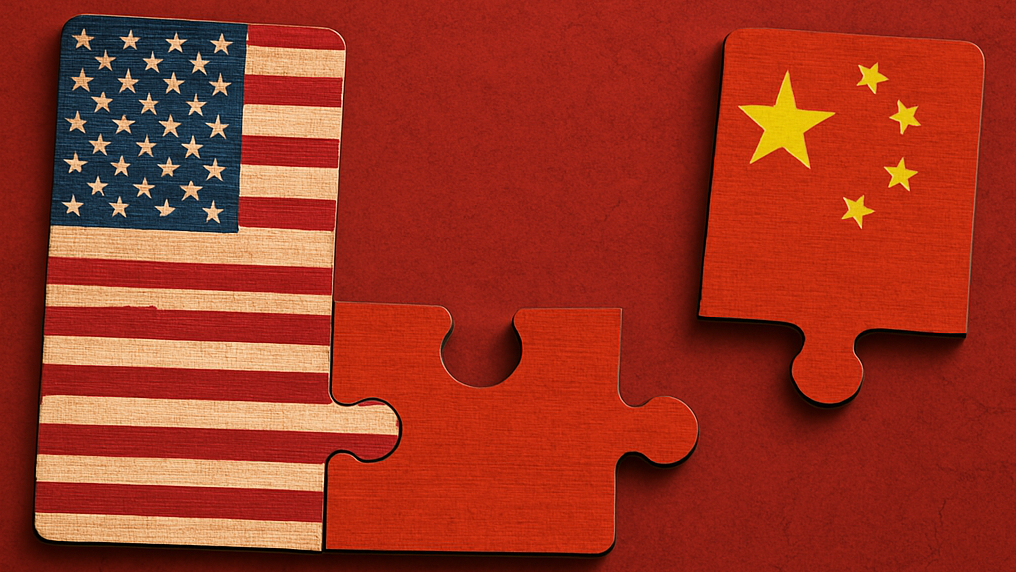
Washington/Beijing, April 9: The United States has escalated its trade conflict with China as a sweeping 104% tariff on Chinese goods took effect on Tuesday, raising alarm over potential damage to the global economy and prompting a sharp sell-off in Chinese markets.
The move follows through on U.S. President Donald Trump’s warning last week that China would face additional penalties if it failed to roll back its own retaliatory tariffs on American exports. The White House imposed the extra 50% tariff after Beijing refused to withdraw a 34% levy it slapped on U.S. goods on April 4, itself a response to Trump’s earlier 34% “reciprocal tariff” announced on April 2. Combined with existing tariffs on fentanyl-linked imports, the total levy on Chinese goods now stands at 104%.
“If China does not withdraw its 34 per cent increase… the United States will impose additional tariffs on China of 50 per cent, effective April 9,” Trump posted earlier this week.
China responded defiantly. “If the U.S. insists on having its way, China will fight to the end,” the Commerce Ministry said, calling the U.S. actions “a mistake on top of a mistake” and accusing Washington of “blackmail.”
Chinese state media echoed that sentiment. “Tariff blackmail will not intimidate China, nor will it undermine justice,” said an editorial in the Global Times, adding, “Pressuring and threatening are not the right way in dealing with China.”
White House Press Secretary Karoline Leavitt defended the move, saying the president “has a spine of steel” and is standing up for American workers. “Countries like China… are making a mistake,” she said. “The Chinese want to make a deal, they just don’t know how to do it.”
Markets were quick to react to the deepening trade rift. China’s benchmark CSI300 Index opened down 1.2%, while the Shanghai Composite shed 1.1%. The SmallCap 1000 Index plummeted over 4%, and the yuan slid to 7.3505 per dollar, its weakest level since September 2023.
Economists warned of significant consequences for both economies and beyond. According to Goldman Sachs and BNP Paribas, the tariff regime could shave up to 2.4 percentage points off China’s GDP growth in 2025, at a time when Beijing is still trying to regain momentum after pandemic-related slowdowns.
In the U.S., the tariffs are expected to add 1-1.5% to inflation this year, according to JPMorgan, as the higher costs of imported goods ripple through the supply chain to consumers.
Industry associations expressed concern. “Tariffs divert capital away from wage hikes and innovation and channel it into unproductive tax payments,” said representatives from IPC and the National Association of Wholesaler-Distributors.
The U.S. and China collectively account for around 43% of global GDP, according to the International Monetary Fund. A prolonged trade war could slow global growth, trigger market volatility, and depress consumer confidence worldwide.
One concern is the potential “dumping” of Chinese goods into other markets if access to the U.S. is blocked. Countries like Vietnam and South Korea could see their markets flooded with low-priced Chinese exports, squeezing domestic industries already battling inflation and supply chain challenges.
With neither side showing signs of backing down, analysts warn of a drawn-out standoff that could have severe global repercussions. “The world can ill afford a trade war between its two largest economies,” said a senior economist at HSBC. “Diplomacy—not retaliation—must prevail.”