

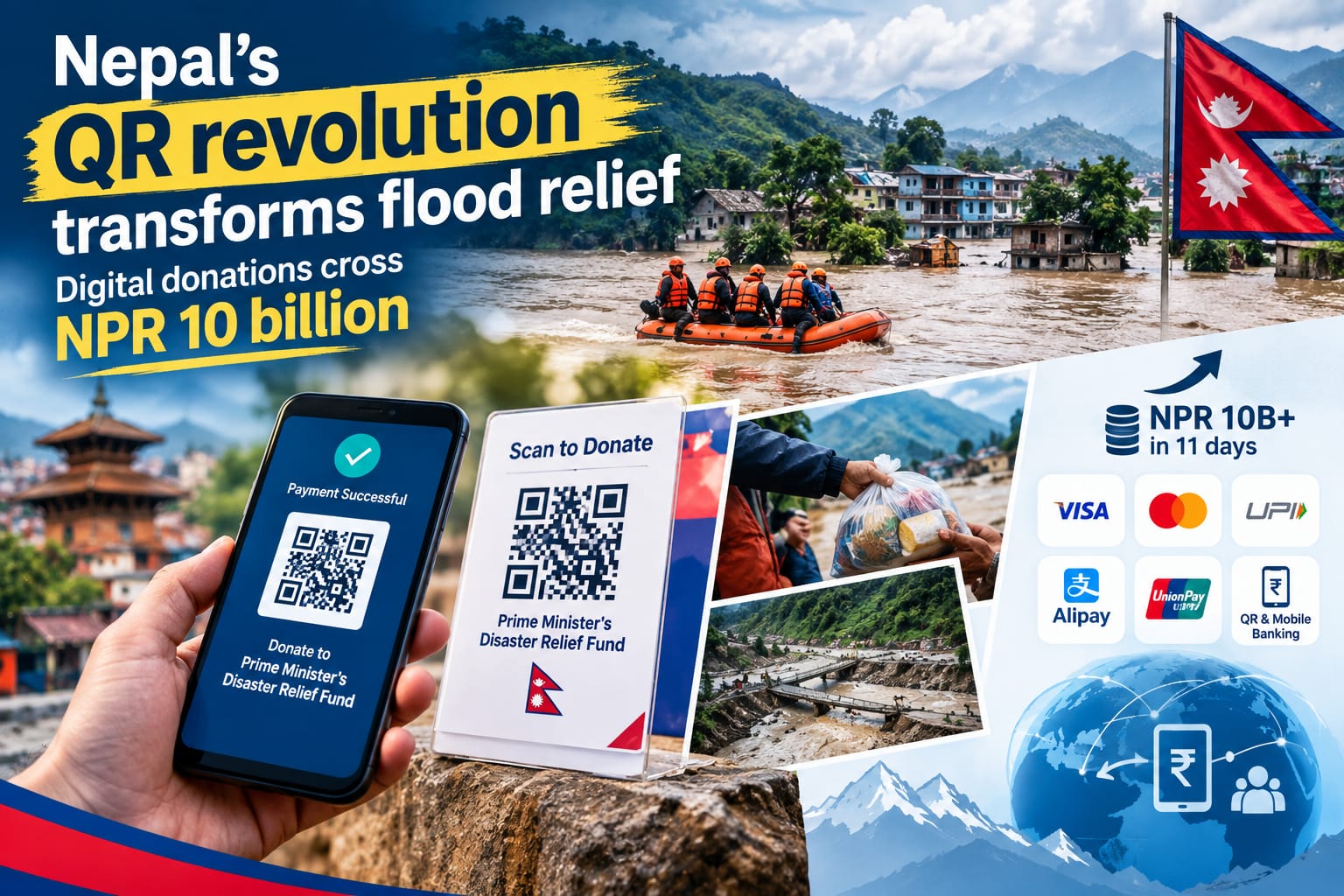
Kathmandu, Sept 6: Nepal’s response to the devastating Bhotekoshi floods has triggered a major transformation in the way disaster relief is funded, with QR codes, mobile banking and international card networks enabling donations to flow directly into the government’s relief fund.
More than NPR 10 billion has been collected by the Prime Minister’s Disaster Relief Fund within 11 days of the August 26 floods, according to The Kathmandu Post, highlighting the growing role of digital payments in mobilising emergency assistance.
The large-scale digital campaign marks the first time in Nepal that individuals have been able to make direct person-to-government transactions on such a scale. From schoolchildren in Nepal to global technology major Nvidia, donors have used digital channels to contribute to the relief effort.
The transformation has also made a significant difference for Nepalis living abroad and international donors, who can now send money directly to the government fund without having to visit a bank or undertake traditional international transfers.
Finance Minister Swarnim Wagle said digital technology had considerably simplified the process of collecting disaster-relief funds.
“For donors living abroad, we arranged for direct payments using dollar-denominated cards such as Visa and Mastercard,” Wagle was quoted as saying.
“They no longer have to visit a bank or go through cumbersome international bank transfers,” he said.
The scale of domestic participation is evident from transaction data provided by the Finance Ministry, digital payments company Fonepay and Nepal Clearing House Ltd (NCHL).
Of the 8,89,145 transactions processed through Fonepay’s network, as many as 8,15,219 were domestic QR payments made by people in Nepal. These transactions generated NPR 2.095 billion for the relief fund.
NCHL had recorded 2,46,614 transactions by Saturday afternoon. Domestic QR payments constituted the largest share, with 1,12,932 transactions generating NPR 390.5 million.
International payment networks have further expanded the reach of the campaign. More than NPR 1.4 billion has been deposited directly into the relief fund through 93,850 transactions using international cards such as Visa and Mastercard, authenticated through the 3D Secure system.
Contributions have also been received through India’s Unified Payments Interface (UPI), China’s Alipay, Visa, Mastercard and UnionPay. By Saturday, UPI had generated NPR 4.854 crore for the relief fund, while Alipay contributed NPR 1.797 crore.
The digital shift represents a sharp departure from previous disasters, when donors largely depended on physical cash and bank visits to contribute to relief efforts.
Nepal Bankers’ Association President Santosh Koirala said the country’s expanding digital financial infrastructure had removed many of the barriers that previously discouraged people from donating.
“In previous disasters, people had to go to banks and queue up to make donations,” Koirala said.
“The digital transformation of banks and financial institutions now means anyone can easily send relief money through a mobile banking app,” he said.
The Bhotekoshi disaster has also brought Nepal’s technology sector into the relief effort. Software and information technology companies have contributed money and relief materials while exploring ways to use technology for rescue and reconstruction operations.
The umbrella bodies NAS-IT and the Computer Association Nepal Federation have said they were working to support rescue and reconstruction efforts through technology as well as financial assistance.
Corporate contributions have added to the relief mobilisation. F1 Soft Group donated NPR 13.5 million to the Prime Minister’s Disaster Relief Fund, while Cedar Gate contributed relief materials worth NPR 130,000 for flood victims.
The digital donation drive has consequently emerged as more than just a convenient payment mechanism. It has demonstrated how Nepal’s rapidly expanding digital financial ecosystem can connect millions of potential donors at home and abroad directly with a government relief mechanism during a crisis.
For a country repeatedly exposed to natural disasters, the Bhotekoshi response could mark a significant shift towards faster, more accessible and more inclusive disaster financing, with a smartphone and a QR scan increasingly replacing the bank queue and cash donation.
