

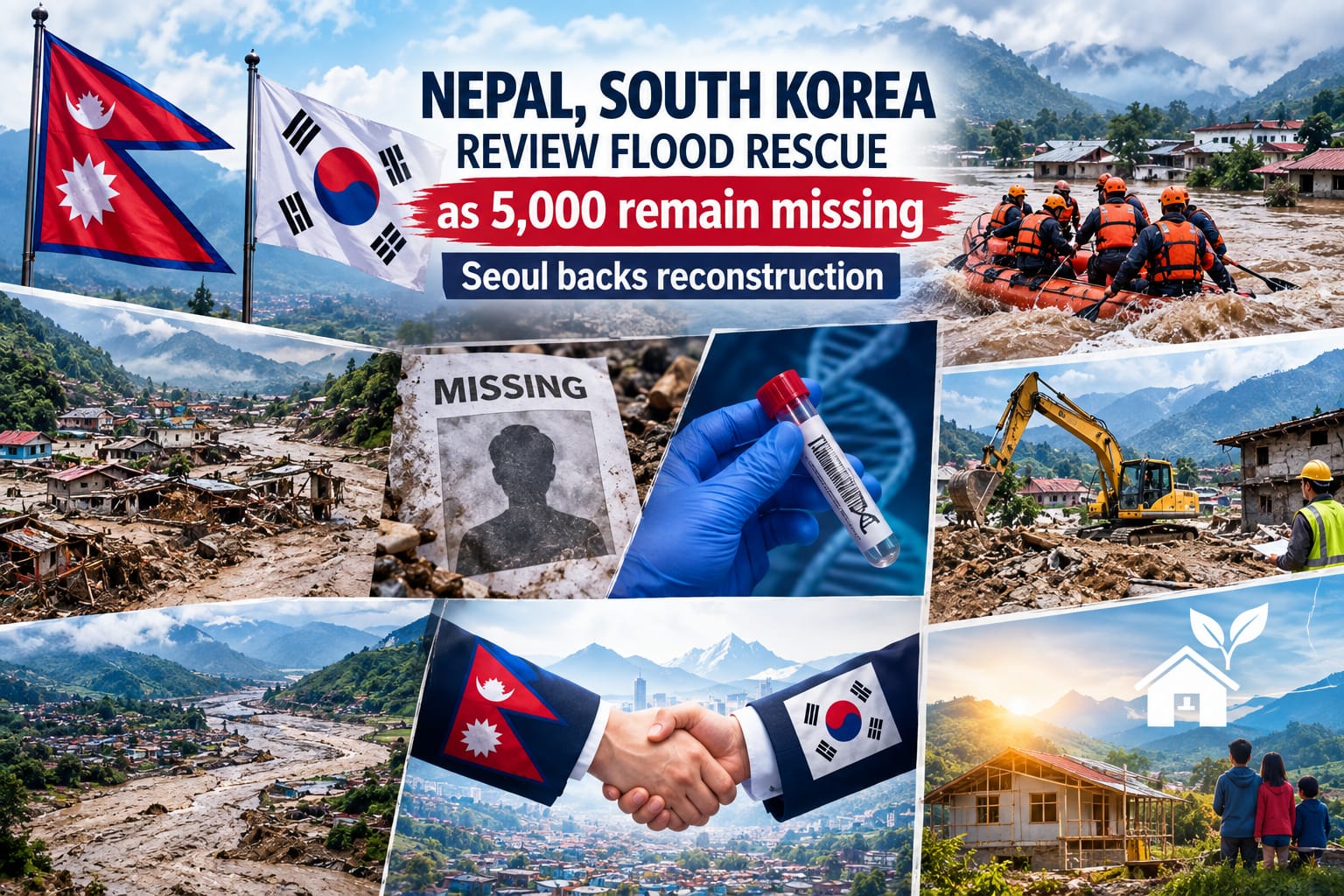
Kathmandu, Sept 6: Nepal and South Korea on Sunday reviewed ongoing search, rescue and relief operations following devastating floods that have killed more than 1,300 people and left around 5,000 missing, with Seoul expressing willingness to support Nepal’s post-disaster reconstruction and raise the issue of climate-related financial assistance at international forums.
Nepal Foreign Minister Shisir Khanal and his South Korean counterpart Cho Hyun held detailed talks in Kathmandu, including discussions on efforts to trace missing South Korean nationals affected by the disaster, according to Khanal’s office.
The meeting came as Nepal continues to deal with the massive destruction caused by flash floods triggered by an ice-rock avalanche near the Nepal-Tibet border on August 26.
The disaster sent huge volumes of water downstream through the Bhotekoshi River, devastating towns and villages in northern and central Nepal. Homes, vehicles, roads and bridges were swept away, while several hydropower projects were damaged.
Khanal thanked the South Korean government for its emergency support, including the deployment of an inter-agency rapid response team and the Korea Disaster Relief Team to flood-hit areas.
South Korea has also provided relief materials and humanitarian assistance as Nepal grapples with the scale of the disaster and continues efforts to locate missing people.
The Nepalese minister emphasised the need to rebuild infrastructure in a manner that is resilient and durable, reflecting the vulnerabilities exposed by the disaster.
Cho expressed Seoul’s readiness to remain engaged beyond the immediate relief phase and support Nepal’s reconstruction efforts.
He conveyed the “willingness of the Korean Government to support Nepal in the post-disaster reconstruction efforts”, according to the statement.
The talks also assumed a wider climate-change dimension, with Cho stressing that countries such as Nepal, which contribute relatively little to global emissions, can face disproportionately severe consequences from climate-related disasters.
“The world community has historical responsibility for the damage done to countries like Nepal due to climate change,” Cho said, calling for greater international attention to the issue.
He also called for Nepal and South Korea to work together to raise awareness about the impacts of climate change at global platforms, including the Conference of the Parties (COP) climate negotiations.
The South Korean foreign minister further said Seoul would raise the issue of financial support that Nepal should receive from the international community, linking disaster recovery with the broader debate over climate responsibility and assistance to vulnerable countries.
The discussions therefore went beyond immediate humanitarian relief, placing long-term reconstruction and climate accountability at the centre of the Nepal-South Korea engagement.
Nepal is facing the enormous challenge of rebuilding infrastructure damaged or destroyed by the floods while simultaneously continuing search operations for thousands of people reported missing.
The ministers also reiterated their commitment to further strengthening bilateral relations based on longstanding friendship, mutual trust and cooperation.
The latest disaster has caused widespread disruption across affected areas, with floodwaters sweeping away settlements, transport links and critical infrastructure along the Bhotekoshi River basin.
The scale of the destruction and the large number of people still unaccounted for have heightened concerns over Nepal’s capacity to recover from the disaster, while the survival and rescue of people trapped in affected areas have remained an immediate priority.
With the emergency response continuing, Kathmandu is now also looking towards longer-term international assistance to rebuild damaged infrastructure and strengthen resilience against future climate-related disasters.
The Nepal-South Korea talks are significant in that context, combining immediate humanitarian cooperation with reconstruction support and a push for greater international recognition of the climate-related vulnerabilities faced by countries such as Nepal.
