

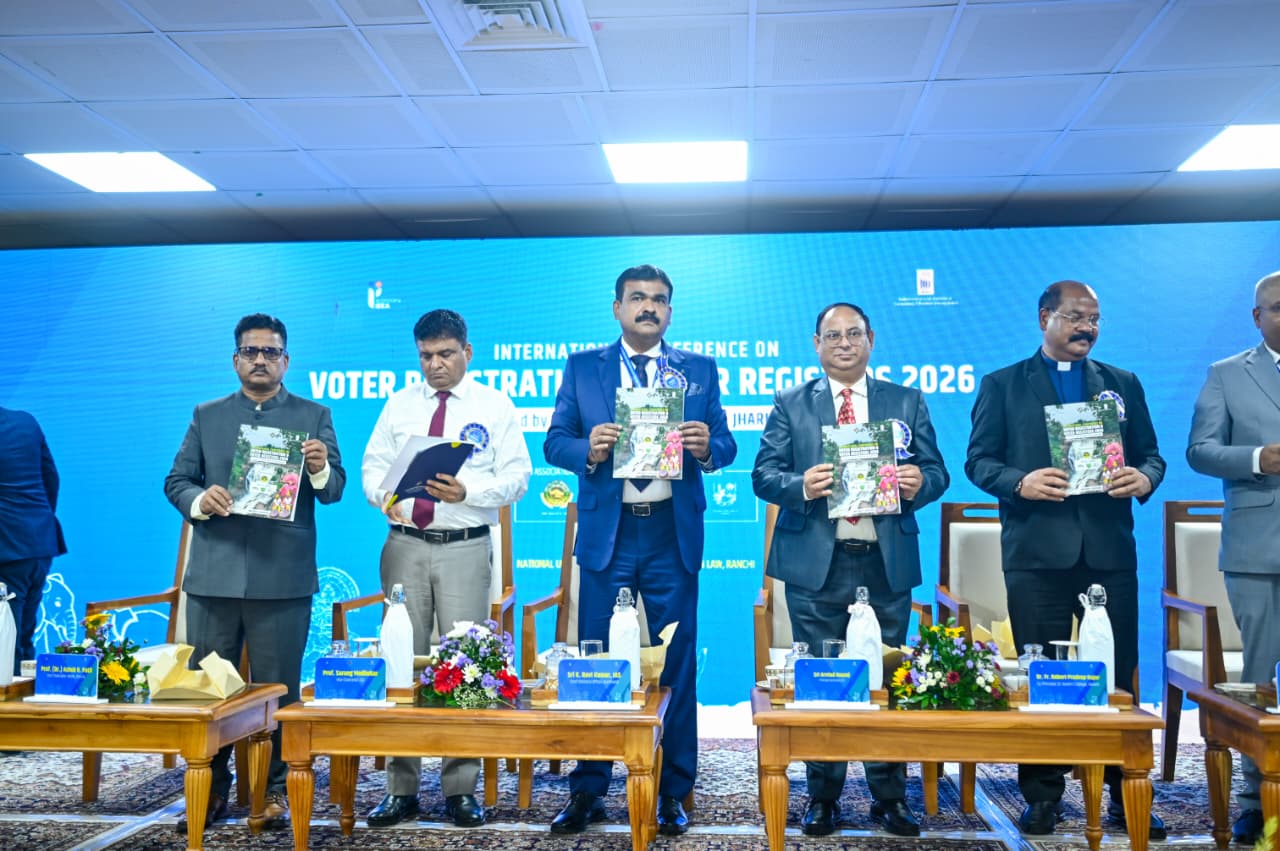
Ranchi, Sep 2: Electoral rolls must remain accurate, inclusive, transparent and regularly updated to ensure citizens’ confidence in the democratic process, experts and election officials said at an international conference on voter registration that began here on Wednesday.
The two-day international conference “Voter Registration and Voter Registers 2026” is being organised by the Office of the Chief Electoral Officer (CEO), Jharkhand, in collaboration with the Central University of Jharkhand (CUJ) at the National University of Study and Research in Law (NUSRL), Ranchi.
Principal Secretary, Election Commission of India, Arvind Anand attended the inaugural session as the chief guest. Jharkhand CEO K. Ravi Kumar, CUJ Vice-Chancellor Prof Sarang Medhekar, NUSRL Vice-Chancellor Prof (Dr) Ashok R. Patil and St Xavier’s College, Ranchi Principal Dr Fr Robert Pradeep Kujur were among those present.
The conference has brought together academicians, researchers, electoral practitioners and experts to examine voter registration systems from national and international perspectives, with discussions going beyond the ongoing Special Intensive Revision (SIR) in Jharkhand.
Kumar said the conference received 230 research abstracts after more than 800 universities and institutions were approached. An independent academic expert committee shortlisted 80 abstracts and selected 58 research papers for publication and deliberation.
“The international conference on ‘Voter Registration and Voter Registers’ has been organised to take the discussion beyond the ongoing SIR and examine voter registration from broader national and international perspectives,” Kumar said.
He said countries across the world follow active, automatic and hybrid voter-registration systems, increasingly using population databases, civil registries, biometrics and continuous updating.
India, he said, has a strong constitutional and legal framework supported by field-level verification, participation of political parties and supervision of the Election Commission of India.
“The fundamental objective [is] ensuring an accurate, inclusive and transparent electoral roll in which every eligible citizen is included and ineligible persons are excluded,” Kumar said.
He also highlighted the growing use of technology and database-based verification to identify anomalies and improve the accuracy of voter records, while stressing that field verification, stakeholder participation, judicial scrutiny and Election Commission oversight remain important.
NUSRL Vice-Chancellor Prof Ashok R. Patil described electoral rolls as the “gateway to democratic participation”, saying credible elections begin with accurate, inclusive and regularly updated voter registers.
“Technology should enhance efficiency without replacing human judgement,” Patil said, stressing that electoral-roll management must balance integrity with inclusion.
“The ultimate goal should be to ensure no eligible citizen is excluded, no ineligible person is included, and citizens can participate in elections with confidence and trust,” he said.
St Xavier’s College Principal Dr Fr Robert Pradeep Kujur said educational institutions have an important role in strengthening democracy through voter awareness campaigns, campus registration drives and civic education.
“An accurate and inclusive voter register is fundamental to a strong democracy,” Kujur said, stressing the need to focus particularly on young voters, migrants and marginalised communities.
He also flagged challenges concerning data integrity, privacy, accessibility, responsible use of technology and artificial intelligence, and public trust in the electoral system.
CUJ Vice-Chancellor Prof Sarang Medhekar highlighted the importance of linking academic research with practical election administration. He said India’s vast electoral process requires extensive logistical arrangements and skilled professionals, while emerging technologies and AI are creating both opportunities and challenges.
Additional Chief Electoral Officer Subodh Kumar said voters and citizens must remain at the centre of the electoral process.
“An accurate, inclusive and transparent electoral roll is the foundation of a strong democracy,” he said, adding that continuous updating is necessary because of migration, urbanisation, changing demographics and the enrolment of young voters.
The ongoing SIR exercise in Jharkhand, he said, is aimed at ensuring that no eligible Indian citizen is left out and no ineligible person is included in the electoral roll.
Two conference books — Voter Registration and Voter Registers: Foundations, Global Practice and Legal Framework (Vol-I) and Voter Registration and Voter Registers: Theory, Awareness, Inclusion and Technology (Vol-II) — along with a souvenir were also released during the inaugural session.
The 58 selected research papers and insights emerging from the conference will be published in both physical and freely accessible digital formats, officials said.
