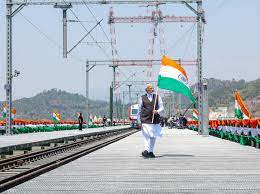
New Delhi, June 9: As Prime Minister Narendra Modi completes 11 years in office, India has undergone a sweeping transformation marked by robust economic growth, major infrastructure expansion, and global recognition for its digital public infrastructure.
Under Modi’s leadership since 2014, the Indian economy has expanded to $4.2 trillion, making it the world’s fifth-largest. The government projects India will soon surpass Japan and Germany to become the third-largest global economy. Average annual GDP growth since 2014 stands at 6.4%, with the latest quarterly data showing a sharp acceleration to 7.4%.
Inflation has also been reined in, falling from 9.4% in 2013-14 to 4.6% today, contributing to macroeconomic stability and improved investor confidence.
One of the most visible changes over the past decade has been India’s rapid infrastructure development. The length of national highways has grown from 91,287 km in 2014 to 146,204 km in 2024, with the pace of construction rising nearly threefold to 34 km per day. In rural areas, nearly 400,000 km of roads have been built, connecting 99% of villages to the national network.
Railways, a key sector in India’s transport ecosystem, saw the addition of 25,871 route kilometres of new tracks—significantly more than the 14,985 km added in the previous decade. Indian Railways now produces more locomotives annually (1,681 in 2024-25) than the United States, Europe, and Japan combined. With 1,617 million tonnes of freight moved annually, it has become the world’s second-largest cargo transporter.
Passenger capacity has also expanded dramatically, with over 30 million passengers served daily. The Dedicated Freight Corridor (DFC), currently under development, is expected to boost cargo efficiency and ease pressure on passenger services. For the first time, railway connectivity now extends to India’s northeastern states.
In aviation, operational airports have more than doubled from 74 in 2014 to 160 today, thanks to the UDAN regional connectivity scheme. The government aims to expand this network to 300 airports by 2047.
Urban development initiatives have been spearheaded through the Smart Cities Mission, with over 8,000 projects worth ₹1.64 lakh crore completed or underway. The Delhi Metro has expanded into one of the world’s largest urban transit systems, and metro networks now serve 15 Indian cities.
India has also made substantial strides in clean energy. Solar energy capacity has grown from 2.82 GW in 2014 to 105.65 GW today, with total renewable energy capacity standing at 228.28 GW. India now ranks third globally in solar and fourth in wind energy production.
A hallmark of Modi’s tenure has been the rapid buildout of digital public infrastructure (DPI), anchored by Aadhaar, the Unified Payments Interface (UPI), and Jan Dhan bank accounts. These platforms have facilitated real-time financial inclusion, direct benefit transfers, and digital access for millions.
The DPI ecosystem now contributes roughly 1% of India’s GDP and is projected to account for 3-4% by 2030. According to the World Bank, India achieved in six years what would typically take decades—its DPI model has since been adopted by over 12 countries.
The past decade has also seen a significant reduction in poverty. Official figures indicate that 171 million people have been lifted out of poverty, with the national poverty rate falling from 29.17% in 2013-14 to 11.28% in 2022-23. Further declines are expected.
As Modi enters his third consecutive term, the government has signalled continued focus on economic growth, infrastructure, and inclusion, positioning India as a rising global power with a unique development model.