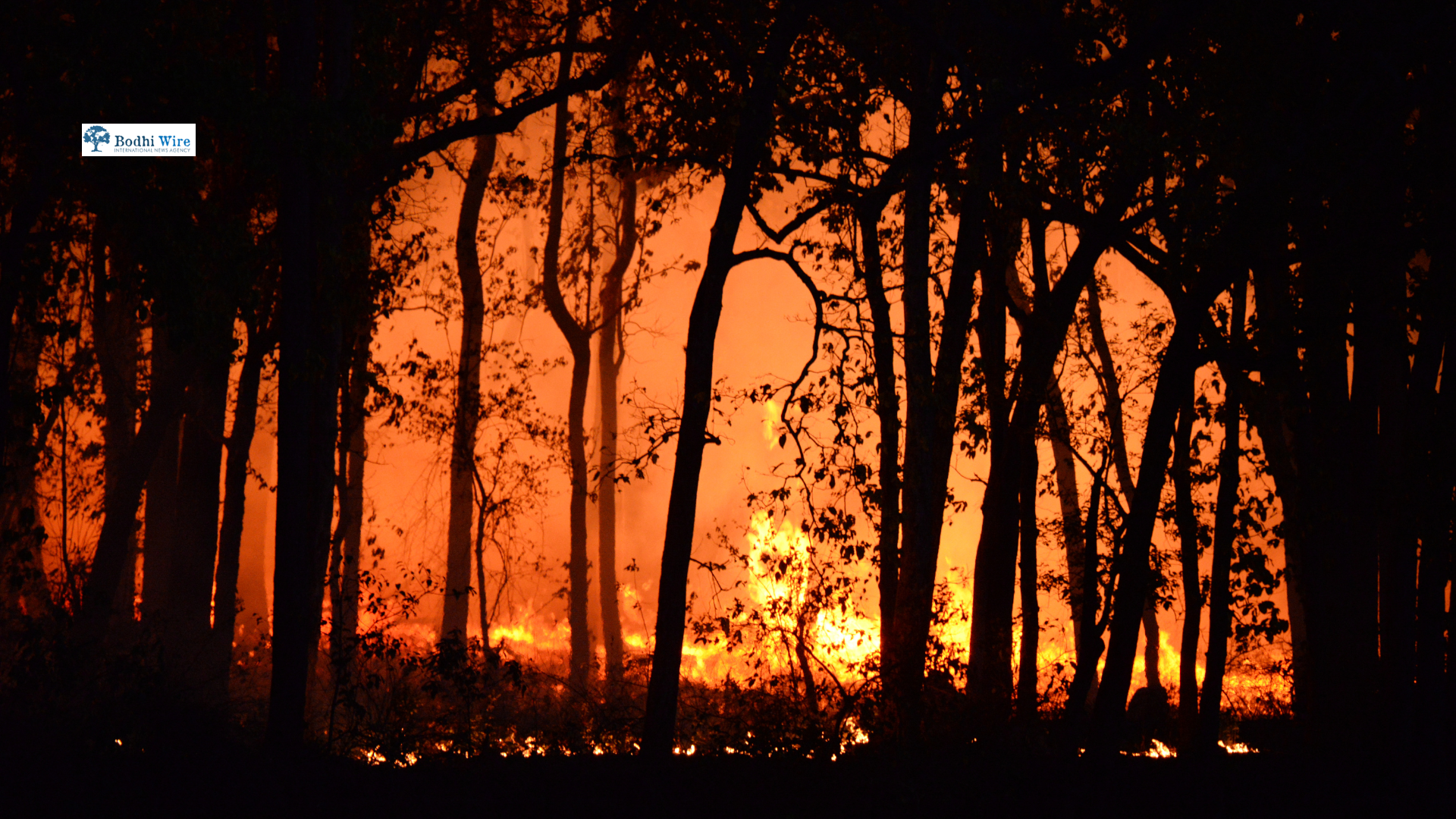
Ranchi, Mar 19 : The Jharkhand Forest Department is facing a shortage of skilled manpower to tackle forest fire incidents, even as rising temperatures have led to fires across different parts of the state.
The Forest Survey of India (FSI), which provides daily satellite feeds on forest fires, reported seven large fires on Monday in Jharkhand—five in West Singhbhum district and one each in Pakur and Khunti districts.
Forest frontline staff on the ground are only equipped with fire blowers, fire beaters, and fire rakes to combat fires. A forest official in West Singhbhum district, speaking anonymously, said that fire lines are created and water bodies are prepared at the onset of the season to retain moisture and prevent fires.
“Once a fire incident happens, we use blowers, batters, and rakes to control it. Due to lack of advanced equipment, we are not able to use water to douse the fire in difficult terrains,” the official said.
The official further noted that foreign countries use helicopters and advanced kits to transport water to remote areas, and states like Meghalaya and Uttarakhand have also adopted these methods.
State conservator of forests and nodal officer (fire) Rajendra Naidu stated that the department plans to procure advanced equipment and integrate modern technology by 2026 to combat fire incidents.
The department is also considering using artificial intelligence (AI) in the Palamu Tiger Reserve (PTR) as part of a pilot project to address forest fires.
“Fire season starts from the last week of February and continues till April last week. With the existing equipment and manpower, it is quite a challenge to combat forest fires. Almost 55% of the forest fire takes place in hilly regions of West Singhbhum, Dalma, and Palamu, but we do not have multi-terrain vehicles or helicopters to douse off fire in those areas. There is also a dearth of high-power pumps to transport water,” Naidu said.
To improve preparedness, the forest department has identified forest sub-beats based on past fire incidents and provided this data to Divisional Forest Officers (DFOs).
Villagers have been engaged, and mock drills have been conducted with them. According to the department’s list, 19 sub-beats fall under the ‘very high’ risk category, while 77 fall under ‘high’ risk zones.