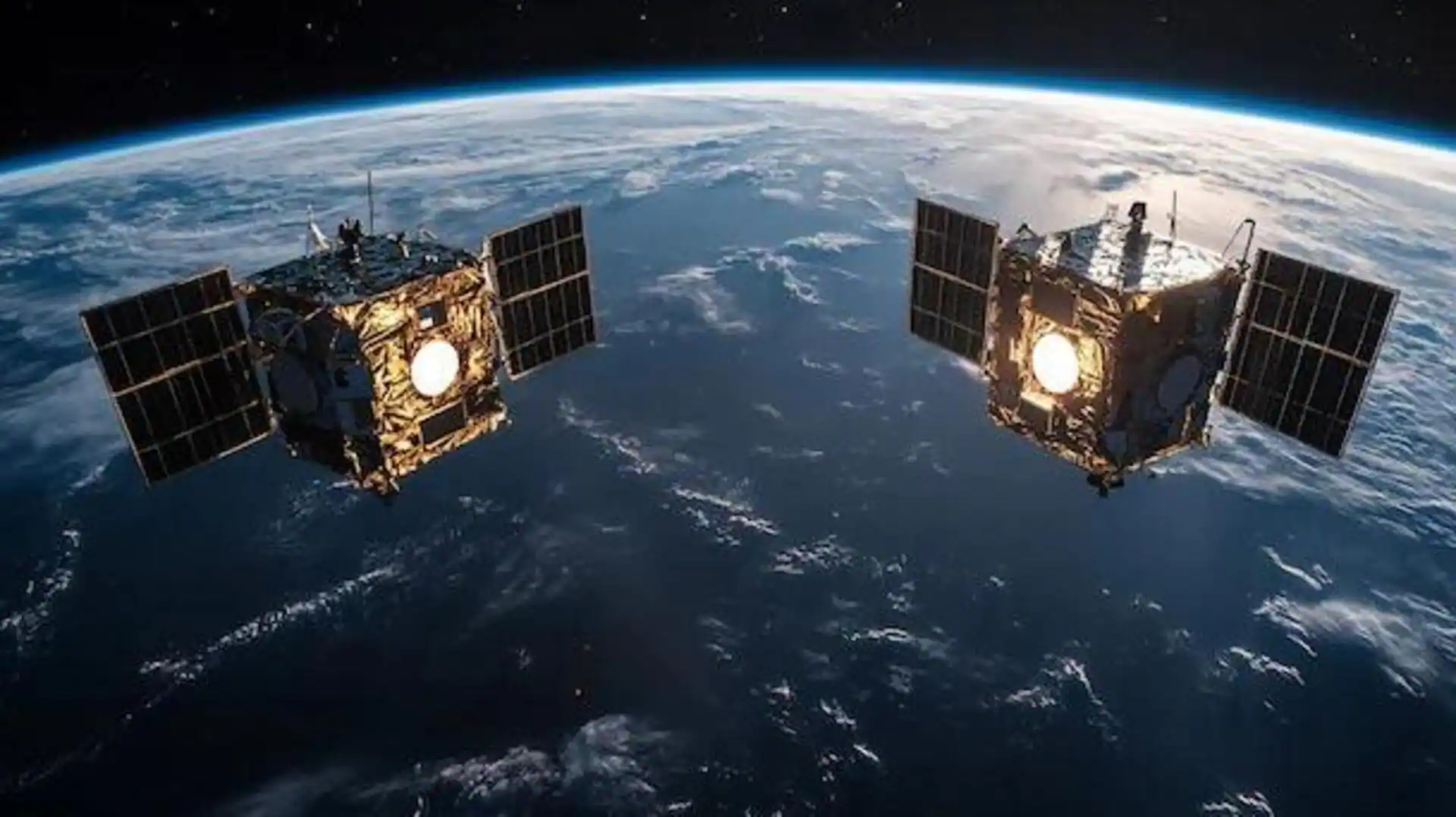
Bengaluru, Jan 22 : The Indian Space Research Organisation (ISRO) is likely to attempt undocking, or the separation of two satellites, for the first time on Monday, officials said. After undocking, the space agency plans to re-attempt docking to enhance precision, they added.
India made history on January 16 by becoming the fourth country in the world, after the United States, Russia, and China, to successfully dock two satellites in orbit. However, the docking experiment had to be postponed twice earlier this month—on January 7, to conduct additional ground simulations, and on January 9, due to the satellites drifting more than expected during one of the manoeuvres.
Docking, a critical process in which two fast-moving satellites or spacecraft are brought together and joined in orbit, is considered vital for missions that require large payloads which cannot be launched in a single go. During the January 16 feat, ISRO successfully brought two 220-kg satellites within three metres of each other. Their extended rings were joined, retracted, and locked in space, transforming them into a composite spacecraft. Commands were sent to the satellites as one unit.
Following the initial docking success, the satellites were moved to a safe distance before being brought back to within three metres of each other on January 12. While onboard cameras provided clear visuals of the satellites, docking was not attempted during this phase. The satellites were subsequently moved apart again, and ISRO studied the data to prepare for the upcoming undocking and redocking attempts.
The development of docking capability marks a significant step for India’s ambitious space program. It is expected to play a critical role in several future missions, including the Chandrayaan-4 mission, which aims to bring back lunar samples using a transfer module that will dock with a re-entry module in Earth’s orbit. The re-entry module will be designed to withstand the intense heat generated upon entering Earth’s atmosphere.
Docking will also be essential for the Bharatiya Antariksh Station, a planned Indian space station to be assembled in orbit by joining five modules. The first module is slated for launch in 2028. Additionally, India aims to send an astronaut to the Moon by 2040, for which docking technology will be crucial.
The mission employs an indigenous Bharatiya Docking System, inspired by the International Docking System Standard used for spacecraft traveling to the International Space Station. Unlike the 24 motors used in the international standard, ISRO’s system uses just two motors, while retaining an androgynous design that ensures identical systems on both the Chaser and Target satellites.
India’s advancement in docking technology positions it as a key player in global space exploration, with ambitious plans that reflect its growing prowess in the domain.