

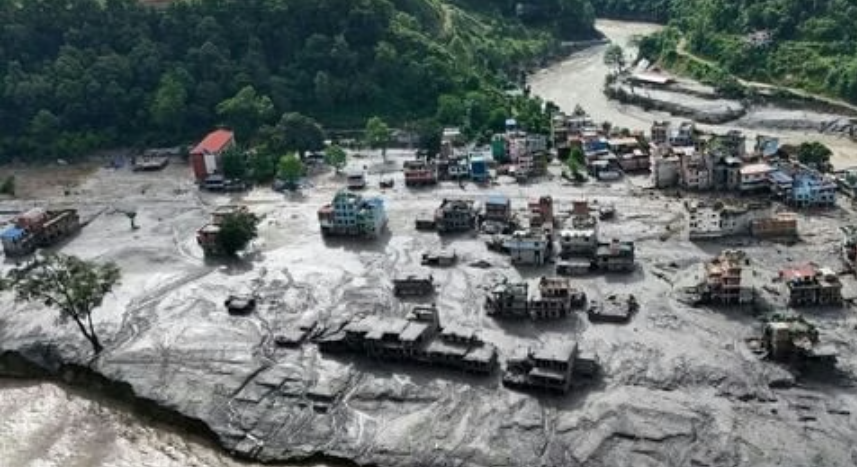
New Delhi, September 3: The Centre on Thursday reviewed India’s preparedness to deal with glacial lake outburst floods (GLOFs), days after a glacier collapse triggered devastating floods in Nepal that killed more than 1,200 people and left thousands missing.
The high-level meeting, chaired by Union Home Secretary Govind Mohan, was attended by officials from Himalayan states and key central agencies, including the National Disaster Management Authority (NDMA), Central Water Commission, India Meteorological Department and Defence Geoinformatics Research Establishment, according to a Home Ministry statement.
The meeting reviewed the evolving threat of GLOFs in the Himalayan region, with emphasis on early warning systems, monitoring of vulnerable glacial lakes and snow-covered areas, identification of high-risk locations and flood flow paths, timely dissemination of alerts, evacuation preparedness and strengthening of emergency response mechanisms.
Officials agreed to strengthen India’s early warning and response systems to minimise loss of life and damage to property in the event of GLOFs or related disasters.
A GLOF occurs when a natural dam holding a glacial lake suddenly collapses, releasing a large volume of water downstream and potentially causing destructive flooding.
The review assumes significance following the catastrophic flash floods in Nepal, which were triggered by a glacial collapse in the Himalayan region.
India and Nepal share a 1,770-km-long border, with Uttarakhand, Uttar Pradesh, Bihar, West Bengal and Sikkim sharing boundaries with Nepal. The meeting also reviewed the preparedness of Himalayan states and Union territories against GLOFs and snow avalanches.
The Home Secretary stressed that preparedness for GLOFs and snow avalanches should move beyond response-oriented measures towards risk-informed planning, preventive mitigation and community-level preparedness, the statement said.
He also called upon states to expedite implementation of GLOF mitigation projects sanctioned by the Centre in 2024.
Experts have called for stronger monitoring of glacial lakes and improved early warning mechanisms in the Himalayan region.
Raghu Murtugudde, professor emeritus at the University of Maryland and visiting professor at the Indian Institute of Technology, Kanpur, said the increasing frequency of GLOFs was linked to global warming and pollution.
He said continuous monitoring of vulnerable glacial lakes would be important, while noting that monitoring thousands of lakes would require significant manpower or greater use of technologies such as drones.
Murtugudde also suggested developing standard operating procedures to guide communities in the event of GLOFs and related flash floods.
The NDMA’s 2020 guidelines on management of GLOFs have highlighted the threat faced by communities living downstream of unstable glacial lakes and noted that major GLOF and flash-flood events have occurred in the Indian Himalayas, including the 2013 Kedarnath disaster in Uttarakhand and the 2005 Parechu River flash floods in Himachal Pradesh.
The guidelines also stressed the need to integrate GLOF-related disaster risk management into development policies and programmes.
The Centre’s latest review comes amid growing concerns over the vulnerability of Himalayan communities and infrastructure to climate-related hazards, including glacial lake expansion, glacier instability, avalanches and sudden flooding.
