

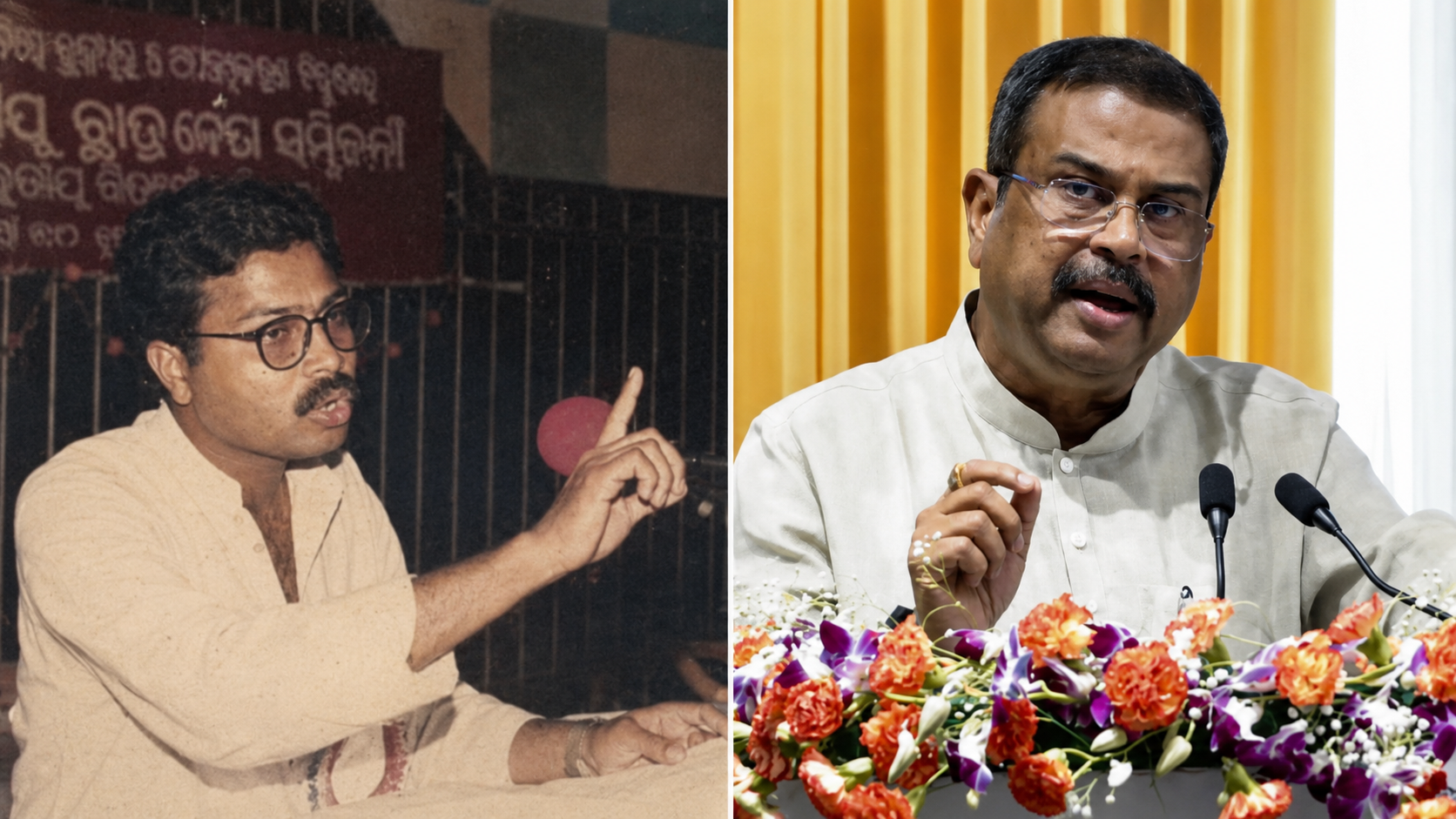
New Delhi, July 25: Nearly three decades after leading a student agitation against an examination paper leak in Odisha, Dharmendra Pradhan has resigned as Union Education Minister following weeks of nationwide protests over alleged irregularities in the NEET-UG 2026 examination.
The resignation has drawn attention to a striking political parallel. In 1997, Pradhan was among the most prominent student leaders protesting against a Plus Two examination paper leak in Odisha. In 2026, he stepped down after facing sustained public pressure over allegations of irregularities in one of the country’s biggest entrance examinations.
In 1997, the Council of Higher Secondary Education (CHSE), Odisha, came under criticism after allegations of a question paper leak in the Plus Two examinations. At the time, Pradhan was serving as a National Secretary of the Akhil Bharatiya Vidyarthi Parishad (ABVP) and had emerged as a prominent face of student politics in the state.
Leading nearly 1,500 students, Pradhan participated in a protest outside the Odisha Secretariat in Bhubaneswar, demanding accountability from the state government and reforms in the examination system. The demonstration later turned violent after police resorted to a lathi-charge on protesters.
According to those associated with the movement, Pradhan was seriously injured during the police action but continued to remain actively involved in the agitation. The protests eventually prompted the Odisha government to initiate corrective measures, including changes in the leadership of the Council for Higher Secondary Education and discussions on reforms in the state’s examination system.
The episode marked an important milestone in Pradhan’s political journey, strengthening his image as a student leader advocating transparency and accountability in public examinations.
Nearly 30 years later, Pradhan found himself confronting a similar crisis from the opposite side of the administration. As Union Education Minister, he faced mounting criticism over alleged irregularities in the NEET-UG 2026 examination, including claims relating to examination security and administrative lapses.
The controversy triggered widespread protests by students across several parts of the country, with demonstrators demanding accountability, examination reforms and action against those responsible for the alleged irregularities. The protests intensified over several weeks and eventually led to Pradhan submitting his resignation.
In his resignation letter, Pradhan said he was stepping down in the larger interest of students and to ensure that the country’s youth did not remain caught in uncertainty. He also reiterated his long association with education and student movements.
The political irony has not gone unnoticed. The leader who once marched on the streets demanding accountability over an examination paper leak ultimately resigned after facing similar demands as the country’s Education Minister.
The episode has revived memories of Pradhan’s early years in student politics and highlighted how the issue of examination integrity continues to remain a politically and socially significant concern nearly three decades later. The developments have also renewed calls for stronger safeguards, greater transparency and structural reforms in India’s examination system to restore public confidence in national-level competitive tests.
