

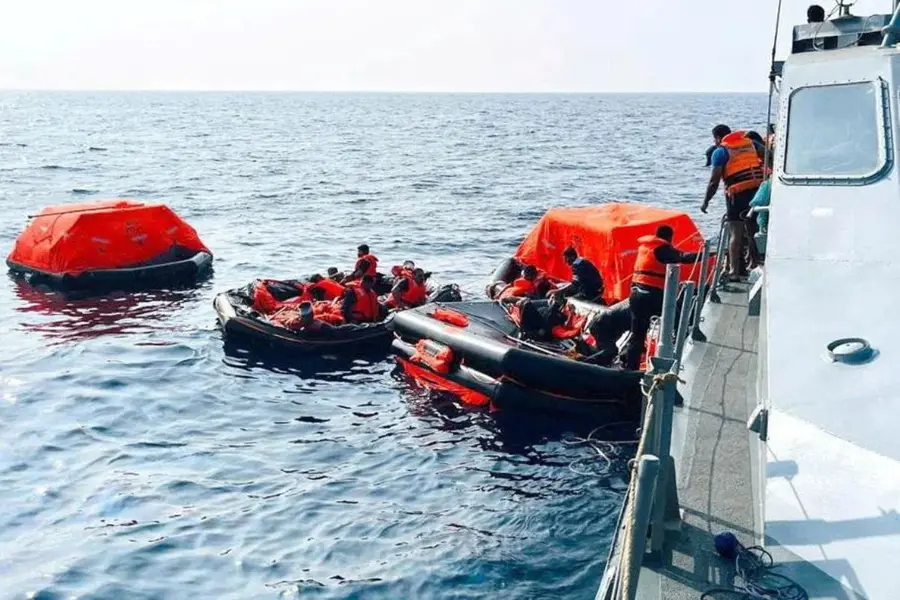
Dubai, 13 March: Thousands of commercial sailors remain stranded on ships in the Gulf as escalating tensions involving Iran, the United States and Israel have turned one of the world’s busiest maritime corridors into a high-risk zone.
Iran has warned it could open fire on vessels attempting to cross the Strait of Hormuz, a narrow waterway that handles a large share of global oil and energy shipments. The threat, combined with ongoing military activity in the region, has forced many oil tankers and cargo vessels to halt movements or remain anchored near ports.
Mariners say the skies above the Gulf have become increasingly dangerous, with drones, cruise missiles and fighter jets frequently seen during the conflict.
“I have seen Iranian drones and cruise missiles flying at low altitude,” said Amir, a Pakistani sailor working on an oil tanker in the region. “I also hear the sound of fighter jets, but we can’t identify which country they belong to.”
Crew members say the situation leaves them exposed with few safety options while at sea.
“There’s no specific hiding place on the ship for this,” said Hein, a senior engineer from Myanmar. “Just this morning two fighter jets fired at each other while we were still working.”
Maritime organisations estimate that around 20,000 sailors could currently be stuck on vessels across the Middle East because of the conflict. Some ships remain offshore waiting for safe passage, while others are unable to leave ports that have come under periodic attack.
“Inside the port, people might think it’s safe, but there have been ships which have been bombarded while anchored,” said Capt. Anam Chowdhury, president of the Bangladesh Merchant Marine Officers’ Association.
Several vessels have already been damaged during the fighting, according to maritime groups tracking the situation.
The risks at sea are compounded by technical and logistical challenges. Ship captains report increasing interference with satellite navigation systems, making it difficult to steer safely through the crowded waters of the Gulf.
At the same time, some crews are struggling with dwindling supplies after weeks or months at sea.
Food rations have been reduced on several ships, while concerns are growing about drinking water, fuel and the ability to replenish supplies if vessels remain stranded.
Families of sailors are also facing uncertainty, particularly after communication disruptions in parts of the region. Ali Abbas, whose son is aboard a ship near the Strait of Hormuz, said he has not been able to contact him after recent missile attacks.
“For God’s sake, please help me,” Abbas said, expressing fears about his son’s safety.
Despite the dangers, many sailors say they must continue working and maintaining their ships while hoping the situation stabilises.
“Nobody can be happy and relax in this situation,” Amir said. “Human life cannot be replaced by any insurance.”
Maritime officials warn that the conflict could have lasting consequences for shipping and trade in the Persian Gulf, one of the most critical routes for global energy supplies.
