

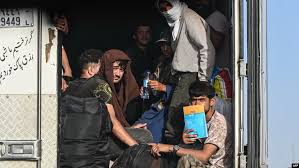
Dubai, Mar 2: Millions of Asian migrant workers across the Gulf are facing mounting risks as the conflict between the U.S., Israel and Iran intensifies, prompting several governments to prepare evacuation and repatriation plans amid fears of a prolonged regional war.
More than 24 million migrant workers are employed across Gulf states, according to the International Labour Organization (ILO), accounting for over 40 per cent of the region’s workforce — the highest proportion globally. A significant number hail from South and Southeast Asia and are engaged in healthcare, construction and service sectors, often in low-income jobs with limited protection.
Casualties among foreign nationals have already been reported following Iranian retaliatory strikes in response to U.S.-Israeli attacks that killed Iran’s Supreme Leader Ayatollah Ali Khamenei.
In the United Arab Emirates, three people from Pakistan, Nepal and Bangladesh were killed. Kuwait reported one foreign national dead and 32 injured, while Bahrain said one Asian worker was killed and two others injured. A Filipino caregiver was killed in Tel Aviv after being struck by shrapnel while helping her ward reach a shelter. Another Filipino worker was injured in Kuwait.
The widening hostilities have prompted governments in the Philippines, Indonesia, Thailand, Pakistan, India, Bangladesh and Vietnam to monitor the situation closely and prepare contingency plans.
Vietnam has temporarily suspended deployment of workers to the Middle East, warning that tensions could remain volatile. Bangladesh said some of its workers are stranded due to airspace closures and has sought cooperation from other nations once the situation stabilises.
India, which has around nine million nationals in the Gulf, said it is taking “necessary and feasible measures” to assist citizens affected by the developments.
The Philippines said it may order a mandatory repatriation of its 2.4 million workers in the region if the conflict escalates further. However, officials cautioned that such a move would have far-reaching consequences.
“It’s not as simple as it sounds. The Filipinos run maybe 50 per cent of the health and service capacity of the Emirates,” a Philippine official said, warning that mass relocation could have a “devastating” impact on both host countries and home economies.
On the ground, anxiety is mounting among expatriates. “It’s been the third day that we are not getting any sleep. You can clearly hear the booming sound of missiles getting intercepted,” said Kris Paglicawan, a retail worker in Qatar.
The conflict has expanded rapidly since the U.S. and Israel launched large-scale strikes on Iran over the weekend. Tehran retaliated by targeting Israel and Gulf states, including energy infrastructure critical to global oil and gas supplies.
At least 555 people have been killed in Iran so far, while 11 deaths were reported in Israel and 31 in Lebanon amid Israeli strikes on Hezbollah targets. The United States has deployed additional forces to the region, with hundreds of missions launched. The Pentagon indicated operations could last “two weeks, four weeks, six weeks,” signalling no immediate end to hostilities.
U.S. Defense Secretary Pete Hegseth said, “This is not Iraq. This is not endless,” though President Donald Trump acknowledged the toll could rise, saying, “Sadly, there will likely be more before it ends.”
Energy markets have reacted sharply. European natural gas futures surged 42 per cent following disruptions linked to the fighting, while oil prices spiked globally. Global equity markets fell amid rising uncertainty and fears of supply disruptions through key shipping routes.
Analysts warned that Asia remains particularly vulnerable to energy shocks. “Asia remains most dependent on oil and gas imports,” one report noted, cautioning that “ongoing geopolitical tensions, if sustained, will increase downside risks.” A prolonged blockade of the Strait of Hormuz could cause “real pain” for energy-importing nations, experts said.
British Prime Minister Keir Starmer said efforts were underway to ensure nationals could return home safely. “We want to ensure that they can return home as swiftly and safely as possible, for their lives are on the line,” he said.
With the conflict widening and military operations intensifying across multiple fronts, concerns are growing over the safety of migrant workers who form the backbone of Gulf economies, even as governments scramble to balance humanitarian needs with economic realities.
