

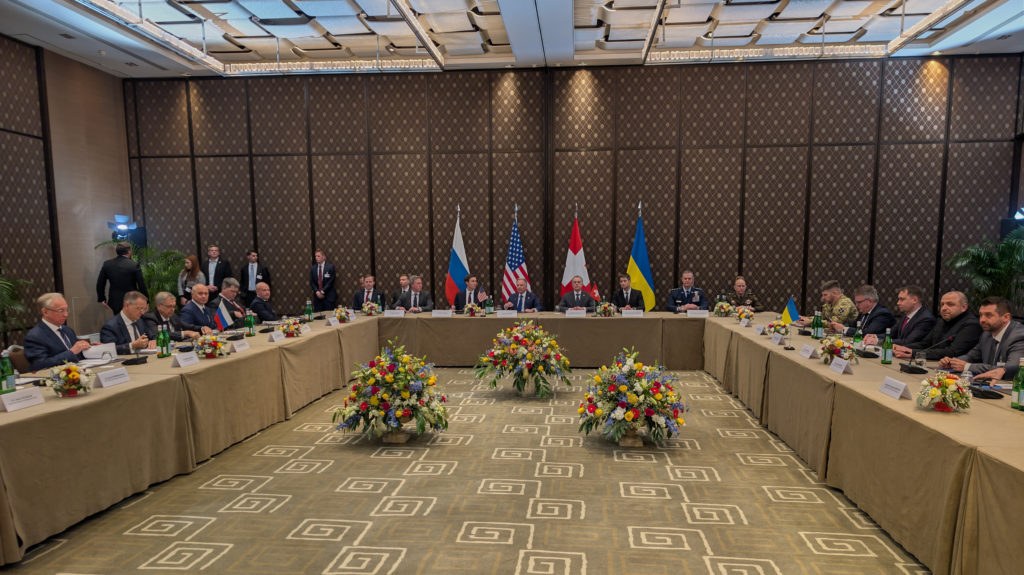
Geneva, 18 Feb : Fresh U.S.-mediated talks between Ukraine and Russia concluded in Geneva on Wednesday without a decisive breakthrough, as both sides acknowledged limited progress but underscored deep divisions over territory and security arrangements.
President Volodymyr Zelensky described the negotiations as “not easy,” saying that while “progress has been made,” the positions of Kyiv and Moscow remain far apart. He accused Russia of “trying to drag out negotiations that could already have reached the final stage,” signalling frustration over what Ukrainian officials see as deliberate delay tactics.
The two-day meetings, facilitated by the United States, followed earlier contacts in Abu Dhabi that produced a prisoner exchange but failed to narrow gaps on core political issues. This week’s discussions focused partly on military mechanics, including the delineation of front-line positions and possible ceasefire monitoring frameworks. Ukrainian negotiator Rustem Umerov called the sessions “substantive and intensive,” adding that the work was “complex” and required “alignment among all parties and sufficient time.”
Despite the technical engagement, the central dispute over territory remains unresolved. Moscow continues to insist on full control of the eastern Donbas region — encompassing Donetsk and Luhansk — a demand Kyiv has repeatedly rejected. Ukrainian officials say any proposal requiring the surrender of additional territory would face overwhelming public opposition and fail in a national referendum.
Russia’s chief negotiator, Vladimir Medinsky, characterized the talks as “businesslike” and indicated that further rounds would take place “soon.” A Russian source described the exchanges as “very tense,” reflecting the sensitivity of the unresolved issues.
Territory at the Core
Nearly four years after Russia’s full-scale invasion, territorial control remains the principal stumbling block to a ceasefire. Russian forces occupy roughly one-fifth of Ukraine’s internationally recognized territory, including Crimea and large portions of the Donbas. Ukrainian leaders argue that conceding additional ground would undermine sovereignty and leave the country vulnerable to renewed aggression.
Zelensky has also raised the historical parallel of the 1938 Munich Agreement, cautioning against concessions that could embolden future expansionism.
Nuclear Plant and Security Guarantees
Another unresolved issue is the status of the Zaporizhzhia Nuclear Power Plant, Europe’s largest, which has been under Russian control since 2022. Kyiv is seeking its return and has floated the possibility of shared oversight involving the United States, a proposal Moscow is widely expected to resist.
Ukrainian officials continue to press for firm Western security guarantees as part of any long-term settlement. Representatives from Britain, France, Germany and Italy were present in Geneva for parallel consultations, underscoring Kyiv’s insistence that European participation is “indispensable” to a durable agreement.
Pressure From Washington
U.S. President Donald Trump has publicly urged faster movement toward compromise, saying earlier this week that “Ukraine better come to the table fast.” Zelensky responded that it was “not fair” to single out Kyiv for concessions while Russia maintains maximalist demands.
Diplomats say Washington is attempting to balance pressure on both sides while preventing a complete collapse of negotiations.
Limited Movement, No Political Deal
While discussions on ceasefire monitoring and military de-escalation mechanisms suggest incremental progress, diplomats caution that without a political understanding on territory, a comprehensive ceasefire remains out of reach.
The war has resulted in tens of thousands of military and civilian casualties, displaced millions and left significant parts of Ukraine’s infrastructure devastated. As the conflict approaches its fourth anniversary, the Geneva talks illustrate both the persistence of diplomacy and the formidable distance still separating the two sides.
