

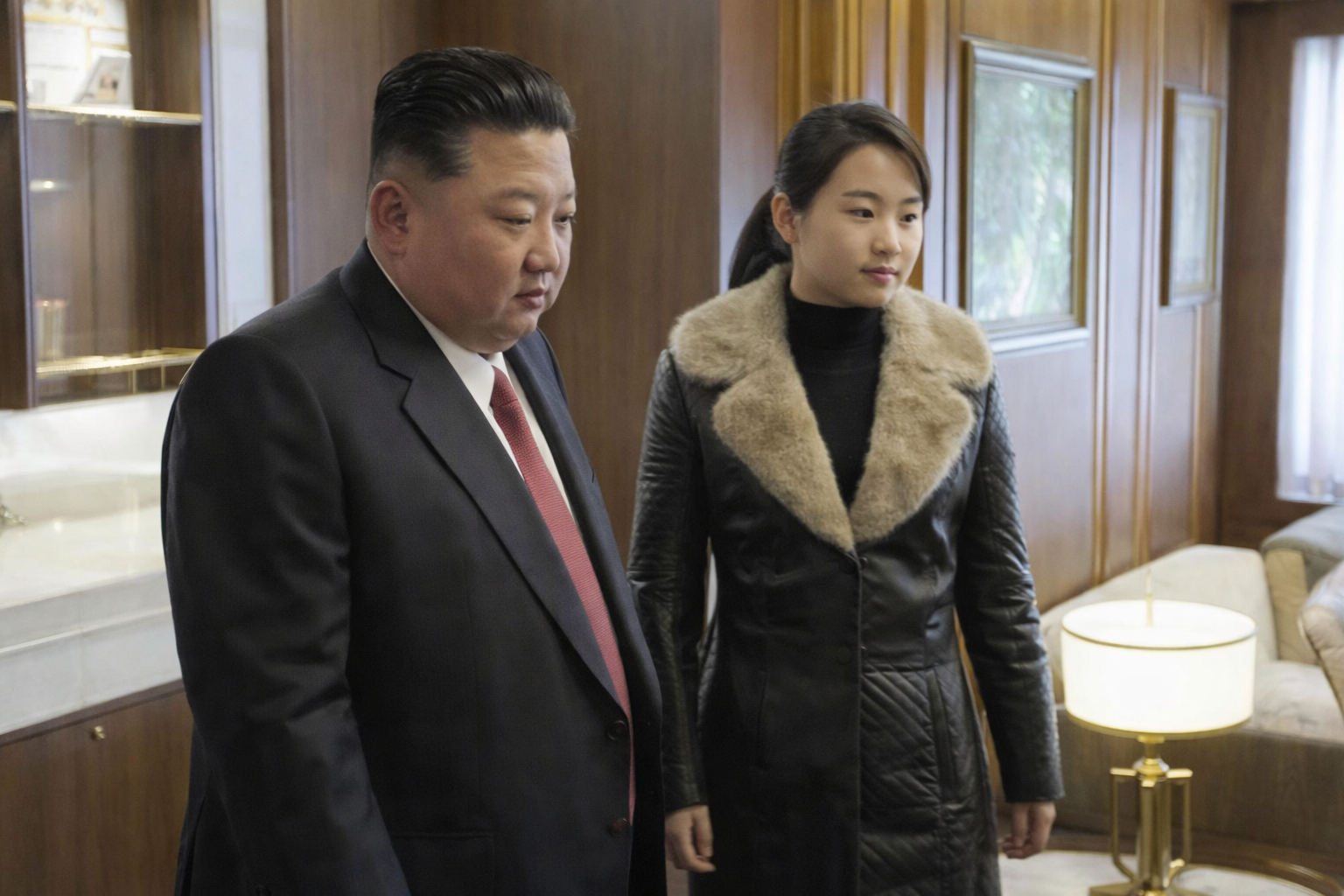
Seoul, Mar 2: Growing public appearances of North Korean leader Kim Jong Un’s teenage daughter have sparked intense speculation that she is being groomed to become the next ruler of the nuclear-armed state, although no official confirmation has been made.
Kim Ju Ae, believed to be around 13 years old, has increasingly featured alongside her father at missile launches, military parades and high-level banquets — a significant departure from North Korea’s long-standing practice of keeping leaders’ children out of the public eye.
South Korea’s intelligence agency recently assessed that she is the “most likely” successor and indicated she has been seen offering opinions on policy matters. North Korean state media has also begun referring to her with elevated honorifics such as “the respected child”, further fuelling debate about succession in the secretive regime.
North Korea has only ever been ruled by members of the Kim family, descendants of founder Kim Il Sung, under what is known as the Paektu bloodline. Kim Jong Un himself appeared publicly only shortly before inheriting power following his father’s death, whereas Ju Ae is being introduced years in advance.
Analysts believe the early exposure could be aimed at preventing a sudden succession crisis in the event of an unexpected leadership vacuum. There is no confirmed evidence that Kim Jong Un is suffering from serious health issues.
Cheong Seong-chang, vice-president at the Sejong Institute, said the language used by state media suggests an effort to build a leadership image around the teenager.
“The state media is using words reserved for the supreme leader. It underlines her own cult of personality,” he said, adding that Kim “might be trying to appoint his heir early to avoid a succession crisis.”
Ju Ae first appeared publicly in 2022 inspecting a missile with her father. Since then, she has often been placed at the centre of official photographs, flanked by top-ranking generals, some of whom have been seen kneeling beside her and whispering in her ear — gestures interpreted by observers as symbolic deference.
However, her potential succession would test North Korea’s deeply patriarchal political structure, where female officials and military commanders remain rare.
Ryu Hyun-woo, a former North Korean diplomat who defected in 2019, expressed scepticism over the possibility of a woman leading the country.
“Military commanders may think to themselves that anyone could be a leader of North Korea now,” he said, suggesting such a development could unsettle the elite. He also argued that Kim may be showcasing his daughter to soften his international image, adding: “Kim is a bigger attention-seeker than you think. He loves all these articles being written about him and his possible heir.”
Others disagree. Researcher Song Hyun-jin noted that women’s economic and social roles expanded significantly after the 1990s famine and argued that gender may not necessarily be a barrier if Kim decides in her favour.
“We cannot think of North Korea with our logic. We must imagine them as the Joseon dynasty,” she said. “Who would dare defy someone of royal blood who is taking the throne?”
The recent promotion of Kim’s influential sister, Kim Yo Jong, to propaganda minister has also been interpreted by some analysts as a move to strengthen internal support and potentially position her as a guardian figure for Ju Ae.
Observers say a clearly signalled succession plan would project regime continuity and stability, particularly given North Korea’s expanding nuclear arsenal. A power vacuum in Pyongyang could trigger regional instability involving South Korea, China and the United States.
“The explicit showcasing of his daughter at the nation’s most critical military milestones is Kim Jong Un’s clear message to the world: the nuclear arsenal, and the dynasty that controls it, are here to stay,” a security analyst said.
If confirmed, Ju Ae’s elevation would mark a fourth generation of Kim family rule, reinforcing the dynastic nature of one of the world’s most secretive regimes and carrying significant implications for regional and global security.
